
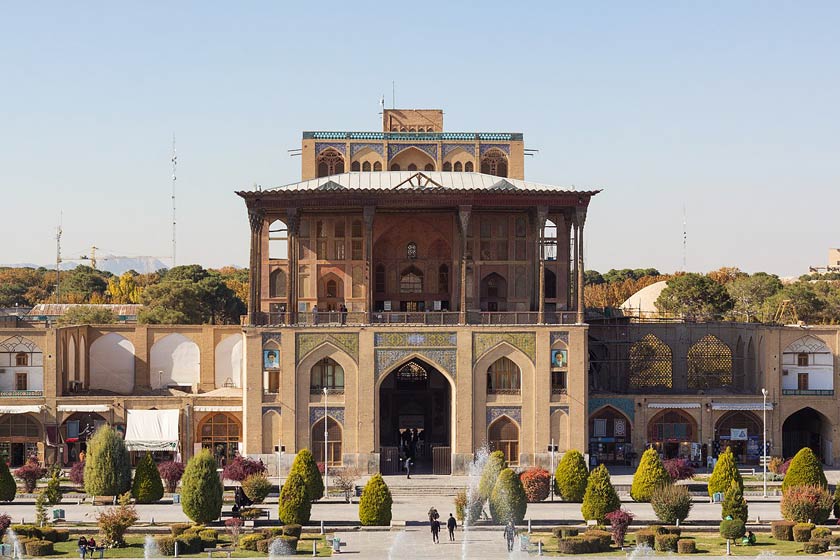
You enter Naqsh-e Jahan Square from the bazaar at its southern end, and the first thing that stops you is not the mosque on your right, nor the row of painted arches on your left. It is the building straight ahead, filling the western horizon of the square. A tall, layered facade of brick and tile, with a deep central recess that looks like a stage curtain pulled open. Above it, a veranda of slender wooden columns juts out against the sky. This is Ali Qapu, the gateway to the Safavid royal precinct, and it has been watching this square since the early seventeenth century.
Ali Qapu is not a single room you walk through and leave. It is a vertical journey. Six floors, thirty-eight metres of climb, narrow staircases that widen into grand halls, then narrow again, past frescoed alcoves and ceilings studded with plaster muqarnas, until you reach the top floor and the room everyone comes for: the Music Hall, where the ceiling is hollowed into shaped niches that were built to carry sound. Step out onto the talar veranda above it, and the whole of Naqsh-e Jahan Square lies below you, exactly as Shah Abbas I intended when he had the balcony constructed so he could watch polo and parades from above his guests.
This guide covers where Ali Qapu sits in Isfahan, how to reach the city and the square on foot, what each floor holds, the two stories behind its name, the best time to come, and how to fit it into a day with the mosque, the bazaar, and the rest of the square. It is written for travelers who want to understand the building, not just photograph its facade.
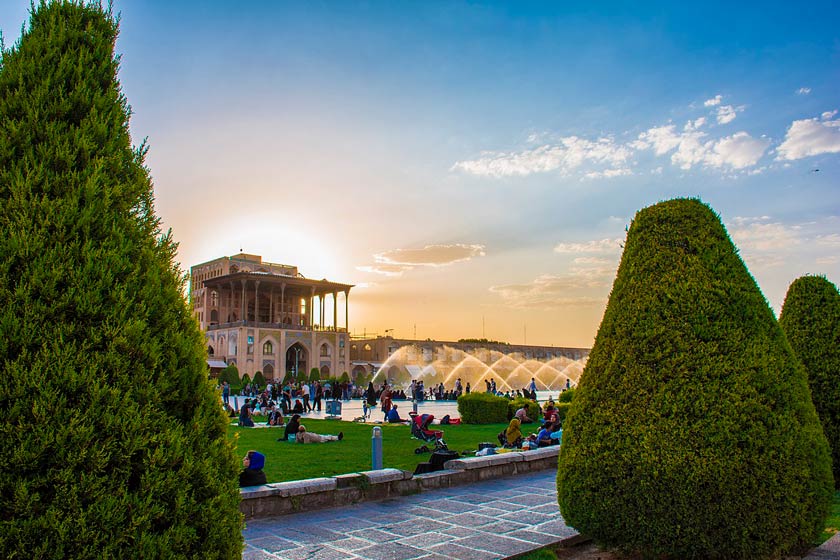
Where is Ali Qapu?
Ali Qapu occupies the entire western side of Naqsh-e Jahan Square, the UNESCO-listed public square in the centre of Isfahan. The palace faces the Sheikh Lotfollah Mosque on the eastern side of the square, and looks across toward the Qeysarieh Gate at the northern end and the monumental entrance to the Shah Mosque (Imam Mosque) at the southern end. The four monuments form a single ensemble, and walking between them takes minutes, not hours.
The address, as it is signed locally, is Isfahan Province, Isfahan, Ostandari Street, Sepah Street, Naqsh-e Jahan Square, western side. In practice, you do not need the address: any taxi driver in Isfahan knows the square, and once you are standing on the paving stones, the palace is the tall building on the west.
The footprint of the building is roughly 1,800 square metres. It rises six storeys to a height of about thirty-eight metres, which made it the tallest structure in Isfahan when it was completed, and one of the tallest in the Safavid empire.
How to get to Isfahan, and to the square
There is no airport inside Isfahan's historic centre. The city is served by Shahid Beheshti International Airport, about twenty kilometres south of the square, and by the intercity bus terminal to the south-west. A railway station handles a smaller share of traffic. Almost every visitor arrives by one of these three doors, and then crosses the last stretch by road.
From Tehran
Tehran to Isfahan is roughly 450 kilometres. By car on the freeway, the drive takes four and a half to five hours in normal conditions. By bus, allow five to six hours, depending on the carrier and the number of stops.
If you do not have a car, open Mehyar, choose Buses, and compare departures from Tehran's southern terminals to Isfahan. A scheduled intercity bus is the cheapest option and runs frequently through the day. For travelers who prefer comfort and a door-to-door rhythm, Mehyar Flights connects Tehran's Imam Khomeini Airport and Mehrabad Airport to Isfahan in about an hour.
From Shiraz, Yazd, and Kashan
Isfahan sits at the centre of the classic Iranian loop, and the road links from the other major cultural cities are straightforward. Shiraz to Isfahan is about 480 kilometres and five to six hours by road. Yazd is roughly 280 kilometres and three to three and a half hours. Kashan is the closest, at about 210 kilometres and two and a half hours.
Mehyar Buses covers all three routes, and Mehyar Taxi is useful for the last stretch from the Isfahan bus terminal to your hotel and then to the square. Organized day tours from Kashan and Yazd often include Ali Qapu as a stop, though a full visit to the square deserves its own day rather than a rushed hour inside a group itinerary.
The last mile: walking the square
Once you are in central Isfahan, Naqsh-e Jahan Square is pedestrian-friendly. The palace entrance is on the western side of the square, reached through the tall portal that opens directly onto the paving. Cars do not circulate inside the square, and the walk from any of the four entrances is flat and short.
From the Grand Bazaar, which threads into the southern arcades of the square, the palace is a five-minute walk across the open space. From the Shah Mosque at the southern end, it is directly opposite. From the Qeysarieh Gate at the northern end, it is a longer but pleasant stroll past the rows of painted shops.

A short history of Ali Qapu
The building you climb today is not the first structure on this site. When Shah Abbas I decided, around the turn of the seventeenth century, to move the Safavid capital from Qazvin to Isfahan, he found a smaller gateway palace already standing here, built in the Timurid period around the early fifteenth century. Rather than demolish it, he had it incorporated into a new, much larger government complex.
The expanded palace was known in its own time as the Dowlat-khaneh-ye Mobarekeh-ye Naqsh-e Jahan, the Blessed Government House of Naqsh-e Jahan, or simply the Qasr-e Dowlat-khaneh, the Palace of the Government House. The name Ali Qapu, which is what everyone calls it today, came later and has its own story, which we will come to.
Construction of the expanded palace is usually dated to around AH 1054, or the early 1640s in the Gregorian calendar, though the work began under Shah Abbas I and continued through the reigns of his successors. The decoration of the interior, in particular, was a long project. The plasterwork, the frescoes, and the muqarnas ceilings were added and reworked over roughly a century, under Shah Abbas I, Shah Abbas II, and Shah Sultan Husayn. What you see on the upper floors is the work of the later period, more delicate and more refined than the heavier Safavid brick of the lower storeys.
The third-floor veranda, the famous talar with its eighteen wooden columns each about ten metres tall, was added under Shah Abbas II around AH 1053. The eyvan behind it, the deep recessed hall that opens from the veranda, is roughly twenty metres high and covers about 480 square metres. It was from this balcony that the Shah watched polo matches, horse races, and military parades on the square below, and it was here that foreign ambassadors were received and shown, deliberately, the scale of what they had come to.
Ali Qapu was, in short, the public face of the Safavid state. It was taller than any other building in Isfahan, it sat at the head of the new imperial square, and it connected the square to the royal gardens and harems that stretched behind it. When the Safavid dynasty fell in the eighteenth century, the palace was damaged, looted, and left to decay. Much of the interior decoration you see today is the result of careful restoration in the twentieth and twenty-first centuries, and some of the frescoes on the lower floors are reconstructions rather than original Safavid work. The muqarnas and the talar, however, are authentic, and they are the reason the climb is worth it.
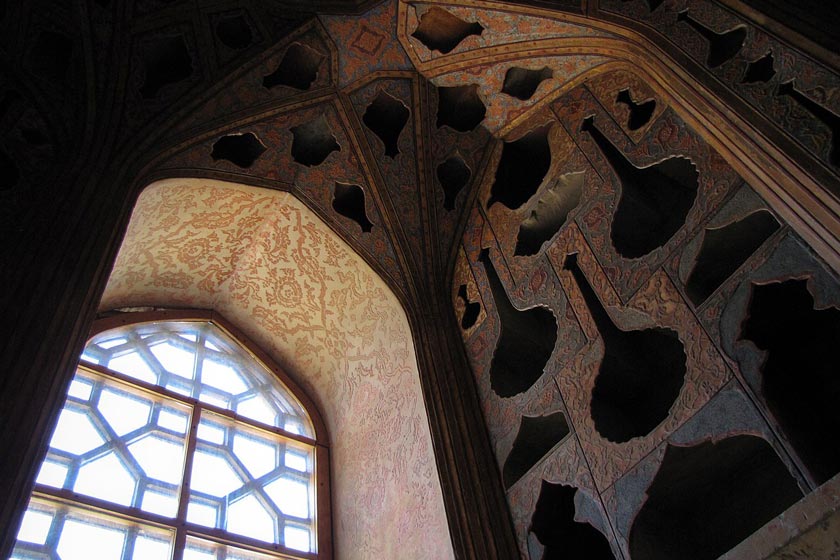
What to see on each floor
The palace is open to visitors as a vertical route. You enter at ground level, climb through a sequence of halls and corridors, and emerge on the top floor at the Music Hall and the talar. The staircases are narrow and the steps are tall, so the climb is slower than the floor count suggests. Allow an hour and a half to two hours for a careful visit, and wear shoes you can climb in.
The ground floor and the entrance
The entrance portal itself is worth a moment. It faces the square, is framed in painted tile, and opens into a ground-floor hall that served as the first reception space for visitors arriving from the square. The rooms on the lower floors are simpler than those above, with thick brick walls and small windows. They were service and guard rooms as much as reception halls, and their heaviness is deliberate: they carry the weight of everything above.
The middle floors: halls, alcoves, and frescoes
The second and third floors begin to show the decorative ambition of the palace. You move through a series of large halls, many with recessed alcoves on two or three sides, and with frescoes painted directly onto the plaster. The subjects are not religious. They show flowers, birds, geometric patterns, and, in some rooms, scenes of court life, hunting, and European-influenced figures that were fashionable in the later Safavid period.
The third floor is where the talar opens. Step out onto the veranda and look across the square. This is the view Shah Abbas II commissioned the columns for: a raised platform from which the court could watch events below without leaving the palace. The eighteen wooden columns, each roughly ten metres tall, are the most photographed detail of the building, and for good reason. They are slender, slightly tapered, and arranged in two rows, with the ceiling between them painted in geometric patterns that catch the light differently at different times of day.
The top floor: the Music Hall
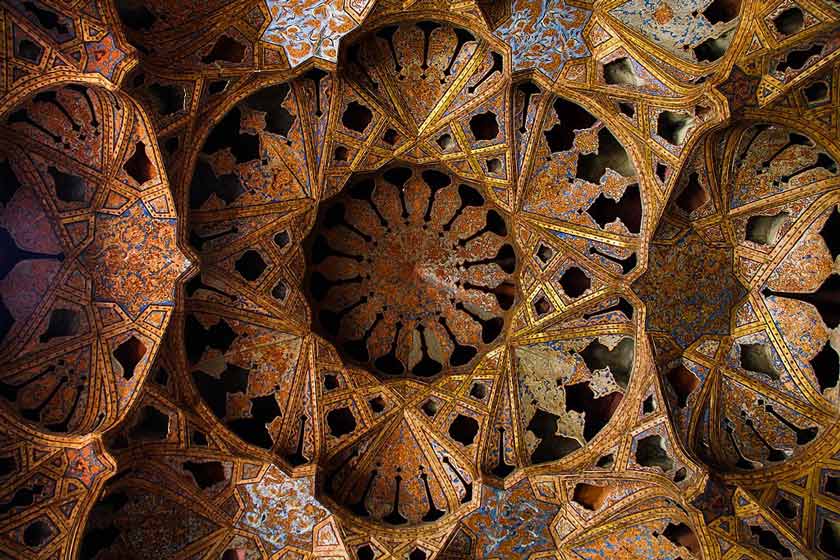
The Music Hall, or Talar-e Musiqi, is on the fifth floor, just below the roof. It is the room that gives Ali Qapu its lasting reputation. The ceiling is covered with shaped plaster niches, arranged in rows and tiers, that were designed to carry and diffuse sound. The exact acoustic effect is debated: some scholars argue the niches were purely decorative, others that they were tuned to amplify specific instruments or voices. What is not debated is that the room sounds different from any other Safavid interior you will visit. Stand in the centre and speak, or clap, and the sound moves around the ceiling in a way that feels deliberate.
The niches are sometimes described as vase-shaped, and the story goes that they were modelled on the shape of inverted wine glasses or musical instruments. Whether the story is true or not, the effect is unmistakable, and it is the room that most visitors remember longest.
The two names of Ali Qapu
The building has two names, and the fact that both are in circulation is itself a small history.
The first name, the one used in the building's own time, was Dowlat-khaneh or Qasr-e Dowlat-khaneh, the Government House or Government Palace. This is the administrative name, and it describes what the building was: the public face of the Safavid state, the reception hall for ambassadors, the office from which the province was governed.
The second name, Ali Qapu, is the one everyone uses today. It has two competing explanations, and both are told with equal confidence by different guides in Isfahan.
The first explanation is linguistic. The Turkic word qapu means door or gate, and ali is the Arabic loanword for high or sublime. Ali Qapu in this reading is the Sublime Gate, a direct echo of the Ottoman Bab-i Ali, the Sublime Porte, which was the gate of the Ottoman grand vizier in Istanbul and, by extension, the Ottoman government itself. Shah Abbas I was a keen student of Ottoman court ceremonial, and a name that echoed it would have been deliberate.
The second explanation is devotional. In this telling, Ali refers not to the adjective "high" but to Imam Ali, the first Imam of Shia Muslims and a figure of central importance in Iranian religious life. The story goes that a door from the shrine of Imam Ali in Najaf, in present-day Iraq, was brought to Isfahan as a blessed relic and set into the palace entrance. The building then became known as the Gate of Ali, or Ali Qapu, in reference to the relic.
Both stories are plausible, and neither can be proved from the surviving records. The linguistic reading is more common in academic writing. The devotional reading is more common on the street in Isfahan, and it fits a pattern in which Safavid architecture was often named after figures of Shia reverence. The honest answer is that the building carried both meanings at once, and that the ambiguity is part of its character.
When to visit Ali Qapu
Isfahan has a continental climate with hot summers and cool winters, and the square is exposed to the sun for most of the day. The season you choose changes the visit more than any other decision.
Spring, from March through May, is the most comfortable period. The weather is mild, the light on the square is soft, and the city is green from the winter rains. This is also one of the busiest seasons, especially around the Nowruz holidays in late March, when domestic visitors arrive in large numbers.
Summer, from June through August, is hot. Daytime temperatures regularly reach the mid-thirties and sometimes higher. The square has almost no shade, and the climb through the palace is warmer than the outside air because the brick stores heat. If you visit in summer, go early in the morning or in the late afternoon, and carry water.
Autumn, from late September through November, is arguably the best season. The heat has broken, the light is golden, and the crowds are thinner than in spring. The palace is at its most photographic in the late afternoon, when the sun is low enough to raking across the facade.
Winter, from December through February, is cold, with occasional frost and grey skies. The square is quiet, the palace is almost empty, and the visit feels more like a private audience than a tourist stop. Dress warmly, because the upper floors are draughty.
One practical note: the palace closes on certain religious holidays, and hours can shift without notice. Confirm locally or check with Mehyar before you plan your morning around the visit.

Combining your visit with the rest of the square
Ali Qapu does not stand alone. It is one quarter of a group, and a visit to the palace without the other three is incomplete.
Sheikh Lotfollah Mosque sits directly opposite, on the eastern side of the square. It is smaller than the Shah Mosque and was built as the private mosque of the royal harem, which is why it has no minarets and no courtyard. The dome is one of the most beautiful in Iran, and the interior tilework is extraordinary. Allow forty minutes to an hour.
The Shah Mosque, known today as the Imam Mosque, occupies the southern side of the square. Its entrance is through the square, but the building itself faces the qibla, so you walk through a long, angled corridor to reach the main prayer hall. The scale is immense, the acoustics under the dome are famous, and the tilework is among the finest of the Safavid period. Allow an hour to an hour and a half. For more on the city's religious architecture, see our Isfahan city guide.
The Qeysarieh Gate marks the northern entrance to the square and the beginning of the Grand Bazaar. The gate itself is painted with a large fresco of the legendary hero Rostam, and the bazaar beyond it is one of the largest covered markets in the Middle East. You can walk for twenty minutes into its depths and still be surrounded by shops.
The Grand Bazaar threads south from the Qeysarieh Gate and connects, at its southern end, to the square and to the Shah Mosque. Along the way, it passes through sections dedicated to carpets, metalwork, spices, and textiles. It is also where you will find most of the cafes and small restaurants suitable for a lunch break between the palace and the mosques.
A full visit to the square, including Ali Qapu, the two mosques, the gate, and a walk through the bazaar, takes a long morning or a relaxed full day. Do not try to fit it into an hour.
Practical notes
Tickets. An entrance fee applies for foreign visitors to Ali Qapu. The price changes, and the rial moves, so treat any figure you read online as a guide rather than a guarantee. Confirm on arrival or through Mehyar before you go.
Hours. The palace is open daily, but hours shift with the season and with the religious calendar. Morning openings are the most reliable. Friday mornings can be busier because of the weekly holiday.
The climb. Six floors means six floors of narrow, steep Safavid staircases. There is no lift. If you have knee or heart problems, the upper floors may not be reachable, and the top floor is the best part. Pace yourself, and do not be embarrassed to stop on the landings.
Photography. The facade and the talar veranda are the most photogenic spots. Inside, photography is usually permitted, but flash may be restricted in rooms with original frescoes. Ask the attendant if you are unsure.
Dress and conduct. Ali Qapu is a historic monument, not a working mosque, but the standards of dress that apply elsewhere in Iran apply here too. Shoulders and knees covered, and a headscarf for women. Speak quietly on the staircases, because the building amplifies sound and other visitors are climbing at the same time.
Money and food. There is no cafe inside the palace. The nearest places to sit, drink tea, and eat are in the Grand Bazaar, a five-minute walk through the square. Keep some cash on hand for small purchases. Mehyar Wallet is useful here: top up before you arrive at the square and you can pay for tickets, tea, and bazaar purchases without hunting for an ATM.
Connectivity. Mobile coverage on the square is good. Inside the palace, the thick brick walls weaken the signal on the lower floors, but the upper floors and the talar are fine. A Mehyar SIM arranged on arrival in Iran covers you for maps, translation, and messaging throughout the visit.
Start your Isfahan trip with Mehyar
Naqsh-e Jahan Square is one of the great public spaces of the world, and Ali Qapu is the building that gives it its vertical drama. A visit to the palace is a climb, a history lesson, and a viewpoint, all in one. Handled well, it is the memory of an Isfahan trip, not just another stop on the itinerary.
Open Mehyar to plan your day in Isfahan. Use Mehyar Taxi to reach the square from your hotel or the airport, Mehyar Buses to compare intercity departures if you are arriving from Tehran, Shiraz, or Yazd, and Mehyar Hotels to find accommodation within walking distance of the square. Top up your Mehyar Wallet before you set out, and you will spend the morning moving between the palace, the mosques, and the bazaar without a single cash detour.
For travelers building a wider itinerary, our guides to Isfahan, the best time to visit Iran, and a first trip to Iran cover the logistics that apply across the country. If you are coming from the capital, the Tehran guide has the transport terminals and orientation you need before you head south.