
Qeshm is called the Island of Seven Wonders in Iranian travel writing, and the nickname is earned rather than sold. Within a day's driving you can boat between trees that stand in the sea up to their necks, walk out to islets joined to the mainland only at low tide, descend into a canyon cut a hundred metres deep by rain, cross the longest salt cave on earth, and finish at a mall on the water with a bowling alley and a four-dimensional cinema.
That mix is the point of the island. Qeshm sits in the Persian Gulf, part of Hormozgan province and far from the Hyrcanian forests of the northern coast, and its sights are spread along a long stretch of shoreline and hinterland. The distances are real, the heat is real, and a rushed overnight tells you almost nothing. This guide covers what is actually there and how to group the sights so you cross the island twice rather than six times.

Where is Qeshm?
Qeshm lies in the eastern Persian Gulf, close enough to the Strait of Hormuz that you can look across to it from the high ground. The island's living heart is on the northern shore, where the town, the bazaars of Dargahan and the ferry crossings sit facing the Iranian mainland, and where the Hara mangrove forest spreads behind the tidal flats toward the villages of Tabl and Salakh.
The rest of the island is a long drive: Kharbs Cave about 13 kilometres south of the northern settlements, Guran Dam some 84 kilometres away in Guran village, Chahkouh Canyon around 100 kilometres from town near Chahvu-ye Sharqi, and Hengam Island two kilometres southeast, reachable only by boat. Plan in clusters, north for the mangroves, centre for the high ground, west for the canyons, seaside for the markets.
How to get to Qeshm
By air. Qeshm has its own airport, and flights from Tehran are typically seasonal or intensified in the winter months when the Gulf coast becomes Iran's warm-season escape. Check schedules on Mehyar Flights early, because one sold-out weekend changes the plan.
By ferry from Bandar Abbas. The classic route is to reach Bandar Abbas by coach or car and cross to Qeshm by roll-on ferry, which runs through the day in normal seasons. Mehyar Buses covers the long approach from Shiraz, Yazd or Tehran; leave a buffer before the crossing rather than a tight connection.
On the island. Distances between sights are large and public transport is thin, so a car with a driver through Mehyar Taxi is the practical way to do Chahkouh, Stars Valley and the southern villages in one long day. Cards issued abroad do not work, so load a Mehyar Wallet before you leave the mainland; the small shops in Dargahan and the village restaurants outside town are cash businesses.
The salt forest, the tide islets and Hengam
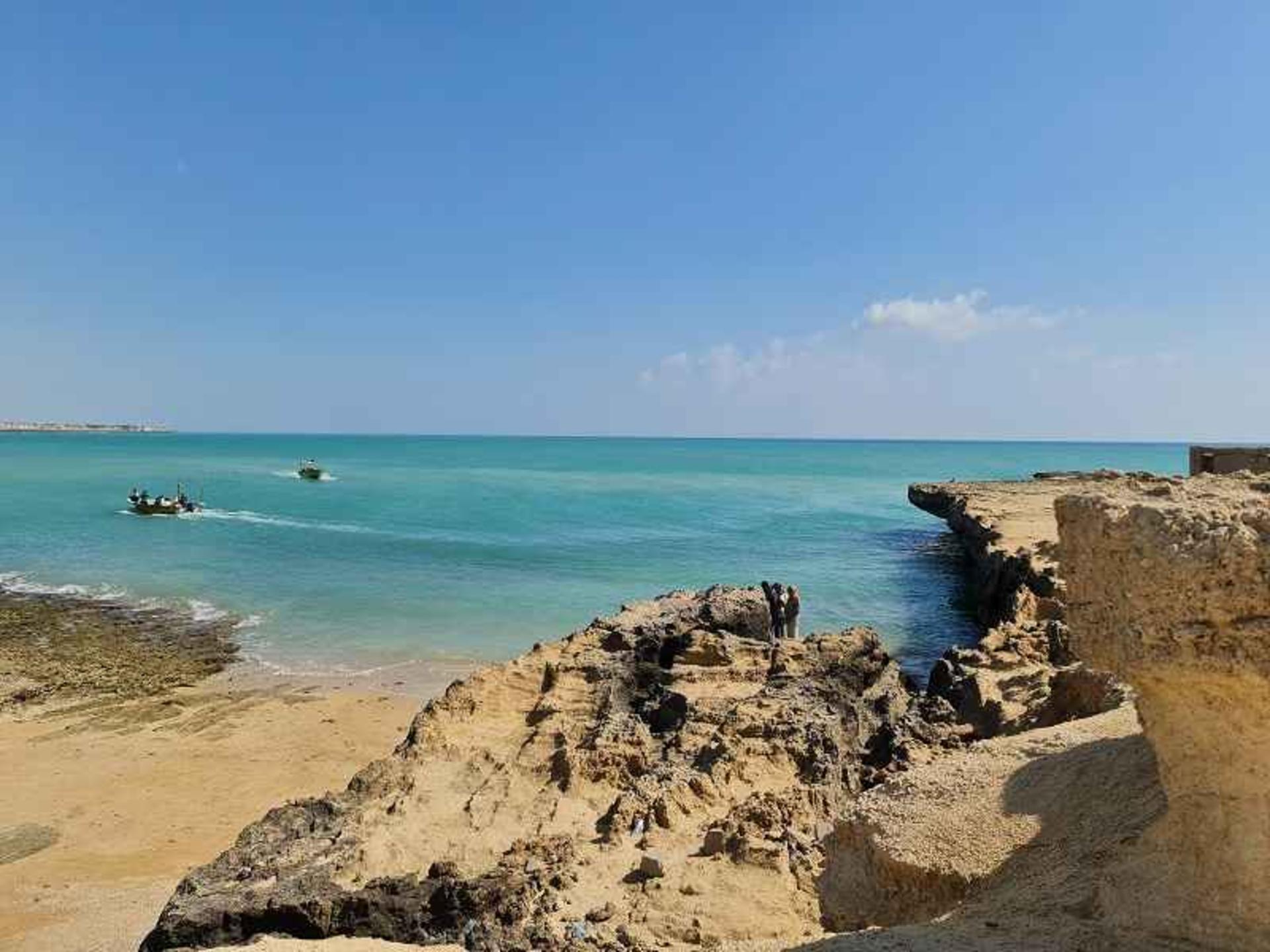
The Hara forests are the island's signature sight: mangroves that grow in salt water and, at high tide, stand submerged to the neck. The trees filter and desalinate the water around them, and the stands north of the island around Tabl village are said to be thirty to forty million years old. They are also a working habitat, with migratory flamingos and pelicans spending the cooler months there alongside reptiles, fish and turtles. Book a boat at high tide, when the channel runs between the crowns and the forest looks as though it is floating.
The Nazy Islands are small, rocky-walled and uninhabited, about half a kilometre off Qeshm and roughly three hectares in all. At low tide the shallow water between them and the shore can be crossed on foot or by car, up to about a kilometre out. From the top of the islets the view runs across the Strait of Hormuz toward Larak Island, which is the best reason to plan against the tide tables rather than the clock.
Hengam Island, 36.6 square kilometres with some fifty kilometres of coast, is the second world of the trip. Boats run to it from Qeshm, and once there you find a traditional settlement, palm groves, limestone hills, a lively market, dolphins offshore and wildlife ashore, plus Silver Beach, Kalleh Khmasi, Khanizi, the beach that glows at night, the red soil, aquarium fish in shallow water, the Mother-and-Daughter rock, a small fishing hamlet and the stranded wreck of a Portuguese vessel.
Stone work: Stars Valley, Chahkouh, Namakdan and the roof of the island
Stars Valley is about two million years old, made by rain, cloudbursts and wind chewing through soil, rock and sand until the ground became a field of sculpted pillars and hollows. Local people explain it more economically: it is where stars fell, hence the name. It is the most photographed and most accessible geology on the island, and late light is worth waiting for.
Chahkouh Canyon takes longer to reach but is the stranger place. Erosion of sedimentary rock has cut it a hundred metres deep, and it is named for the wells the villagers of Chahvu-ye Sharqi dug at its mouth to catch rainwater. At the entrance the walls are tall and the floor wide; walking south it narrows until the sky becomes difficult to find, and in a few sections is too tight to continue. Expect to turn back somewhere.
Namakdan Cave is the longest salt cave in the world, a very different walk: pale passages carved in a salt dome, floor and walls crystalline under a torch. Statues Valley is the same slow erosion on a wider stage, rows of rock columns standing like an audience.
Both belong to the middle of the island, along with Bam-e Qeshm, the roof of Qeshm, on the Salakh to Tabl road about five kilometres south of Tabl and four kilometres northeast of Salakh, at the southern edge of the Hara forest. Its upper parts are limestone and its slopes sandstone, marl and silt, and the plateau sits around 120 metres above the sea across eight hectares, high enough to look down on the whole Hara forest and the northern Persian Gulf coast. Away from town lights, it is also a stargazing spot.
Caves, castles and a dam
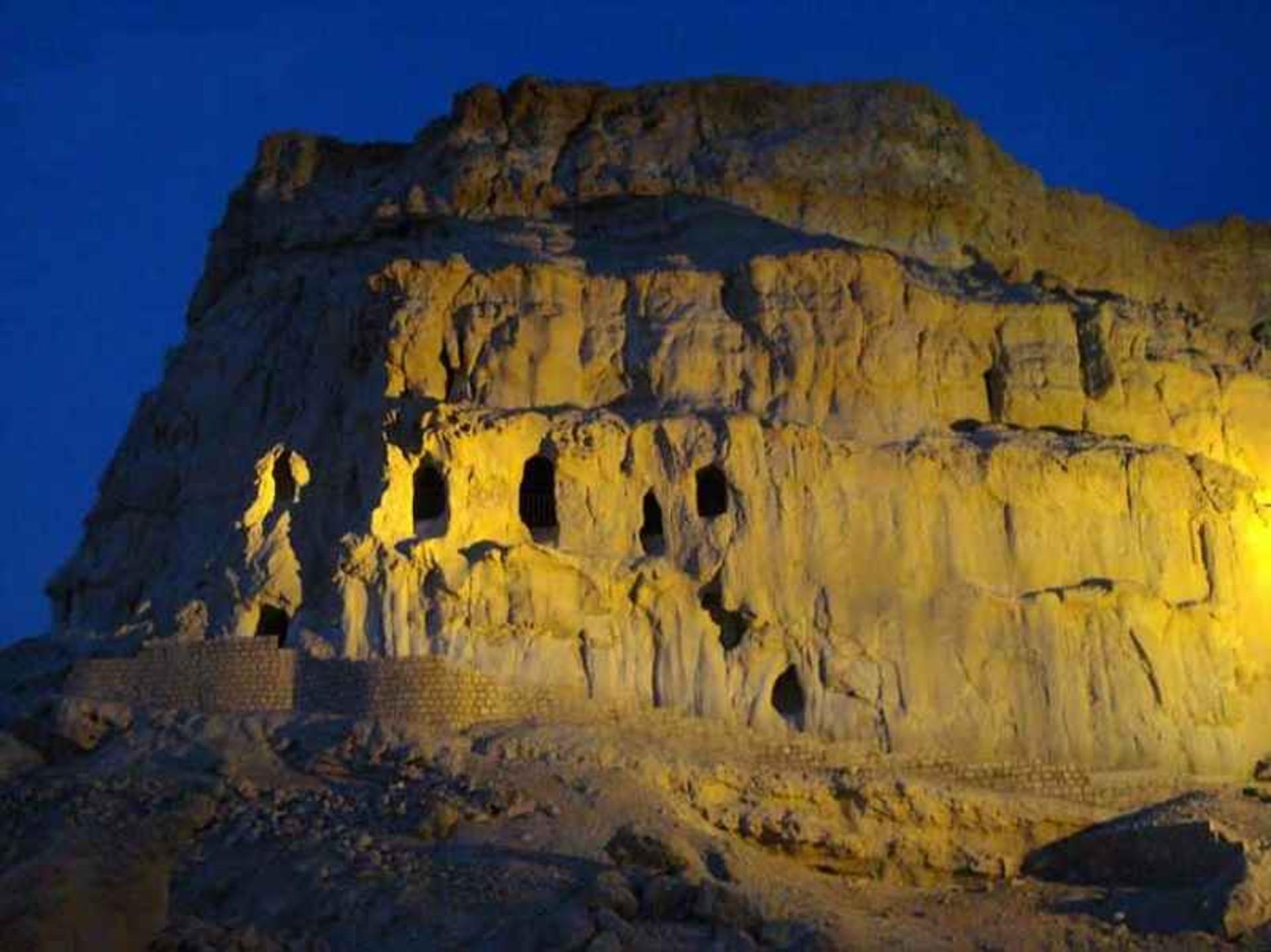
Kharbs Cave, thirteen kilometres south of the northern towns, belongs to the Median period and was formed in the folds that run out from the Zagros. Its shape is natural, its use is not fully settled: a temple of Mithra, a place to keep the bones of the dead, a shelter from pirates, all have been proposed, and the mysterious cut of its walls keeps the argument alive.
The Portuguese Castle on the north coast was built in the early sixteenth century on the orders of the seafarer Alfonso de Albuquerque and covered some 2,000 square metres. It was raised from limestone, gypsum and local saruj with the red soil of Hormuz, using Iranian building traditions, and survives as columns, a water reservoir and a watchtower, with gulls and pelicans working the shore beside it.
Guran Dam, in Guran village 84 kilometres away, is an engineering puzzle rather than a ruin: the works visible today belong to the Pahlavi I period, but some specialists place its foundation in the Achaemenid era and its crown in the Sasanian. What the island cares about is its famously sweet water.
The bazaars and the malls


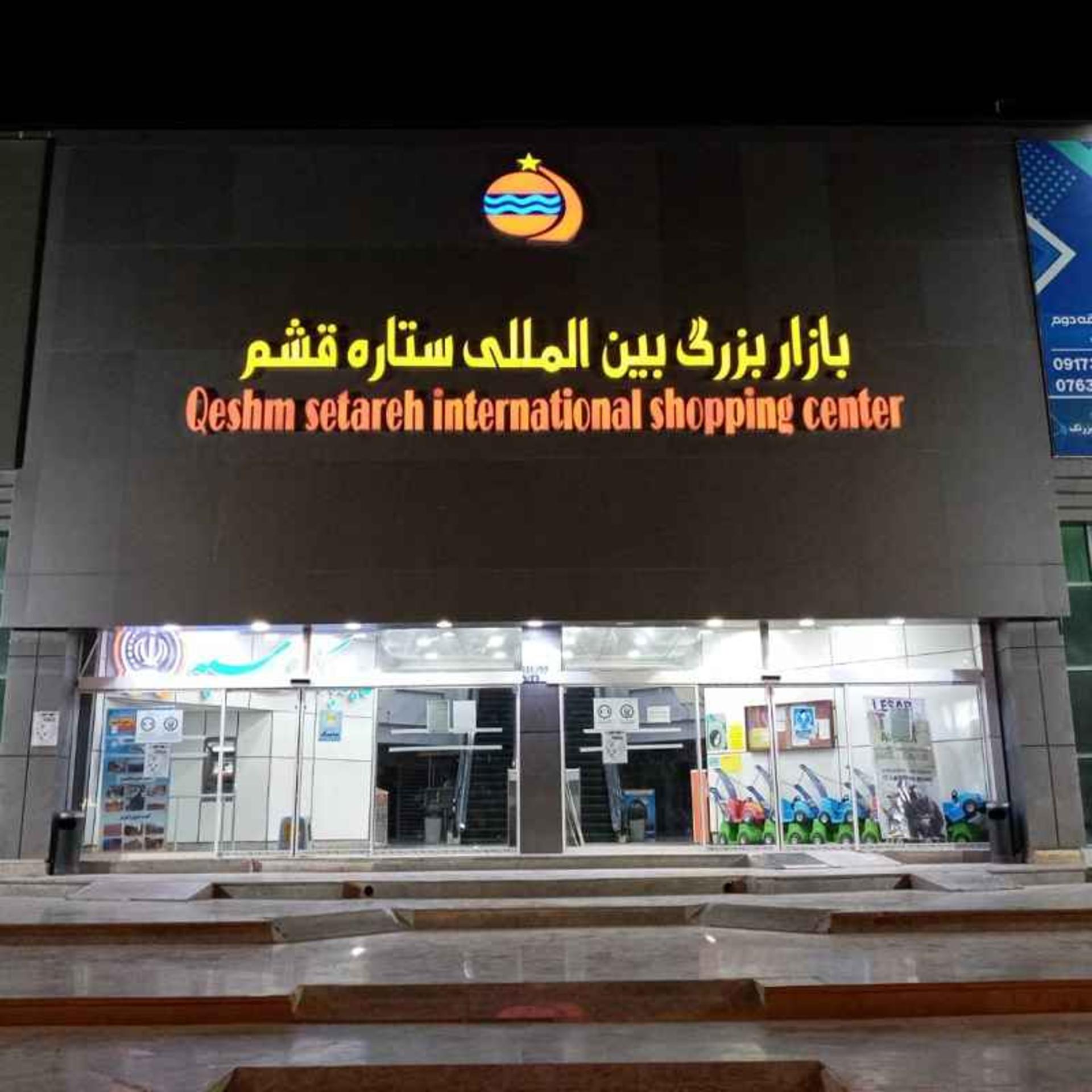
Qeshm's reputation for plentiful, inexpensive goods rests on its markets, and four are worth distinguishing. Nakhl Dargahan bazaar, near the sea and among the most attractive on the island, has 224 commercial units plus restaurants and cafés and is the place for wholesale clothing. The Old Dargahan bazaar is the traditional labyrinth of back-to-back alleys, mostly wholesale, where the last remaining items of a line go cheaply and the hours lengthen on busy days. Setareh bazaar, one of the oldest, runs retail over three floors, from appliances, toys, perfume and baby goods to banks, a billiard hall, a traditional restaurant, a café, a pizzeria, a barbershop and a prayer room, near the Khalij Fars bazaar and the Pardis and Ferdosieh complexes.
The City Centre is the modern end of the same trade: two phases joined by a sky bridge, on the Persian Gulf shore, with billiards, bowling, an amusement hall and a 4D cinema. Phase one has three floors, two of them shops and the top one given over to games and fast food, selling clothing, bags and shoes, costume jewellery, chocolate and coffee, cosmetics, hunting gear, electronics and island handicrafts; phase two carries the foreign brands and the higher prices.
Crocodiles, evenings and water
The Nopek Crocodile Park in north Qeshm is the first and largest crocodile park in the Middle East, the region's only breeding and keeping centre for the animals and a national reference point for crocodile zoology. It opened in 2011 with twenty specimens of Crocodylus porosus, the saltwater crocodile and the world's preferred farmed species, and visitors are taken close in to see feeding, nesting and the raising of hatchlings. The rest of the population runs to tortoises, iguanas and Burmese pythons; parrots, peacock, Egyptian vulture, mynah, guineafowl, marsh eagle and African ostrich; and ferret, wild goat, monkey and hedgehog.
After dark the island moves to its seaside parks: Olive Park, Cinema Darya Park and the shore parks at Helal, Aftab and Laft, where families take the cooled embankment and the night food stalls. Laft itself, a winter favourite, is a village and old port on the north coast with historic houses, and Qeshm town is the base for jet skis, parasailing, diving and the other water sports sold along the shore.
When is the best time to visit Qeshm?
November to March is the season: mild days, cool evenings, the mangroves full of migrants and the island at its most civilised. Summer is humid and the sun punishing, so midday sightseeing is a mistake even with a car, while the spring and autumn shoulder months are a reasonable compromise if you are pairing the Gulf with Shiraz or Yazd.
Where to stay, and how to order the days
Stay on the northern shore, where the ferries, the bazaars and the boats to Hengam and the Hara forest all leave from. Rooms run from simple town guesthouses to resort complexes and fill on winter weekends; compare what is genuinely open through Mehyar Hotels before you fix the dates.
Give it three days. Day one is the water: Hara forest at high tide, then the Nazy Islands at the low tide that follows. Day two is the stone: Stars Valley and Chahkouh, with Namakdan and Statues Valley if the car keeps moving. Day three is Hengam by boat, or the interior, with Guran Dam, the southern villages and Bam-e Qeshm for the view and the sky. Put the bazaars in the evenings, when the heat has gone and the shops are still open.
Around Qeshm
The island is usually paired with the mainland ports of Hormozgan and the longer run of the Persian Gulf coast. Our guides to Kish and Shiraz cover the common pairings, Best Time to Visit Iran settles the seasonal question, and Paying in Iran explains the cash situation you will meet in every bazaar listed here.