
Fars province is a land where agriculture and history intertwine so thoroughly that one cannot be understood without the other. The plains around Persepolis and Pasargadae draw most of the attention, but the mountainous eastern reaches of the province hold landscapes of equal depth and rather fewer visitors. The Basiran area, situated near the town of Estahban, is one of those places. It occupies a stretch of foothill terrain where the Zagros range begins its long descent toward the coastal plain, and where generations of farmers have cultivated fig orchards on slopes that receive no irrigation beyond what the sky provides. The result is a cultural landscape of unusual distinction, recognized internationally for its heritage value and locally cherished for the quality of its fruit, the clarity of its springs, and the quiet beauty of its terraced hillsides.

Where is Basiran?
The Basiran area lies in the eastern part of Fars province, within the administrative boundaries of Estahban county. Estahban itself is a small town roughly ninety kilometres southeast of Shiraz, reached by a road that passes through the plains of Marvdasht and then climbs into the lower Zagros foothills. The drive from Shiraz takes about an hour and a half, and the landscape changes noticeably along the way. The irrigated fields of the Marvdasht plain give way to dry farming country, where the hills are lower and the vegetation sparser, but where the absence of water on the surface is matched by an unexpected richness in what grows from the soil.
Basiran is not a single village or a defined park. It is a region, a stretch of rural landscape that encompasses several villages, their surrounding orchards, and the natural systems of springs and seasonal streams that sustain them. The elevation ranges from around fifteen hundred metres on the lower slopes to over two thousand metres on the ridges above, and the climate reflects this range. Summers are warm and dry, winters are cool, and the annual rainfall, while modest at around two hundred and twenty-four millimetres, is sufficient to support the remarkable fig orchards that define the area.
The Rainfed Fig Orchards
The fig orchards of Estahban and the surrounding Basiran area are not merely agricultural. They are a heritage system of international significance. In 2023, the Food and Agriculture Organization of the United Nations designated the Estahban Rainfed Fig Orchards as a Globally Important Agricultural Heritage System, recognizing the centuries-old practices that have shaped this landscape without degrading it. The orchards cover approximately twenty-five thousand nine hundred and fifty hectares and contain an estimated two point six million fig trees, making this the largest concentration of rainfed fig cultivation anywhere in the world.
What makes these orchards remarkable is not their size alone but the methods used to maintain them. The gardeners of Basiran and the surrounding villages employ techniques that have been refined over more than two hundred and fifty years, practices designed to maximize the capture of rainwater, to prevent soil erosion on steep slopes, and to maintain the health of trees that may live for centuries. The terraces on which the trees grow are built and maintained by hand, each one shaped to catch and hold the rain that falls during the winter and spring months. The soil between the trees is carefully managed, with cover crops and mulching practices that reduce evaporation and add organic matter.

The fig cultivars grown here represent an extraordinary genetic diversity. The orchards hold more than seventy-five percent of Iran's fig varieties and roughly seventeen percent of the world's known fig cultivars. These are not commercial monocultures but a mosaic of types, each adapted to slightly different conditions of soil, elevation, and exposure. Some produce fruit for drying, others for fresh consumption, and still others for the local specialty of fig paste and fig leather that are sold in the markets of Shiraz and beyond. Walking through the orchards in late summer when the fruit is ripening, you encounter a range of flavours and textures that is difficult to find anywhere else.
Springs and Water Systems
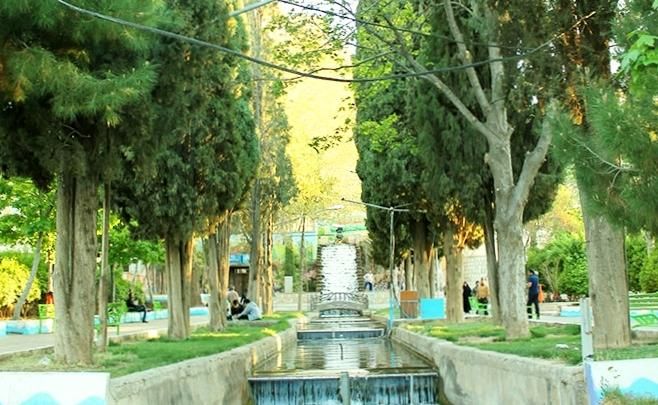
Agriculture in a rainfed landscape depends entirely on how well water is captured and conserved, and the Basiran area has developed water systems that reflect this dependence. The springs that emerge from the limestone foothills are central to the life of the region. Several of them are named and locally significant, serving as gathering points and landmarks. The water from these springs supplements the rainfall, providing moisture for domestic use and for small garden plots where vegetables and herbs are grown in addition to the fig orchards.
The relationship between the springs and the orchards is carefully managed. In traditional practice, the water is distributed through a system of channels and cisterns that direct it to the terraces most in need. This is not irrigation in the conventional sense, since the trees themselves depend on rainfall, but the spring water provides a critical supplement during dry spells and supports the younger trees that have not yet established deep enough root systems to survive on rainfall alone.
Villages and Rural Life
The villages of the Basiran area are small and built in harmony with the landscape. Stone and mudbrick are the traditional materials, and the houses cluster on the slopes in ways that minimize their footprint on the terraced orchards below. Life here follows the rhythm of the agricultural year. Spring is the season of pruning and planting, summer brings the harvest, and autumn is devoted to drying the fruit and preparing it for market. Winter is a time of rest and repair, when the terraces are maintained and the channels cleared for the next year's rains.
The people of Basiran are known for their hospitality, and visitors who make the effort to reach the area are likely to be offered tea and perhaps dried figs by farmers they encounter on the trails. The pace of life is slow, and the landscape rewards those who take time to walk through it rather than drive past. The paths between the orchards connect the villages and the springs, and following them is the best way to understand how this landscape works, how the terraces hold the soil, how the trees shade the ground, and how the whole system has been sustained across generations.
History and Cultural Significance
The cultivation of figs in this region has a history that stretches back centuries, and the practices used today have roots in the agricultural traditions of the Zagros foothills that predate the Islamic period. Fars province has been a centre of Iranian civilization since the time of the Achaemenids, and while the monumental sites of Persepolis and Pasargadae dominate the historical narrative, the agricultural landscape of the eastern Zagros has its own claim to significance. The Basiran area represents a continuity of practice that is as important as the ruins of ancient capitals, a living heritage that feeds people today as it has for generations.
The designation of the Estahban fig orchards as a GIAHS site by the FAO has brought international attention to this continuity. It has also raised awareness of the challenges facing traditional agricultural systems in Iran, where urbanization, climate change, and the pressures of modernization threaten practices that have been refined over centuries. For visitors, the Basiran area offers a chance to witness a landscape that is both productive and beautiful, where the boundary between nature and culture is not a line but a gradual transition, and where the fruit of the land is as much a part of the heritage as any monument.
Practical Information
The Basiran area has no formal entrance or visitor centre. It is an open landscape of villages and orchards, and access is free. The best way to visit is to drive from Shiraz to Estahban and then explore the surrounding countryside by car or on foot. The roads between the villages are passable, though some are unpaved and may be rough after rain. Local residents can direct you to the springs and to the most interesting stretches of orchard.
Accommodation in the area is limited. Estahban town has basic guesthouses and hotels, and some villages may offer homestay opportunities for those who arrange in advance. Camping is possible in the orchards with the permission of the gardeners, though you should be careful not to damage the trees or the terraces. Bring supplies, as shops in the villages are small and stocks are limited.
Best Time to Visit
The best time to visit Basiran depends on what you want to see. Late summer, particularly August and early September, is the fig harvest season, and the orchards are at their most active. The fruit is abundant, the drying racks are full, and the aroma of ripening figs fills the air. Spring, from March through May, is the green season, when the hillsides are covered in wildflowers and the streams are running with snowmelt. The weather is mild and the landscape is at its most verdant.
Summer can be very hot, particularly in July and August, when temperatures in the lower elevations exceed thirty-five degrees. If you visit during this period, plan your walks for the early morning and late afternoon, and carry plenty of water. Winter is quiet and cool, and while the orchards are dormant, the landscape has a stripped-back beauty of its own, with bare branches against grey limestone and the occasional snowfall on the higher ridges.
How to Get There
Open Mehyar and choose Taxi from Shiraz to reach Estahban. The drive covers approximately ninety kilometres and takes about an hour and a half on a road that passes through the plains of Marvdasht before climbing into the foothills. The route is straightforward and well-signposted, and it passes through several towns and villages along the way.
Mehyar Buses connects Shiraz to Estahban and other towns in eastern Fars. The bus journey takes roughly two hours and is a comfortable option for those without a car. From Estahban, local taxis and shared transport can take you to the villages of the Basiran area. The distances are short, and the roads, while sometimes rough, are passable in ordinary vehicles.
If you are driving from further afield, Estahban is accessible from Isfahan via a longer route through the central Zagros, a journey of approximately four hours. This route passes through some spectacular mountain scenery and is worth considering for those combining a visit to Basiran with other destinations in Fars or Isfahan province.