
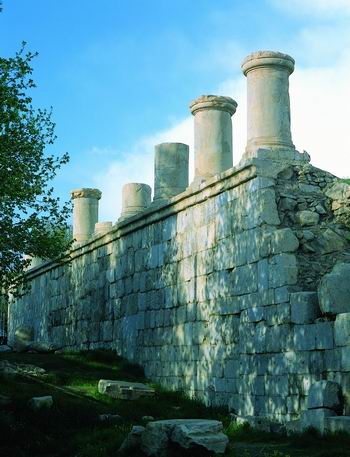
On the edge of the modern town of Kangavar in Kermanshah province, a massive stone platform rises from the plain, its colossal columns and carved blocks telling a story that stretches back over two millennia. This is the Anahita Temple, one of Iran's most remarkable and debated ancient monuments. Dedicated to Anahita, the ancient Iranian goddess of water, fertility, and wisdom, the site was used across multiple eras, from the Achaemenid period through the Sassanian era and possibly beyond.
Registered as a national heritage site of Iran, the temple ruins are among the most significant archaeological sites in western Iran. The sheer scale of the stone construction, with blocks weighing several tons each, speaks to the importance of this sanctuary in the ancient world. Visitors today can walk among the enormous foundations and imagine the rituals that once took place here, with water flowing through carved channels as an offering to the deity who governed the life-giving rivers of the plateau.
Where Is the Anahita Temple?
The temple ruins sit right in the town of Kangavar, approximately 70 kilometers east of Kermanshah city and about 75 kilometers west of Hamadan. Kangavar occupies a strategic position on the ancient royal road that connected the Iranian plateau to Mesopotamia, one of the great trade and pilgrimage corridors of the ancient Near East. The temple's position along this route suggests its role as a major religious waypoint for travelers, merchants, and pilgrims moving between the highlands of Persia and the river valleys of Iraq.
The surrounding Kangavar Valley is a broad, fertile plain ringed by the Zagros Mountains. This landscape has supported human settlement for thousands of years, and the valley floor contains numerous archaeological mounds and historical features that testify to its long occupation. The temple itself commands a prominent position, visible from the main road as you approach the town, its massive stone blocks standing out against the agricultural fields and modern buildings.
The Goddess Anahita and Her Cult
To understand the temple, you need to understand the goddess it honors. Anahita, known in Avestan as Ardvi Sura Anahita, was one of the most important deities in the pre-Zoroastrian and Zoroastrian pantheon. She was the divinity of the cosmic waters, the sacred river that mythically encircled the earth and from which all the world's rivers flowed. She governed fertility, wisdom, and healing, and her worship was widespread across the Iranian world.
Temples dedicated to Anahita were typically located near water sources, springs, or rivers. The choice of Kangavar was no accident. The site sits near natural springs and watercourses that feed into the larger river system of the Kermanshah region. Archaeologists have identified what appear to be water channels carved into the stone platform, supporting the connection between the site and the water goddess. These channels would have allowed water to flow across the temple surface during rituals, creating a powerful sensory experience for worshippers.
Anahita's cult was so important that even the Achaemenid kings, who were Zoroastrians, honored her. Artaxerxes II (reigned 404 to 358 BCE) is known to have erected statues of her in major cities across the empire. Some scholars believe the Kangavar temple received royal patronage during this period, though the evidence remains debated among archaeologists.
The History of the Site
The current ruins show construction phases spanning several periods, and the archaeological story is complex. The Achaemenids (550 to 330 BCE) may have initiated construction at the site, given the enormous column bases that resemble Achaemenid architectural styles seen at Persepolis and Susa. The Sassanians (224 to 651 CE) are credited with the largest phase of construction, expanding and renovating the temple complex.
The massive stone blocks were quarried from nearby mountains and transported to the site using ancient engineering techniques. Some blocks weigh many tons, and the precision of their cutting and fitting speaks to the advanced skills of the builders. Decorative carving on certain blocks includes floral motifs, geometric patterns, and what may be representations of the divine figure associated with water and fertility.
Excavations at the site have revealed layers of occupation and use that extend beyond the ancient period. The site continued to hold local significance through the Islamic era, and the surrounding area contains medieval pottery fragments and other artifacts. This long span of use makes the temple a palimpsest of Iranian religious history.
What to See at the Temple
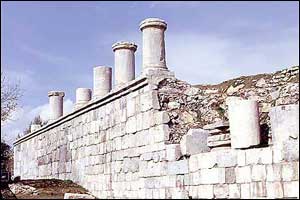
The temple platform is the most striking feature, a raised stone structure covering a large rectangular area. Colossal column bases remain in place, their massive diameter giving a sense of the grandeur of the original structure. Scattered stone blocks bear carved decorations including floral motifs and geometric patterns. The site also includes remnants of staircases, retaining walls, and the aforementioned water channels.
The column bases are particularly impressive. Several stand over a meter high, carved from single blocks of stone with the precision typical of Achaemenid and Sassanian workmanship. Walking among them, you get a tangible sense of the temple's original scale. The platform itself offers views across the Kangavar Valley and the surrounding Zagros foothills.
Archaeologists have identified different zones within the complex, including what may have been a central sanctuary, ancillary chambers, and open courtyards. Interpretation of these zones is still evolving as research continues, but the overall layout suggests a large ceremonial complex rather than a single-purpose building.
The Kangavar Valley and Surroundings
The valley around the temple is one of the most productive agricultural areas in Kermanshah province. Wheat fields, orchards, and vegetable gardens stretch across the plain, fed by the springs and rivers that made this place sacred to the water goddess. The Zagros Mountains form a dramatic backdrop, their limestone ridges rising steeply from the valley floor.
Beyond the temple itself, Kangavar town is a pleasant place to spend some time. The local bazaars offer traditional Kermanshahi products, including dairy goods, handicrafts, and regional specialties. The town serves as a good base for exploring other archaeological and natural sites in the region, including the nearby Taq-e Bostan rock reliefs and the historic city of Kermanshah itself.
How to Get There
From Kermanshah, take the eastbound highway toward Hamadan and exit at Kangavar. The drive takes about one hour on a well-maintained road. From Hamadan, head west on the same highway for a similar distance. The temple ruins are visible from the main road as you approach Kangavar from either direction, and local signage directs you to the site.
Regular intercity buses run between Kermanshah and Hamadan, stopping at Kangavar along the way. Local taxis are available from the bus station to the temple, which is a short ride from the center of town. If you are traveling with Mehyar, you can book a taxi from Kermanshah for a comfortable day trip to Kangavar and back, with the flexibility to stop at other sites in the valley along the way.
Best Time to Visit
Spring from March to May is ideal, when the valley is green, wildflowers bloom across the foothills, and temperatures are mild and pleasant. Early autumn from September to October is also excellent, with warm days and cool evenings. Summer can be quite hot, with temperatures regularly exceeding 35 degrees Celsius, and the open site offers very little shade, so bring water, a hat, and sunscreen. Winter is cold, with occasional snow, but the site remains accessible and the atmospheric quality of the light on the ancient stones has its own appeal.
Practical Details
The site is managed by Iran's Cultural Heritage organization. A small entrance fee applies, and the site is open daily during daylight hours. There are basic visitor facilities near the entrance, including a small information area. Allow at least one to two hours to explore the temple platform and appreciate the stonework. Combine your visit with the town of Kangavar and the wider valley for a half-day or full-day excursion from Kermanshah.