
The Binalud Mountains rise between Mashhad and Neyshabur like a wall of grey rock that softens into green wherever water finds a way down. Bar Waterfall is one of those places where the mountain shows its gentler face. The cascade does not announce itself from a distance. There is no single viewpoint from which you can take in the full height of the fall. Instead, the water descends in a series of tiers, each one feeding into the next through channels of smooth stone, and you discover them one by one as you walk upstream along the stream. The valley around the waterfall is thick with orchards and gardens that have been nourished by this water for generations, and the combination of running water, fruit trees, and mountain air makes the place feel more like a cultivated retreat than a wild cascade.

Where is Bar Waterfall?
The waterfall sits near the town of Bar in the Binalud mountain range of Razavi Khorasan province. Bar is a small town nestled in a valley between the peaks of the Binalud, roughly thirty kilometres south of Neyshabur and about seventy kilometres west of Mashhad. The Binalud range itself stretches for approximately one hundred and fifty kilometres between the two cities, forming a natural barrier that shapes the climate and agriculture of the entire region. The mountains catch moisture from westerly weather systems, and the southern slopes, where Bar sits, are greener and more vegetated than the arid plains that fall away to the north.
The wider Bar valley is known across the region for its extensive orchards. Walnut, cherry, apple, and pear trees line the roads and fill the hillsides, fed by a network of mountain streams that descend from the higher peaks. The waterfall is part of this water system, though it sits further upstream where the terrain is steeper and the vegetation denser.
The Staircase Cascade
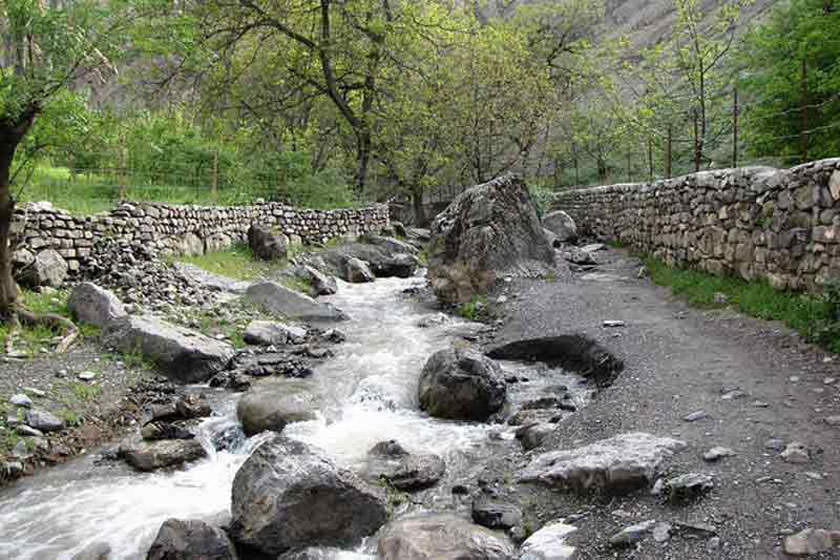
What makes Bar Waterfall distinctive is its structure. The water does not plunge in a single drop. It descends in a staircase of rock ledges, each one creating a small cascade that feeds into a pool before spilling over the next step. The effect is continuous movement and sound, a sequence of small dramas rather than one grand gesture. Because the tiers are staggered and set into a narrow gorge, you cannot see the full extent of the waterfall from any single point. You have to walk along the stream to appreciate how far the water travels from the top of the fall to the valley floor below.
The rock faces around the cascades are stained with minerals and covered in moss and algae where the spray reaches, giving the stone a green and amber palette that changes with the light. In spring, when snowmelt feeds the stream at its fullest, the water is white and forceful, filling the channels and splashing over the ledges with enough energy to carve the rock further. By late summer, the flow reduces to a gentler pace, and the pools between the tiers become clear enough to see the stone patterns beneath the surface.
The vegetation around the waterfall is notably rich for this part of Iran. The Binalud mountains support a mix of mountain steppe and woodland, and the Bar valley, with its reliable water supply, hosts a denser cover than the surrounding slopes. You will find walnut and almond trees, wild pistachio, and various shrubs that thrive in the moist microclimate the waterfall creates. Birdlife is present but not conspicuous, with swifts and swallows hunting insects over the water and smaller birds moving through the undergrowth.

The Bar Valley and Its Orchards
The Bar valley has been shaped by water as much as by geology. The streams that feed the waterfall continue downstream through a landscape of terraced gardens and orchards that have been cultivated for centuries. The combination of altitude, cool nights, and reliable water makes the valley ideal for fruit growing, and the orchards of Bar are known in the region for their walnuts and stone fruits. Driving through the valley on the way to the waterfall, you pass rows of trees heavy with fruit in summer, and in autumn the leaves turn gold and the harvest is brought in.
The orchards are not just agricultural. They shape the character of the place, creating a landscape that is half-wild, half-tended, where the boundary between garden and mountain is blurred. The waterfall sits at the upper end of this cultivated zone, where the stream is still fast enough to cut through rock rather than meander through soil. The transition from orchard to wild cascade happens gradually, and the walk from the town to the falls passes through this gradient of human and natural landscape.
The valley also offers expansive views of the Binalud range. The terrain is open enough that from various points along the trail you can see the peaks rising above the tree line, and on clear days the视野 extends across the surrounding mountains in several directions. The sense of space is one of the valley's quiet attractions, a contrast to the crowded shrines and bazaars of Neyshabur and Mashhad.
How to get there
Open Mehyar and choose Taxi from Neyshabur to reach the town of Bar. The drive covers roughly thirty kilometres and takes about forty minutes on a road that climbs steadily from the plain into the mountains. The route passes through villages and orchards, with views of the Binalud peaks growing closer as you ascend. From Bar town, a trail leads to the waterfall. The walk is not long but involves some uphill sections and uneven ground, so wear sturdy shoes.
Mehyar Buses connects Neyshabur to Mashhad and other cities in Razavi Khorasan. If you are coming from Mashhad, the drive to Neyshabur takes about an hour, and from there another forty minutes to Bar. The total journey from Mashhad to the waterfall is roughly two hours by car.
If you are driving yourself, follow the road south from Neyshabur towards Bar. The route is signposted and the road is paved for most of the way. Parking is available near the town, and from there the trail to the waterfall is well-used and easy to follow. Ask locals if the signs are unclear, as the town is small and everyone knows the way to the falls.
The trail from Bar to the waterfall takes about thirty to forty-five minutes, depending on your pace and how often you stop to look at the cascades. The path follows the stream for much of the way, crossing it in places where stepping stones or simple bridges provide a way over. The final approach to the main cascade involves some scrambling over wet rock, so take care and use your hands when needed.
Best time to visit
Spring, from April to May, and early summer in June bring the strongest water flow and the most vibrant greenery. The snowmelt from the Binalud peaks feeds the stream at its fullest, and the orchards are in blossom or heavy with young fruit. The air is cool and fresh, and the valley is at its most inviting.
Autumn, particularly October, offers a different appeal. The orchard trees turn gold and red, the harvest is underway, and the weather is mild. The waterfall flow is lower than in spring, but the colours and the harvest atmosphere make it a pleasant time to visit.
Winter is cold and the trail can be icy. The waterfall continues to flow, and the sight of water moving through a frosty landscape has its own beauty, but the path requires careful footing and warm clothing. Snow is possible but usually not deep enough to block the trail entirely. Check local conditions before setting out in winter.
Practical tips
The visit is free and the waterfall is accessible at all times. There are no entrance gates or formal opening hours. Allow one to two hours for the round trip from Bar town, including time at the waterfall and along the trail.
Bring water and a light snack, as there are no shops on the trail. The town of Bar has small cafes and shops where you can rest before or after the hike. In summer, local families sometimes sell fruit and cold drinks near the trailhead.
The hike is easy to moderate in difficulty. It is not a technical climb, but the trail involves uphill sections and some uneven ground near the waterfall. Children can manage it with supervision, and older visitors should take care on the wetter sections near the cascades.
Photography is good in all seasons, with the best light in the morning when the sun is behind the eastern peaks and the valley is in soft shadow. The tiered structure of the waterfall makes for interesting compositions, and the contrast between the green vegetation and the grey rock is striking.
Combine the visit with other attractions in the area if you have time. Neyshabur itself has several historical sites, including the tomb of Omar Khayyam and the Attar of Nishapur mausoleum. The city of Mashhad, with the Imam Reza Shrine, is about an hour's drive to the east. The Binalud mountains also offer other hiking opportunities for those who want to spend more time in the area.