
Rising from the flat plains of Khuzestan in southwestern Iran, the Chogha Zanbil ziggurat is one of the most extraordinary ancient monuments in the Middle East. Built around 1250 BCE by King Untash-Napirisha of the Elamite Empire, this towering temple complex is the best-preserved ziggurat in the world outside Mesopotamia and was the very first site in Iran to be inscribed on the UNESCO World Heritage List, in 1979. Standing more than 3,200 years after its construction, Chogha Zanbil offers a direct window into one of the great civilizations of the ancient world.

What is a ziggurat?
Before diving into Chogha Zanbil specifically, it helps to understand what ziggurats were. Ancient Sumerians, Akkadians, Elamites, and Babylonians built ziggurats as massive stepped temple structures to honor their deities. These towering buildings, evolving from simple raised platforms dating back to the sixth millennium BCE, formed part of larger temple complexes and served as symbolic bridges between heaven and earth.
People in various regions of the ancient Middle East regarded these structures for hundreds of years as symbols of celestial mountains. Scholars suggest that ziggurats might represent the primeval mound where the universe originated, heavenly mountains, bridges between heaven and earth, or celestial stairways linking gods and humans. Mesopotamians considered mud as the purest substance and used it to build these stepped structures that ascended towards the heavens.
The Elamite city of Dur Untash
The Chogha Zanbil site, located in the Khuzestan plain about 30 kilometers southeast of Susa (Shush), spans over 100 hectares. The name "Chogha Zanbil" was chosen because the site's most prominent structure, its ziggurat, resembled an inverted basket (zanbil means "basket" in local dialect) before excavation revealed its true form.
This ancient city, known in Elamite as "Al-Untash" and in Akkadian as "Dur Untash," was established under the orders of Untash-Napirisha, one of the most powerful Elamite kings. The city flourished during his twenty-year reign from approximately 1320 to 1300 BCE. Elam was an ancient civilization stretching from the Zagros Mountains to the plains of southwestern Iran, existing from around 2900 BCE to 646 BCE. Archaeologists divide the Elamite civilization into three periods: Old, Middle, and Neo-Elamite. Chogha Zanbil belongs to the Middle Elamite period, the era of the civilization's greatest architectural achievement.
King Untash-Napirisha ordered the construction of temples for both groups of gods worshipped by people living in the mountains and the plains. The main ziggurat was built for the worship of Inshushinak, the patron god of Susa and the Khuzestan plains, and Napirisha, the god of the highland residents. Many archaeologists believe that the king's goal in building this city was to create a spiritual center that would unite the highland and lowland populations of his realm.

The three concentric walls
The city of Dur Untash was built with three concentric walls, each enclosing specialized spaces. The outermost wall enclosed a large area intended to protect the entire city, though archaeological evidence suggests that residential construction was never completed in this zone. Between the outer and middle walls lies the royal district, containing palaces, a grand entrance, and its own temple. Between the middle and inner walls is the temenos, the sacred precinct with temples dedicated to various Elamite gods. The innermost wall houses the ziggurat itself, the city's tallest and most prominent building.
To supply water to this ambitious project, Untash-Napirisha constructed a canal stretching approximately 50 kilometers to a reservoir, with nine conduits bringing filtered water to an internal basin. This hydraulic engineering achievement demonstrates the sophistication of Elamite urban planning.
Architecture of the ziggurat
The ziggurat of Chogha Zanbil is precisely oriented towards the cardinal points, exemplifying ancient architectural planning. Its core consists of mud brick, covered by a two-meter-thick layer of baked bricks for protection. Originally reaching approximately 52 meters in height across five levels, the structure today stands at about 25 meters, with its uppermost stages having been destroyed over the millennia.
Access to the ziggurat was via a vaulted staircase hidden from the outside, which differs from broader Mesopotamian ziggurats that typically featured three external staircases. The building was dedicated to both Inshushinak and Napirisha, reflecting the dual nature of the city as a unifying center.
Rows of inscribed bricks encircle the entire ziggurat, repeating approximately every tenth row. These bricks bear cuneiform inscriptions expressing the reasons for construction, the builder's name, and the materials used. About 6,500 inscribed bricks have been found at the site. One inscription reads: "I, Untash-Napirisha, have built a multistory temple of golden brick, silver brick, and have dedicated this holy place to the gods Inshushinak and Napirisha. May the curse of the Sacred Precinct befall on him who destroys or harms this work."
Discoveries and artifacts
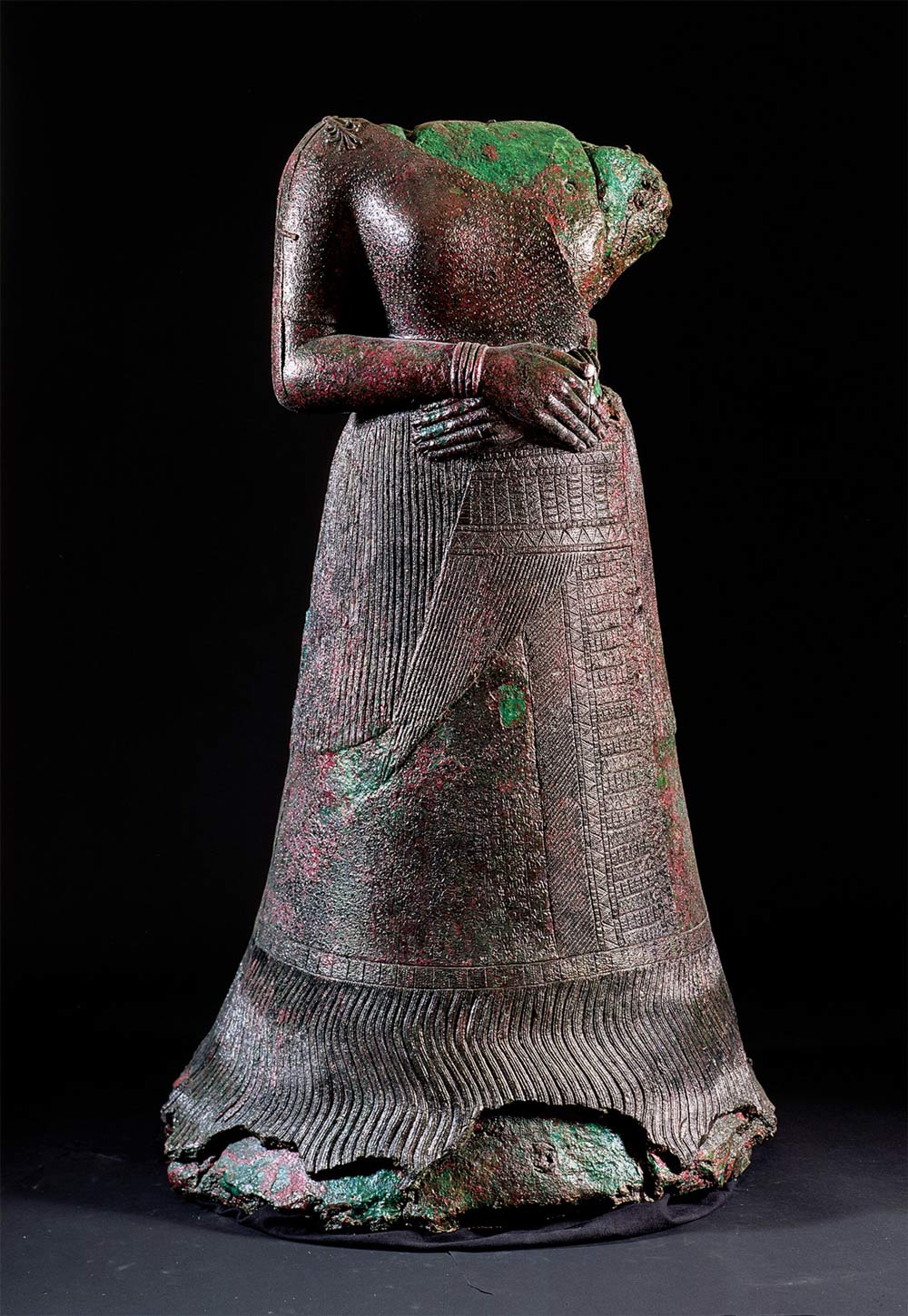
Excavations at Chogha Zanbil have yielded remarkable finds. Among the most celebrated is a bronze statue of Queen Napirasu, wife of Untash-Napirisha, dating to around 1250 BCE. Now housed in the Louvre Museum in Paris, the statue is a masterwork of Elamite art. Roman Ghirshman, the French archaeologist, conducted extensive explorations of the site from 1951 to 1962, revealing much of what we know about the complex today.
Vaulted tombs in the royal residence's basement revealed cremation practices, alongside a temple dedicated to Nusku, the fire god. Glazed door plaques bearing royal inscriptions, ceremonial weapons decorated with boar and lion motifs, glass pipe fragments used for decorating wooden doors, and numerous amulets and statuettes have all been recovered from the site. The use of baked brick, gypsum plaster, and architectural ornamentation in faience and glass underscores the sophistication and enormous resources invested in the construction.
The fall of Dur Untash
Despite its grandeur, the city's fortunes were short-lived. In the twelfth century BCE, Elamite kings abandoned Dur Untash in favor of the older city of Susa, transferring much of its artistic and religious treasures to newly restored temples there. Then, in 640 BCE, the Assyrian king Assurbanipal completely destroyed what remained of Dur Untash during his conquest of Elam. The city lay buried beneath sand and soil for more than 2,500 years until modern excavations brought it back to light.
How to visit Chogha Zanbil
Chogha Zanbil lies approximately 30 kilometers southeast of Susa and about 80 kilometers north of Ahvaz, the capital of Khuzestan province. The nearest major city is Ahvaz, which has an airport with domestic flights connecting it to Tehran and other Iranian cities. From Ahvaz, visitors can reach the site by car in roughly one hour. Open Mehyar to plan your route and book a Taxi or Bus for the journey.
The region experiences a hot desert climate, with summer temperatures regularly exceeding 45 degrees Celsius. The best time to visit Chogha Zanbil is during the cooler months, from October to April, when the weather is mild and comfortable for exploring the open-air site.
Nearby attractions
A visit to Chogha Zanbil pairs naturally with excursions to other historical sites in the region. The ancient city of Susa, one of the oldest continuously inhabited settlements in the world, lies just 30 kilometers to the northwest and features ruins spanning thousands of years of history. The Haft Tappeh museum, located en route from Ahvaz, displays artifacts from the Elamite period. The Tomb of Daniel in Susa is also worth visiting. For travelers exploring southwestern Iran, Mehyar Hotels can help you find accommodation in Ahvaz or Susa as a base for exploring these ancient sites.

Why Chogha Zanbil matters
Chogha Zanbil is more than an archaeological curiosity. It stands as proof that the Elamite civilization, often overshadowed by its Mesopotamian neighbors, possessed architectural, engineering, and artistic capabilities that rivaled any of its contemporaries. The ziggurat's survival for over three millennia, despite Assyrian destruction and the ravages of time, testifies to the quality of its construction. For anyone interested in the deep history of human civilization, Chogha Zanbil is an essential destination that offers an experience few other sites in the world can match.