
Every walled city reveals its character at its gates, and nowhere is that truer than in Tabriz. For centuries the greatest commercial city of northwestern Iran sat behind a ring of walls pierced by ten monumental gateways, each one an instrument of policy as much as architecture. Through them flowed silk from Gilan, leather from the bazaar's tanneries, pilgrims bound for the shrine cities, and caravans that had crossed the mountains from Anatolia and the Caucasus. The gates of Tabriz were the city's official face: here strangers were counted, duties were collected, news was announced, and at dusk the day itself was formally closed with the blast of a horn. Today only two of the gates survive in original form, yet their names still organise the map of the city, and their stories explain how Tabriz understood its place in the world.

Why Tabriz Was Walled
The wall system that travellers describe in later centuries took its definitive shape in the era of Karim Khan Zand, in the eighteenth century. Tabriz had been shattered by a catastrophic earthquake, and the rebuilding of the city included a new defensive circuit ordered under the local Donboli dynasty, which governed Azerbaijan in those years. The old walls had guarded a medieval metropolis; the new ones enclosed a city determined never again to be an easy prize. Ten gates, or darvazeh in Persian, were set into the circuit, positioned so that every major road of the region ended at a doorway of its own.
The logic was commercial as much as military. Tabriz lived by the caravans, and each caravanserai road approached the city from a different quarter of the horizon. A traveller arriving from Isfahan entered by one gate, a merchant from Istanbul by another, and the administrators at each portal could see at a glance what the road was bringing them. The gate system was the customs office, the newsroom, and the border of the city in a single line of masonry.
A Day Measured by the Gates
The rhythm of life at the walls was as formal as a ritual. As evening fell, the watchmen closed the gates and sounded the korneh, a long horn whose deep note rolled across the rooftops to announce that the city was sealed. Nobody entered, nobody left, and the roads outside belonged to the night. At dawn the call flipped: the gates swung open with the azan, the call to morning prayer, and the day's traffic of carts, horses, and foot passengers resumed. For anyone who lived between the walls, the day began and ended at a gate, and the sound of the korneh became one of the defining memories of the old city.
This discipline mattered because the plain around Tabriz was open country. Raids, feuds between khans, and the movements of armies were facts of life in the borderlands of three empires, and a city that could close itself at dusk slept more soundly than one that could not.

The Gates, One by One
Khiyavan, the eastern gate. Khiyavan opened the city towards Iraq-e Ajam and the long road that ran to Isfahan and central Iran. The quarter outside it was among the liveliest in Tabriz, lined with the gardens and villas for which the district was famous. Merchants arriving from the Iranian interior passed beneath its arch, and its name remains attached to one of the city's main streets.
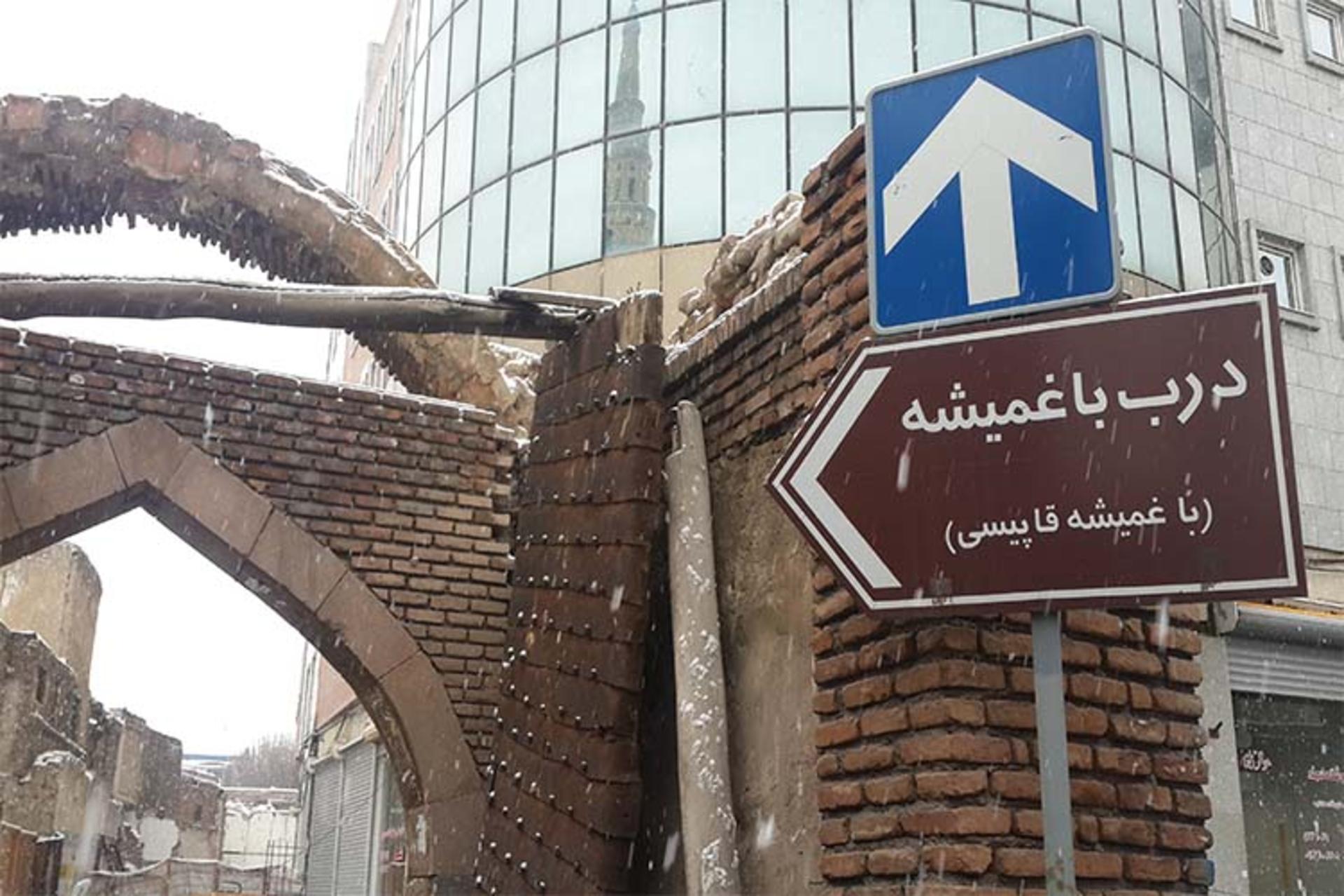
Baghmisheh, the gate of the noble road. On the northeast side stood Baghmisheh, also called Darb-e Ala, the high gate, facing the fertile district of gardens from which it took its name. It served travellers bound for the northern routes and for the summer pastures beyond the Aji Chay. Baghmisheh is one of the two gates whose fabric still stands, and its tilework is among the most photographed surfaces in the city.
Sorkhab, the red quarter's gate. Sorkhab served the northeastern quarter of the same name, one of the oldest districts of Tabriz. Its portal handled the daily traffic of that neighbourhood and the roads that climbed away from the city in the same direction.
Nobar, the southern gate with the deepest roots. The Nobar gate was associated with a history far older than the Zand wall, with some accounts tracing a gate on the site back to the year 400 AH. It opened the city to the south, and a symbolic reconstruction of it now stands on Tarbiat Street, keeping the name alive in the modern street plan.
Miyar Miyar, the vanished gate. On the road that corresponds to today's Ferdowsi Street once stood the gate remembered as Miyar Miyar, a name whose doubled syllables have puzzled chroniclers for generations. Of its structure no trace survives, and the gate exists now only in documents and in the memory of the neighbourhood.
Gajil, the western gate of towers. Gajil, on the western side and known in old records as Darb-e Sard, was built in a heavier style, with towers and arches that made it a fortress as much as a portal. It covered the roads towards the western provinces and was one of the most formidable points of the circuit. A rebuilding project has recently returned a symbolic version of Gajil to the city, and its name survives in one of Tabriz's largest districts.
Istanbul, the gate of the great caravans. The most important of all was the gate facing northwest, remembered as the Istanbul gate. It stood on the route of the great caravans to the Ottoman Empire, and through it flowed the wealth of the westward trade. It was also the scene of the city's political dramas: crowds gathered at the Istanbul gate during the battles of the constitutional period, and the portal watched more history than any other doorway of Tabriz.
Docheh, the camel gate. The northern gate, Docheh, took its name from the camel caravans that dominated its traffic. Heavy freight entered and left the city through this portal, and its approaches were busy with the loading and unloading that fed the bazaar's warehouses.
Vijuyeh, the western neighbour. Vijuyeh stood on the western side of the circuit, serving the district of the same name and the country roads of its direction. It shared the western burden of defence with Gajil and handled the everyday traffic of its quarter.
Qala, the gate by the citadel. In the southwest, Qala took its name from the citadel, the qala of the city. It connected the wall to the fortress quarter and served the roads of its own corner of the horizon.
The Architecture of a Gate
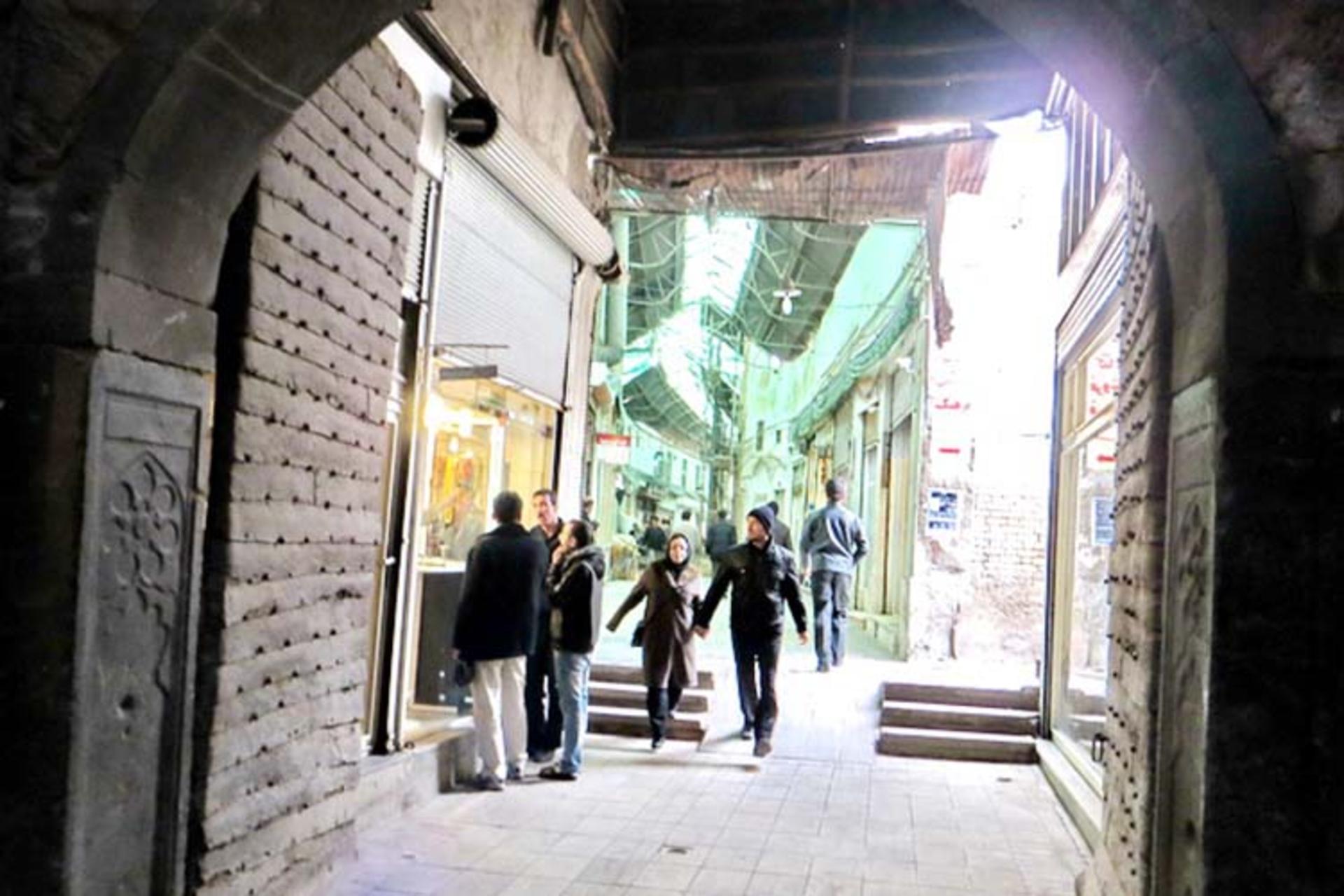
A Tabriz gate was designed to impress before it was designed to resist. Each principal portal carried a tall minaret-like tower, and the brick faces were dressed with tilework in the blues and turquoises that the city's workshops did better than anyone. Bands of inscription framed the arch, and most of the gates carried verses of poetry in their tile bands, so that the traveler passing beneath read a line of verse as the price of admission. The combination of defence and elegance was deliberate. A gate told the approaching caravan two things at once: the city is strong, and the city is civilised. Both messages were true, and both were worth the masonry.
Inside the arch, the gate functioned like a small building in its own right. Guard rooms, spaces for the customs clerks, and stairways to the ramparts filled the thickness of the wall, and the roof of the gatehouse served as a watch platform from which the watchmen sounded the horn and scanned the road at dusk.
What Survives Today
Time, earthquakes, and the modernisation of the twentieth century swept most of the gates away when the walls came down and the city grew past its old circuit. Two gates remain standing in their historic fabric: Khiyavan and Baghmisheh. Both are rewarding stops, and Baghmisheh in particular preserves enough of its tilework to give a sense of what all ten once looked like. For Nobar and Gajil, the city has built careful symbolic reconstructions, so that visitors can at least stand at the historical points of the circuit and see a full-scale memory of the lost architecture.
The best way to experience the gates is not as isolated monuments but as a circuit. Starting at Baghmisheh in the northeast, the route passes the sites of Sorkhab and Khiyavan, crosses the city to the Nobar reconstruction on Tarbiat Street, and finishes at Gajil in the west, where the rebuilt gate anchors the district that still bears its name. Walked in order, the circuit traces the exact line of the old wall, and the names of the gates keep appearing on street signs, district boards, and shop fronts along the way.
Planning Your Visit
Give the circuit half a day, more if you plan to enter the bazaar on the way. Spring and early autumn are the kindest seasons, since the sites are open-air and the Tabriz wind is sharper than newcomers expect. Comfortable shoes matter more than a guidebook, because the distances between gate sites are real, and the pleasure of the route comes from the streets between them.
Getting around with Mehyar. The gate sites are spread across the city, and the fastest plan is to ride between them by taxi. Open Mehyar, choose Taxi, and set your destination, and the fare appears before you confirm, so you can hop from Baghmisheh to Tarbiat Street to Gajil without negotiating. Travellers arriving from other provinces can book Mehyar Buses to Tabriz's main terminal and take a taxi from there to the first gate of the circuit.
The gates of Tabriz were built to control a road, and they ended up defining a city. Ten doorways once decided what entered, what left, and when the day began and ended, and their names still do quiet duty on every map of the town. Stand beneath the tilework of Baghmisheh or the rebuilt arch of Gajil and you are reading the front page of the city's history, spelled out in brick and verse.
