
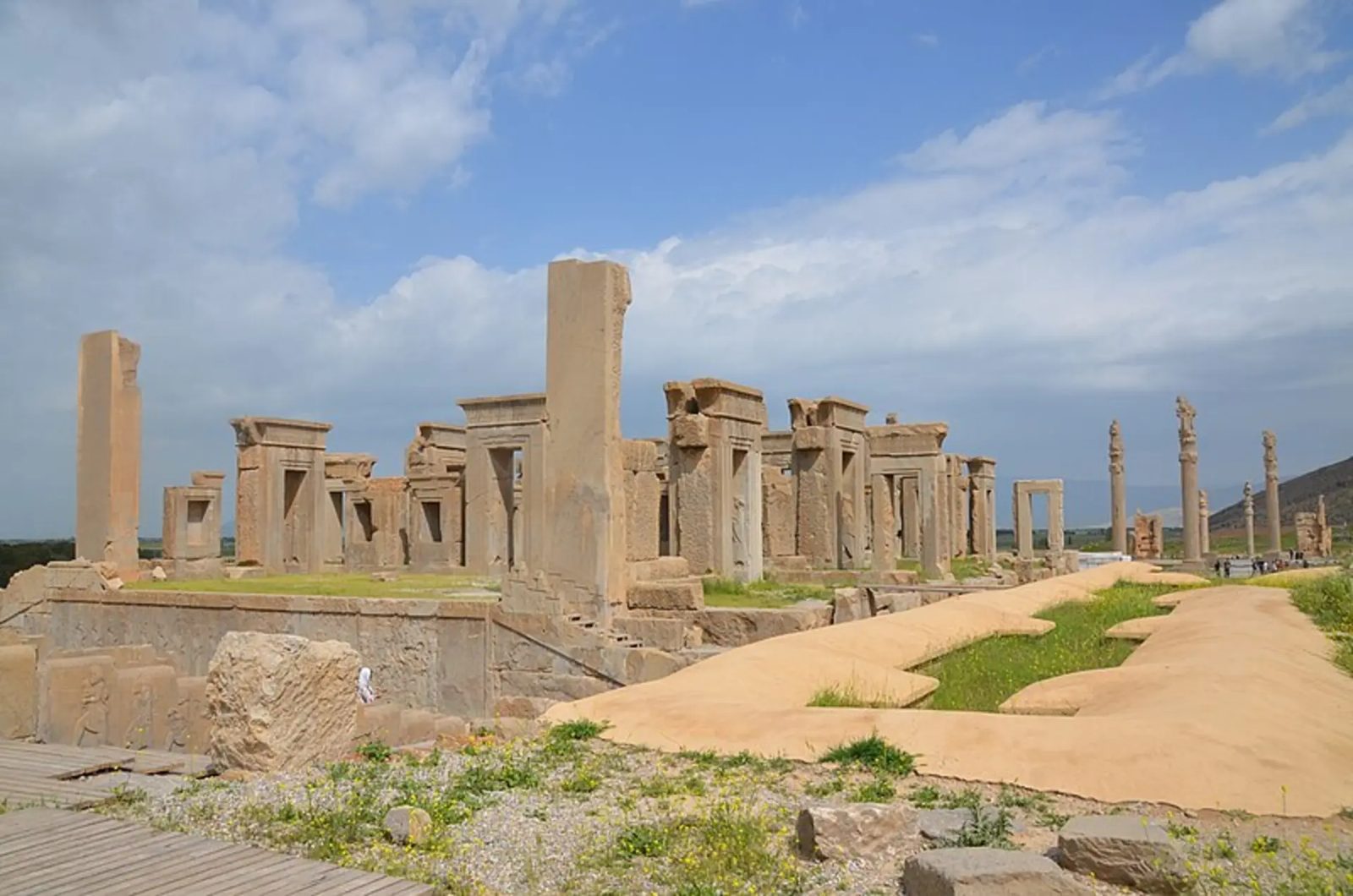
Most travelers come to Fars province for Persepolis, the vast ceremonial terrace that announced the Achaemenid Empire to the world. Then they drive a few minutes north and meet something stranger: a cliff face carved with four colossal crosses, each one a royal tomb suspended high above the plain. This is Naqsh-e Rostam, and for many visitors it leaves a deeper mark than the palaces it sits beside.
Naqsh-e Rostam is the royal necropolis of the Achaemenid kings, later reused by Sasanian rulers who carved their own triumphal reliefs directly beneath the tombs. In one compact site you read three layers of Iranian history: an Elamite panel, four Achaemenid tombs, and nine Sasanian rock reliefs, with the mysterious Ka'ba-ye Zartosht standing in front of the cliff like a locked stone box whose key was lost centuries ago.
This guide covers what you will see, how to reach the site from Shiraz, how to combine it with Persepolis and Pasargadae in a single day, and the practical details that make the difference between a rushed stop and a memorable one.

Where is Naqsh-e Rostam?
Naqsh-e Rostam sits in Fars province, in the Marvdasht plain, at the foot of the Kuh-e Rahmat (Mountain of Mercy) range. The site is roughly 6 kilometers northwest of Persepolis, about 12 kilometers from the town of Marvdasht, and about 60 to 70 kilometers northeast of Shiraz. If you are driving from the city center, count on a little over an hour each way depending on traffic leaving Shiraz.
The site is open-air and compact. You can walk the main path in 45 minutes to an hour, though travelers who read the signboards carefully and photograph the reliefs often stay closer to 90 minutes.
How to get there
The simplest and most comfortable option is a private car or a taxi, and this is where Mehyar makes the day easy. Open Mehyar, choose Taxi, and set your destination to Naqsh-e Rostam. Because the site sits between Persepolis and Marvdasht, you can also book a driver for a half day and ask to stop at Persepolis first, then Naqsh-e Rostam, before returning to Shiraz. Agree on the waiting time at each stop in advance, since mobile coverage is fine but flagging a passing car at the site itself is unreliable.
If you are traveling on a budget, take a bus or shared taxi from Shiraz to Marvdasht, then hire a local taxi for the final leg. This costs less but eats time, and the last return from Marvdasht to Shiraz can be crowded in the late afternoon. Tour agencies in Shiraz also run daily half-day trips that pair Persepolis and Naqsh-e Rostam, which suits travelers who prefer a fixed schedule and a guide.
For travelers continuing to Yazd, Isfahan, or Kerman, Naqsh-e Rostam works well as a stop on a longer road day. Use the Mehyar planner to check driving times and to book a hotel in Shiraz for the night before and after, since the site has no accommodation nearby.
A short history of the site
The cliff was already sacred before the Achaemenids arrived. An Elamite relief, roughly 3,000 years old, shows a seated deity with snakes coiled around the figure, a rare survivor from a period that predates the Persian Empire. When Darius I founded Persepolis in 518 BCE, he chose this older, venerated rock for his own tomb, and his successors followed.
Four tombs are cut into the cliff. Only the tomb of Darius I is identified with certainty by an accompanying inscription. The other three are generally attributed to Xerxes I, Artaxerxes I, and Darius II. A fifth, unfinished tomb lower on the rock is often linked to Artaxerxes III or to Darius III, the last Achaemenid king. The tombs were looted after Alexander's conquest, but the facades survived, and their cross shape gave the site its local nickname, the Persian Crosses.
Centuries later, the Sasanian kings returned to the same cliff. Below the Achaemenid tombs they carved nine reliefs celebrating their own legitimacy: investitures, court scenes, and above all the triumph of Shapur I over the Roman emperor Valerian, captured at Edessa in 260 CE. That relief remains one of the most historically important rock carvings in Iran.
What to see
The Achaemenid rock tombs
Each tomb is carved as a cross. The upper arm holds a relief of the king standing before a fire altar, with the winged figure of Ahuramazda above, symbolizing divine approval. The central panel is the entrance to the burial chamber, and the lower arm is a blank façade. The scale is deliberately overwhelming: the tombs sit roughly 20 meters above the ground, so you always look up.
The tomb of Darius I is the most studied, partly because of the long trilingual inscription on its façade. The tombs of Xerxes I, Artaxerxes I, and Darius II repeat the pattern with variations. The chambers themselves are closed, and pigeons now occupy what the kings intended as eternal silence, which is its own quiet irony.
The Sasanian reliefs
Below the tombs, nine reliefs are cut into rectangular recesses. The most famous shows Shapur I on horseback, with the Roman emperor Valerian kneeling in submission and a standing Roman figure, often identified as Philip the Arab, pleading nearby. Next to it is a relief of Ardashir I receiving the diadem of kingship from the god Hormizd, an image that fuses politics and religion in a single frame.
Other panels show Bahram II with his court, an equestrian combat, and the investiture of Narseh by Anahita. Several of these reliefs were carved over older, pre-Achaemenid carvings, and traces of the earlier figures are still visible at the edges. Signboards in English stand below each relief, and they are worth reading before you photograph.
Ka'ba-ye Zartosht
Facing the cliff is a squat, square tower of pale limestone, about 12 meters high, known as the Ka'ba-ye Zartosht, the Cube of Zoroaster. Its purpose has been debated for decades. Some scholars proposed a fire temple or a flame memorial for the tombs nearby, but the lack of ventilation makes that unlikely. Others suggested a treasury or a repository for royal documents. The current consensus leans toward an Achaemenid royal tomb, though the debate is far from closed.
What is certain is the value of its inscriptions. On three walls, Shapur I left a trilingual text in Middle Persian, Parthian, and Greek, and below it the priest Kartir recorded his own rise and his role in shaping the Sasanian state religion. For historians, these inscriptions are among the most important documents to survive from Sasanian Iran.
Hours, tickets, and on-site tips
The site is generally open daily from morning until late afternoon. In the cooler months, closing time comes earlier, around 17:00, while in spring and summer the site stays open later. Ticket prices for Iranian and foreign visitors differ, and both change with inflation. Treat any figure you read online as a rough guide and confirm at the entrance or through your hotel before you go.
Bring water, a hat, and sun protection. There is almost no shade at Naqsh-e Rostam, and the stone radiates heat by midday. Wear shoes with grip, since the paths are uneven and the ground around the tower is gravelly. Tripods and large camera bags may attract attention from staff, so keep your setup simple. If you want the reliefs in the best light, come in the early morning or the late afternoon, when the low sun rakes across the carvings and the shadows deepen the figures.
Best time to visit and how to pair it with nearby sites
Spring, from April to early June, and autumn, from late September to November, are the most comfortable seasons. Summer in the Marvdasht plain is genuinely hot, often well above 35°C, and if you visit then, start at opening time and finish before noon. Winter days are cool and clear, which makes the reliefs easy to photograph, though mornings can be chilly.
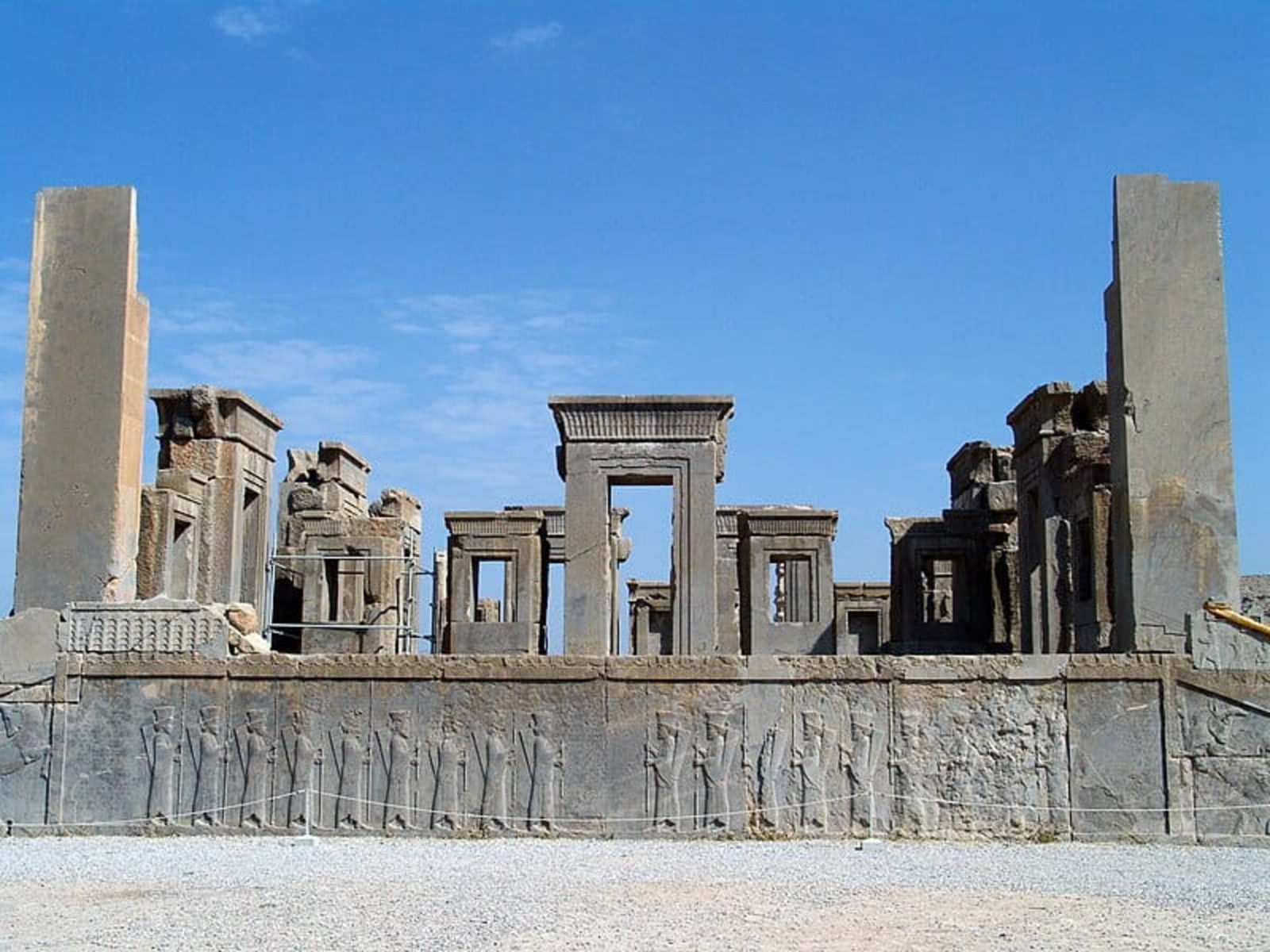
The classic pairing is a single day that covers Persepolis in the morning, Naqsh-e Rostam around midday or early afternoon, and Naqsh-e Rajab, only a few minutes away, on the way back. If you have a full day and your own driver, add Pasargadae, the earlier Achaemenid capital and the tomb of Cyrus the Great, roughly 80 kilometers north. That makes for a long but rewarding circuit that traces the empire from its founding to its burial grounds.
For more context before or after your visit, read our guides to Persepolis and Pasargadae, and use the Shiraz article for hotels, food, and city logistics.
Practical notes and where to stay
Naqsh-e Rostam has no hotels, restaurants, or shops of its own. The nearest services are in Marvdasht, and the widest choice of accommodation is in Shiraz, which makes a comfortable base. Book through Mehyar Hotels to compare options in Shiraz, and use Mehyar Taxi for the day trip so you are not dependent on uncertain return transport.
Carry cash for entrance fees and small purchases, since card readers and international cards are not reliable at small sites. If you are visiting in summer, plan the site for the first or last hour of the day. If you are visiting in winter, bring a light jacket for the wind that moves across the plain.
Naqsh-e Rostam rewards preparation. Read a little before you arrive, look up at the tombs, and then turn to the reliefs below, where a Sasanian king stands over a captured Roman emperor and a priest named Kartir wrote his own version of history into the stone. It is a place about permanence, and it makes that point without raising its voice.
Start your day with Mehyar: open the app, book a taxi from Shiraz, and let the planner handle the timing so you arrive before the heat and the crowds.