
In the heart of Kerman stands one of Iran's most complete and impressive Safavid-era urban complexes, a sprawling 11,000-square-metre ensemble that once formed the commercial, spiritual, and civic centre of the city. The Ganj Ali Khan Complex is not a single building but an integrated collection of structures, built over three decades at the turn of the seventeenth century, that together illustrate the full range of Safavid urban planning at its finest. Walking through its square, browsing its bazaar, peering into its bathhouse, and resting in its mosque offers a more authentic encounter with the Safavid world than almost any other site in Iran outside Isfahan.

The Man Behind the Complex
Ganj Ali Khan was one of the most powerful governors of the Safavid era, serving as the ruler of Kerman for nearly 30 years under Shah Abbas I. During his long tenure, he transformed Kerman from a provincial town into a thriving commercial and cultural centre. The complex that bears his name was designed and built by Sultan Mohammad Memar Yazdi, a master architect from Yazd who brought the refined Isfahani architectural style to the desert city. The result was an urban complex that rivalled the great squares of Isfahan and Yazd in scope and sophistication.
The complex was constructed in stages over several decades. The square and bazaar were completed in 1005 AH (approximately 1596 CE), making them the oldest elements. The school followed in 1007 AH, the mosque was added soon after, and the caravanserai, bathhouse, and water reservoir were all completed between 1020 and 1021 AH (roughly 1611 to 1612 CE). The mint, or zarrab-khaneh, occupied the northern side of the square. Much of the original complex was damaged during the campaign of Aqa Mohammad Khan Qajar in the late eighteenth century, but the core structures survived and have since been carefully restored.
The Square: Kerman's Naqsh-e Jahan
The central square of the Ganj Ali Khan Complex can be thought of as Kerman's answer to Naqsh-e Jahan in Isfahan. Like its famous counterpart, it embodies the classical Iranian principles of urban planning, with civic, commercial, and religious elements arranged in deliberate harmony around an open gathering space. The square served as a social hub where merchants, scholars, travellers, and ordinary citizens converged for commerce, prayer, and community life.
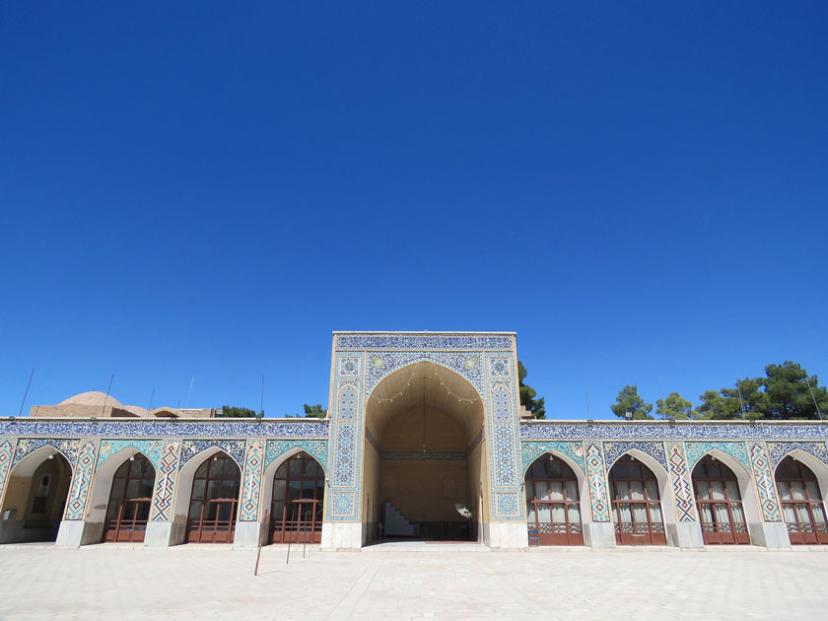
Today, the square is framed by brick arcades, decorative tilework, green spaces, and a central water pool that catches the desert light. The interplay of proportions between the surrounding structures and the open space demonstrates a mastery of urban design that remains impressive centuries later.

The Bazaar and Qeysariyeh
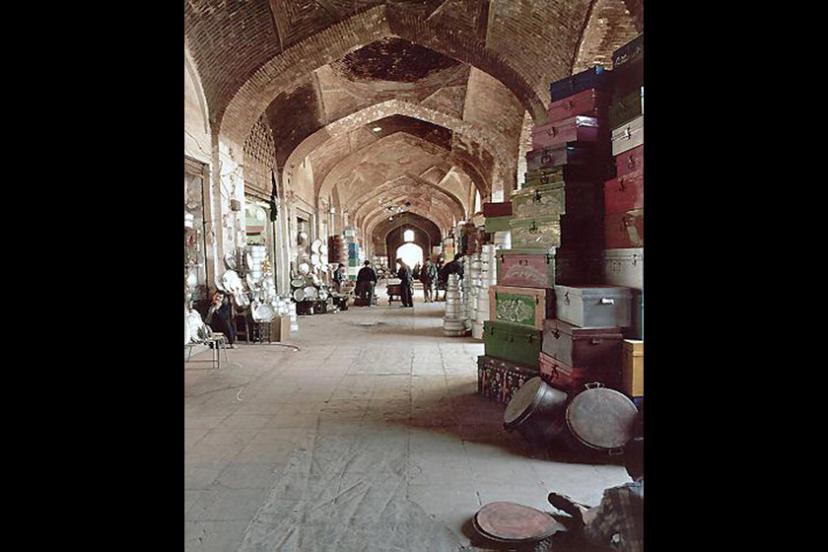
On the southern side of the square, the Ganj Ali Khan Bazaar extends into the commercial heart of old Kerman. This vaulted corridor, lined with shops on both sides, was once the main artery of the city's trade. To the right of the bazaar entrance stands the historic bathhouse, and along the left side, arched alcoves shelter small vendors and craftspeople. At the far end of the bazaar lies the Zar-gari Bazaar, also known as the Qeysariyeh, the goldsmiths' quarter where jewellers and metalworkers have plied their trade for four centuries.
The bazaar remains an active commercial space. Visitors will find carpets, spices, copperwork, and traditional Kermani handicrafts among its stalls. It forms part of Kerman's Grand Bazaar, one of the oldest continuously operating marketplaces in southeastern Iran.
The Mosque
The Ganj Ali Khan Mosque occupies the northeastern corner of the square. Originally, it may have functioned as the prayer hall for the adjacent caravanserai or the school. The mosque is modest in scale, consisting of a single prayer hall and an entrance portico. The portico's facade is simple, adorned with geometric plasterwork, while the floor is paved with stone and the wooden door is crowned by a stone inscription.
Inside, a narrow corridor leads to the domed prayer hall. The dome features twelve light openings that create a shifting pattern of illumination throughout the day. The mihrab, carved from marble and decorated with a vase motif, is the spiritual focal point. The interior decoration includes painting, plaster relief, muqarnas, and band-kashi (architectural articulation), all typical of the refined Safavid aesthetic. The mosque has been recently restored and is now used exclusively for visitors rather than daily prayers.

The Bathhouse
The Ganj Ali Khan Bathhouse, on the southern side of the complex, is one of the finest surviving examples of a Safavid public bath in Iran. Completed in 1020 AH, it follows the classic Persian hammam layout with a changing room (rakhtakan), a warm room (garmkhaneh), and a hot room, all decorated with stucco, tilework, and paintings depicting scenes from the Shahnameh and contemporary daily life.
The bathhouse has been converted into a traditional tea house, where visitors can sip tea amid the atmospheric vaulted chambers and ornate decoration. It is one of the most photographed interiors in Kerman and a highlight of any visit to the complex.
The School and Caravanserai
On the eastern side of the complex stand the school and the caravanserai, built in 1007 and 1021 AH respectively. The school, a centre of religious and scholarly learning, features a courtyard surrounded by lecture rooms and student cells. The caravanserai, built to accommodate merchants and their goods, provided secure lodging along the trade routes that passed through Kerman.
Together, these structures illustrate how the complex served both spiritual and commercial needs. Travellers arriving on the Silk Road branches that ran through Kerman could pray at the mosque, conduct business in the bazaar, rest at the caravanserai, and bathe at the hammam, all within a few hundred metres.
The Mint and Water Reservoir
The zarrab-khaneh, or mint, occupied the northern side of the square. This was where coins were struck for the Safavid state, a function that underscores the economic importance of Kerman under Ganj Ali Khan's governorship. The presence of a royal mint in the city marked it as a centre of fiscal significance within the empire.
On the western side, the ab-anbar, or underground water reservoir, provided fresh water to the complex and the surrounding neighbourhood. These subterranean cisterns, with their characteristic wind catchers and access stairs, are among the most ingenious hydraulic structures in traditional Iranian architecture.
Getting to the Ganj Ali Khan Complex
By Mehyar Taxi. The simplest way to reach the Ganj Ali Khan Complex is through Mehyar's taxi service. Set your destination to Meydan-e Shohada in central Kerman, and the driver will take you directly to the entrance. A private car gives you flexibility to combine the complex with other Kerman sights in a single outing.
By Mehyar Buses. Kerman is connected to major Iranian cities by regular bus services. Mehyar Buses offers scheduled routes with advance booking through the app. The complex is within walking distance of Kerman's central bus station area.
By Organised Tour. Most cultural tours of Kerman include the Ganj Ali Khan Complex as a primary stop. Tours from Tehran, Yazd, or Shiraz typically cover transport, a knowledgeable guide, and entrance fees. Check Mehyar for available tour options.
Best Time to Visit
Kerman's desert climate means that the best times to visit are spring and autumn, when daytime temperatures are mild and evenings pleasantly cool. March through May and September through November offer ideal conditions for exploring the open square and walking the bazaar corridors. Summer can be very hot, with temperatures regularly exceeding 35 degrees Celsius, though the underground bathhouse and water reservoir remain cool. Winter days are generally sunny and mild, but nights can be cold.
Allow at least half a day to explore the full complex properly. The bazaar alone can easily occupy an hour or two for those interested in shopping or simply absorbing the atmosphere.
Practical Tips
- Combine with Shahzadeh Garden. The UNESCO-listed Shahzadeh Garden at Mahan is only a 30-minute drive from the complex. Use Mehyar Taxi to connect between the two sites in a single day.
- Explore the Grand Bazaar. The Ganj Ali Khan Bazaar connects to Kerman's larger Grand Bazaar network. Allow time to wander beyond the main complex and discover the deeper commercial quarters.
- Try Kermani cuisine. The area around the complex is home to excellent traditional restaurants serving local specialties such as boz bash (goat stew) and qavoot (a nutritious powdered drink unique to Kerman).
- Visit the bathhouse tea room. Do not miss the chance to drink tea in the atmospheric setting of the converted Safavid bathhouse.
- Photography. The complex is exceptionally photogenic, especially the tilework on the square arcades and the painted interiors of the bathhouse. Early morning and late afternoon light is best for the open square.
- Stay nearby. Several hotels and traditional guesthouses are within walking distance of the complex. Use Mehyar Hotels to find and book the best available options.
- Use Mehyar Wallet. Pay for entrance fees, tea, purchases in the bazaar, and transport conveniently through the Mehyar digital wallet.
The Ganj Ali Khan Complex is more than a collection of old buildings. It is a complete portrait of Safavid urban life, a place where commerce, faith, scholarship, and social ritual coexisted within an architectural masterwork. For anyone seeking to understand the richness of Iranian cultural heritage beyond the well-trodden path of Isfahan and Shiraz, Kerman's great complex is an essential stop.