
Qazvin is the city that was Iran's capital before Isfahan was, and it has never quite recovered from being second best. For 57 years the Safavid court sat here, and the layer of architecture that left behind is the reason to come: a brick-vaulted bazaar that predates the dynasty, a royal pavilion that is said to be the only survivor of Shah Tahmasp's palace group, and a Friday mosque so old that its first walls went up on the site of a Sassanid fire temple.
The city also has a gentler claim. It is called the capital of calligraphy in Iran, it sits at the junction of the roads to the north and the west, and its Qajar houses, water reservoirs and two minority churches make a compact, walkable cultural day out that most travellers still skip on the way to the Caspian. This guide covers what is actually here, how to reach it from Tehran, and how to order the sites so you are not crossing the city four times.

Where is Qazvin?
Qazvin is the capital of Qazvin province in northwestern Iran, sitting on the plain where the routes from Tehran branch toward Gilan and the Caspian to the north and toward Tabriz and Turkey to the west. That crossroads position, more than anything, explains its history: it was a garrison city, a royal seat and a market town in that order.
The old city is small enough to visit on foot with short taxi hops. The bazaar, Masjid-e Nabi, the Chehel Sotoun pavilion and the great ab anbar cluster around the central squares; the Qajar mansions of Aminiha and Sepahdar sit a few streets away; and the two churches are spread through the newer quarters. Outside the built-up area, the gardens of Baghestan spread across the southern half of the city.
How to get to Qazvin from Tehran
Qazvin is about 150 kilometres west of the capital, a two-hour drive on the freeway, and it is one of the easiest cultural day trips from Tehran in the country.
By Mehyar Taxi. A private car with a driver is the most efficient way to do the city in a day, because the sites are scattered and the waiting between them is long. Book through Mehyar Taxi, and ask the driver to hold the morning for the bazaar and mosques and the afternoon for the houses and the gardens road.
By Mehyar Buses. Coaches and minibuses run constantly between Tehran and Qazvin along the western motorway, and the city is also on the northbound route to Rasht, so it slots naturally into a Caspian itinerary. Buses drop you within easy taxi range of the centre.
By air. Qazvin has no airport of its own; Tehran's airports are the gateway, and the road transfer is straightforward. Check connections on Mehyar Flights before you plan anything tighter than a full day.
Getting around the city. Most of the historic core is walkable. For Sepahdar, the Baghestan gardens and the ab anbar side of town, short local taxi rides are cheaper than the time you would spend walking in summer heat.
The bazaar and Masjid-e Nabi
The Qazvin Bazaar is the oldest fabric in the city and still the most atmospheric. Its Safavid core was expanded in the Qajar period with caravanserais, saras and timchehs, and it was registered on the national heritage list in 1977. The covered Qaysariyeh section, with vaults of brick that seem too high to stand, is the heart of it. Four doors open into the complex, one at the Timcheh Sarbaz, one into the covered timcheh, one eastward toward Saray-e Vazir and one onto a small charsu. Within it are Saray-e Saad al-Saltaneh, Saray Vazir, Saray Haj Reza, Saray Razavi, the Saray-e Khoshnevisan where the city's calligraphers worked, Timcheh Seyyed Kazem, Saray-e Shah and the money changers' row. Note that in more than nine centuries of use the bazaar migrated from south to north, and the Friday mosque was left standing outside its arcades.
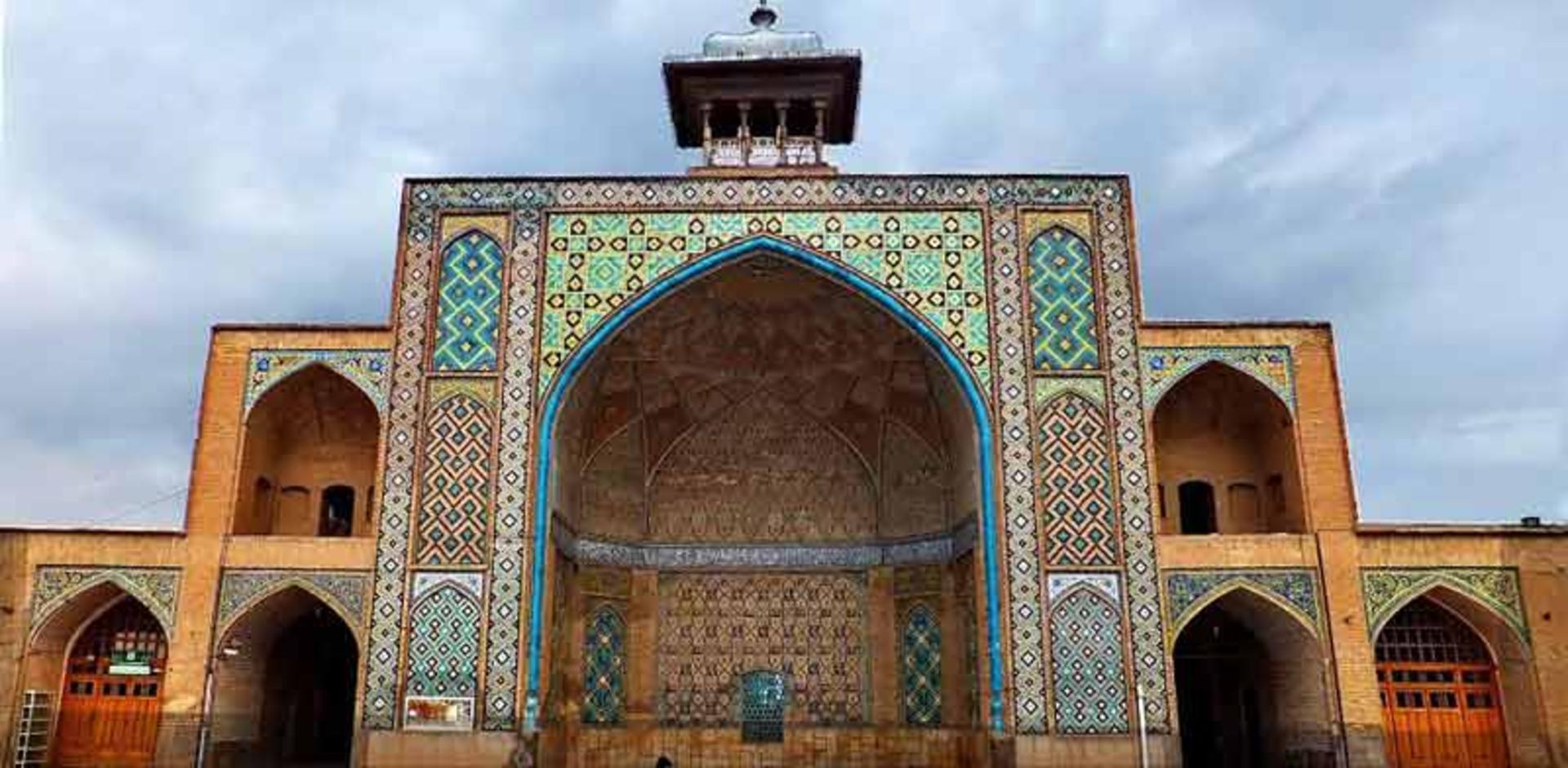
Masjid-e Nabi, the Prophet's Mosque, opens from the south side of the bazaar onto Imam Khomeini Street and is still used for congregational and Friday prayers. It covers some 14,000 square metres in its present Qajar form, built under Fath-Ali Shah on the endowment site of Aqa Jamal Vazir, and it has three portals faced with mina and oslobi tilework, a lapis-blue nastaliq inscription band and Qur'anic verses from Surah Am Ya'tasselun and Hal Ata. It was listed as a national monument in 1931.
Safavid and Qajar palaces
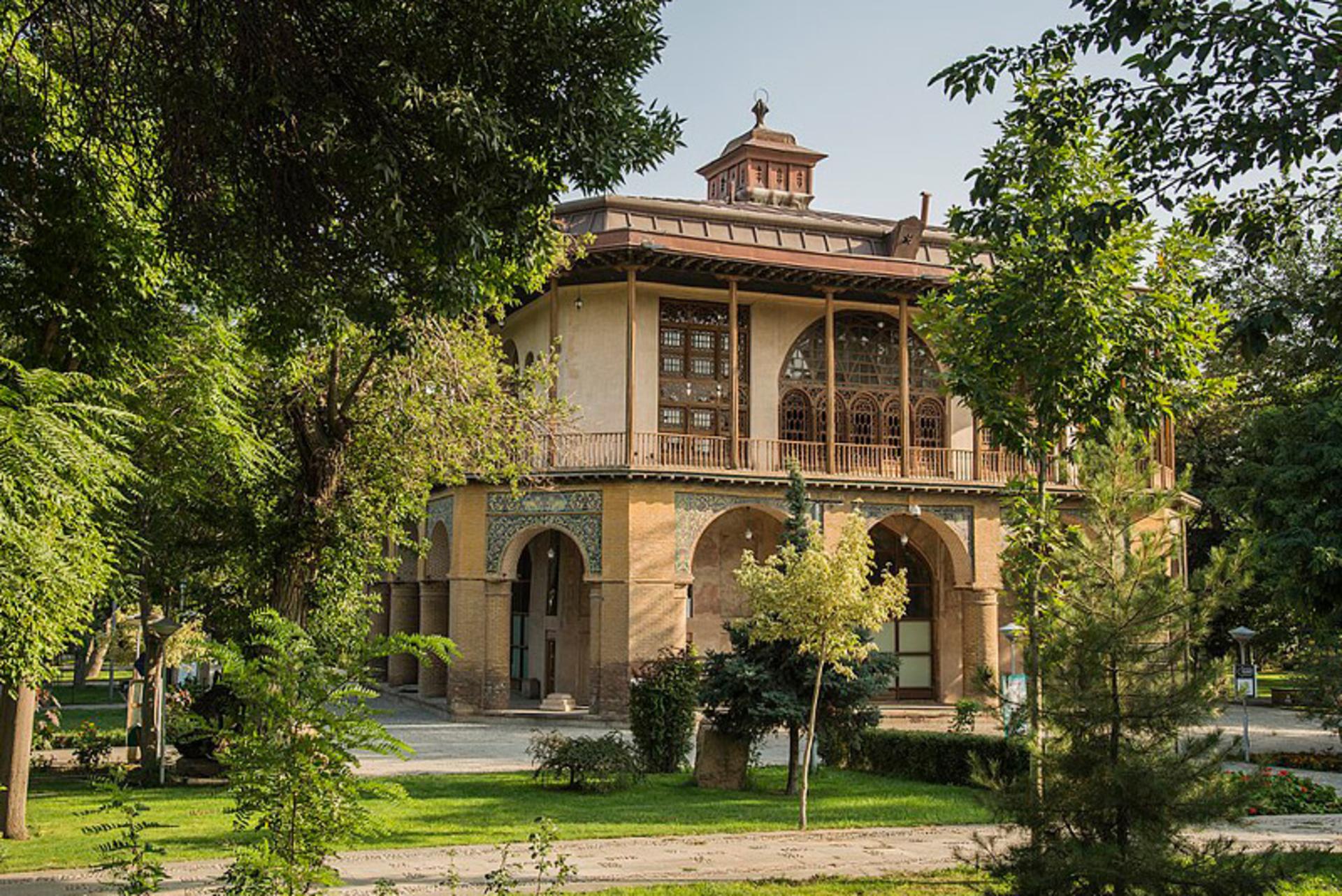
The Chehel Sotoun palace museum, also known as the Kolah Farangi of Shah Tahmasp, stands on Sabze Meydan, the square now called Freedom Square. It is said to be the only surviving pavilion of the palace ensemble laid out after the court moved from Tabriz in 951 AH, when the square was planted as a char bagh garden with a pavilion, hall, iwans and pools. The plan is attributed to a Turkish architect who worked from a small chessboard model, and the fine wooden windows are the giveaway. The Qajar governor Mohammad Baqer Saad al-Saltaneh restored it and gave it the Chehel Sotoun name, and Safavid paintings survive inside. Listed in 1955.
Two grand Qajar houses complete the picture. Aminiha House and Hussainiya was built in 1275 AH by the merchant Haj Mohammad Reza Amini and is laid out as three parallel halls between a north and a south courtyard. Its orsi windows with coloured glass were lifted out during rowzeh recitations so the halls could merge into one space, and inside are a forty-lamp chandelier, single-piece antique carpets, painted and mirrored ceilings, stucco and wooden girih work, with a serdabe, basement and sharbatkhaneh below. The Sepahdar Mansion, at the end of West Falastin Street, was built around 1323 to 1327 AH for Mohammad Vali Khan Sepahsalar Tonekaboni, drawing on the Kolah Farangi and the city's large guesthouse. It has two floors and a central hall with a rectangular room above, and it was used by Russian and British forces during the First World War before being seized for a tax debt.
Water, worship and two churches
The Sardar Bozorg Ab Anbar, built in 1812 in the Rah-e Rey quarter by two noble brothers who served under Fath-Ali Shah, Mohammad Shah and Naser al-Din Shah, is the largest single-domed water reservoir in Iran and arguably the world. Its tall brick dome carries light-catchers, the volume exceeds 3,000 cubic metres, stone benches sit at the door, and fifty stone steps of about 25 centimetres each drop to the arched Rah-e Shir channel. Listed in 1976.
The Jameh Mosque of Qazvin, the Atiq or Great Mosque, is among the largest in Iran and is said to be the oldest congregational mosque built in the country. It was first raised on a Sassanid fire temple, whose place stood at the south iwan, in a four-iwan plan, and was ordered in 192 AH under Harun al-Rashid. Mongol damage was repaired quickly, the oldest fabric dates to the second Islamic century, the Safavid period restored the iwans, the east iwan is Qajar, and the Khamartash maqsura was added in 500 AH by the Seljuq vizier Khamarutash ibn Abdullah. The west minaret was restored in 2013, and a museum of stone and pottery works sits in the west shabestan. Listed in 1931.
The Qajar Bathhouse, built in 1057 AH by Amir Gone Khan Qajar, a commander of Shah Abbas, as the Hammam Shahi, covers about 1,045 square metres with the usual sarbineh, miandar and garmkhaneh and separate men's and women's sections; spiral steps from the south door rise to a large octagonal sarbineh with a central pool and six shahneshin. Cultural Heritage bought it in 2000 and it now works as an anthropology museum of tribes, customs and occupations. Listed in 2005.
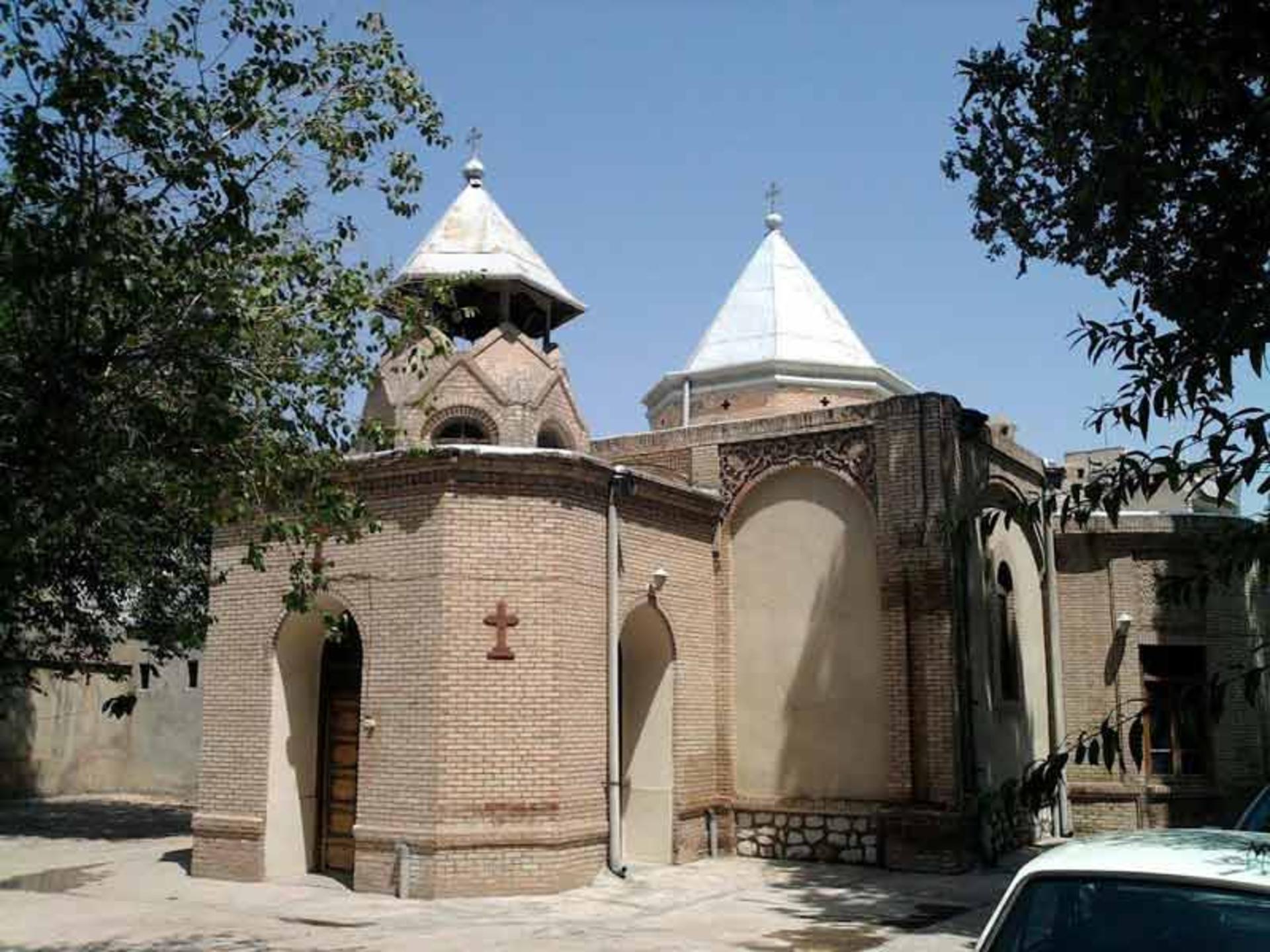
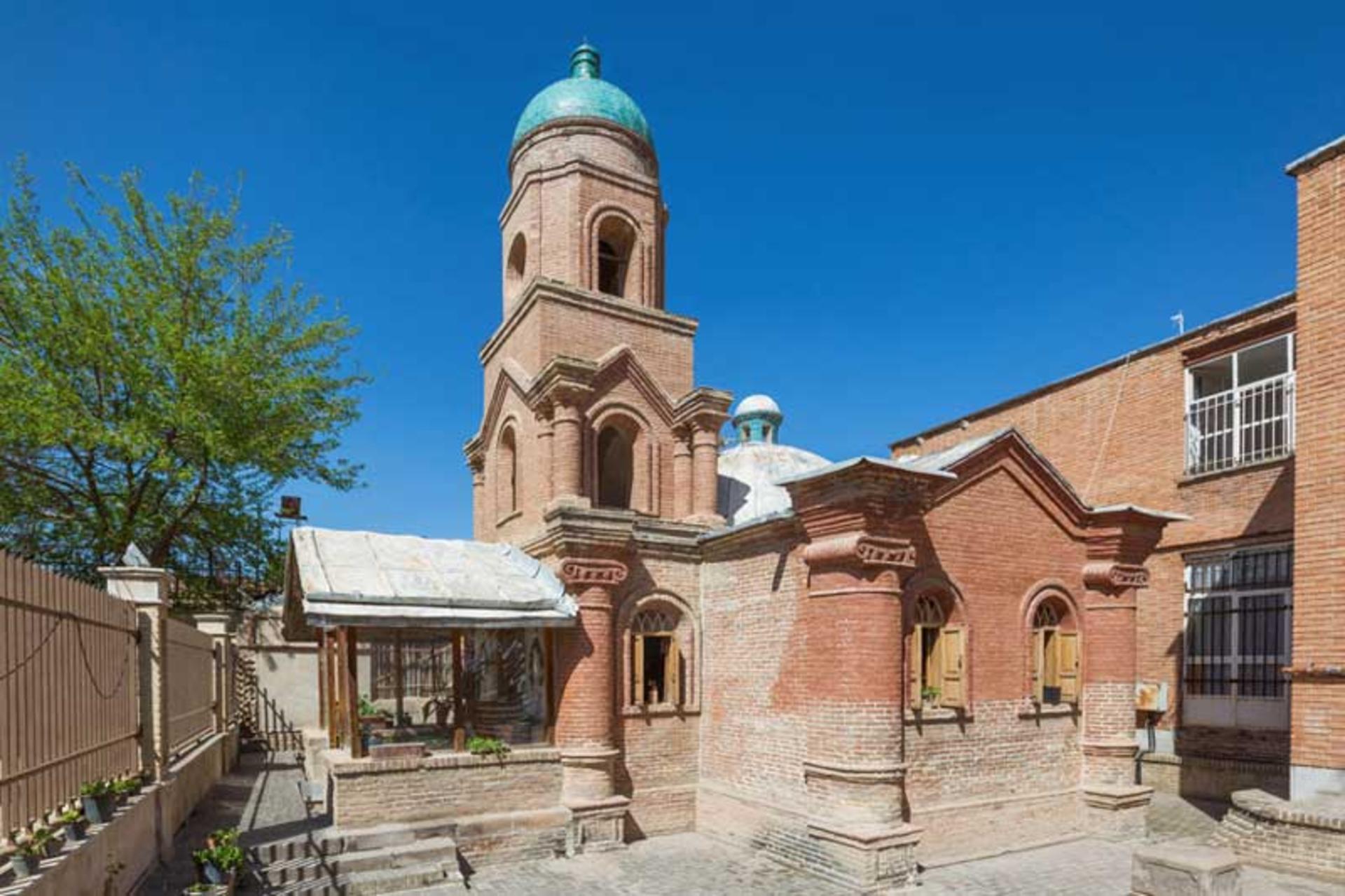
Qazvin also holds two Christian churches, unusual on the Iranian plateau. The Rafi Church on Talaghani Street stands in the yard of the Armenian school of the same name; it was built in the Pahlavi I period in brick on a cruciform plan, with a rectangular nave on four columns, an apse to the east reached by steps, and an octagonal space beneath the bell. Its Assumption rite of the Virgin Mary falls with the Grape Festival in August and draws Armenian associations from across the country. The Kantor Church is the smallest Orthodox church in Iran and has been described as the third smallest in the world. "Kantor" is Russian for a seat or centre, and the building goes back to the years of the Russian occupation during the Second World War, which is also why two Russian graves, a pilot and an engineer, lie in its yard. It is also called the Bell Tower, it is attributed to a builder known as Ostad Hossein, later Hossein Kantor, and its cross under the dome is set at a slant.
Baghestan, the garden belt
Below the city, on land that slopes out of the Alborz foothills, the traditional Baghestan gardens cover more than 2,500 hectares across the southern half of Qazvin. They are over a thousand years old and depend on flood irrigation rather than canals, which is why they were praised by Nasir Khusraw as gardens without wall or thorn. Driving the garden road in fruit season gives you the best view of the city's other face: not stone and brick, but orchard, spring and slow water.
When is the best time to visit Qazvin?
April to June and September to November are the comfortable windows, with dry, clear days and the gardens in leaf. Summer is hot and flat, and the walks between the bazaar, the mosque and the museums are long enough to feel it. Winter brings cold nights and occasional snow, but also the emptiest museum rooms of the year.
Where to stay, and how to order the day
Stay in the centre rather than on the ring road, since the best part of Qazvin is the evening walk from the bazaar to Masjid-e Nabi while the shops are still open. Rooms range from business hotels serving the transit traffic to restored Qajar houses; booking through Mehyar Hotels shows what is genuinely available, and weekend coaches from Tehran fill the smaller properties. For a longer stay, the provincial road north toward Rasht has resort stops, and the garden belt south of town has rural houses.
Money is worth planning for. Cards issued abroad do not work, and several of the smaller museums and shops take cash only, so load a Mehyar Wallet before you leave the motorway and let Mehyar Taxi cover the hops between sites.
Around Qazvin
From here the northern provinces are within a half day, and the western road continues toward Tabriz and the Azerbaijan circuit. Our guide to Mazandaran covers what you reach by driving north from the city, and for the wider calendar see Best Time to Visit Iran; for cards, cash and prayer times, Paying in Iran and our Tehran guide are the two pieces to read before you set out.