
Perched on a razor-back ridge at two thousand metres above the Alamut Valley, the ruins of Alamut Castle still command the landscape the way they did a thousand years ago. This was the headquarters of Hassan Sabbah, the enigmatic leader of the Nizari Ismailis who turned this mountaintop into one of the most formidable strongholds of the medieval Islamic world. What the Mongols could not fully erase and what centuries of treasure hunters failed to plunder, the Alborz Mountains have preserved as one of Iran's most atmospheric historical sites. In 2026, UNESCO inscribed Alamut Castle and six related fortifications across the valley on the World Heritage List, making it Iran's thirtieth World Heritage Site and confirming what hikers and historians have long known: this is a place unlike any other.

Where is Alamut Castle?
Alamut Castle sits in the Alamut region of Qazvin Province, in the Alborz mountain range of northwest Iran. The fortress rises above the small village of Gazorkhan, northeast of the town of Moallem Kalayeh, at approximately 2,163 metres above sea level. The surrounding valley is a narrow ribbon of green carved by the Andaj River, flanked by rugged peaks that have protected this area since long before the castle existed.
The castle is not in Tehran, despite the common misconception. It is roughly 240 kilometres northwest of Tehran, or about 105 kilometres north of Qazvin city. The final stretch from Moallem Kalayeh to the castle base is a winding mountain road through forest and alpine meadow that takes at least an hour and a half on good days, and considerably longer when the road is slick with spring snowmelt.
The story behind the fortress
The castle's origins go back to the ninth century, when a Deylamite king is said to have spotted an eagle perched on the summit of this remote hill. Taking it as an auspicious sign, he ordered a fortress built on the site and named it Alamut, which local tradition translates as "Eagle's Nest" or "Eagle's Teaching." The name stuck, and the castle has carried it for more than eleven centuries.
The fortress entered the grand narrative of Islamic history in 1090 CE, when Hassan Sabbah, a brilliant theologian and strategist born in Qom, seized the castle. Hassan Sabbah had been expelled from the court of the Seljuk Sultan Malik-Shah and travelled to Egypt to study the Ismaili faith. On his return to Iran, he searched the country for a base from which to lead the Nizari Ismaili community, a branch of Shia Islam that faced persecution under the Seljuk Empire. He chose Alamut.
Hassan Sabbah is said to have taken the castle without bloodshed, paying its previous ruler three thousand gold dinars. From this mountaintop, he directed Ismaili affairs for thirty-five years, organising a network of fortresses across the Alamut Valley and beyond. His followers became known in European chronicles as the "Assassins," a name derived from hashshashin, though the historical reality was more nuanced: Hassan Sabbah built a sophisticated state that resisted the Seljuk Empire through a combination of military strategy, intelligence gathering, and targeted political actions.
One of the most famous episodes took place in 1092, when a follower disguised as a dervish killed the powerful Seljuk vizier Nizam al-Mulk on the road from Isfahan to Baghdad. The story shocked the medieval world and cemented Alamut's reputation as a place of fear and mystery.
What the Mongols found and what they left
The castle's golden age as an Ismaili stronghold ended in 1256 CE, when Hulagu Khan, grandson of Genghis Khan, laid siege to Alamut with a massive Mongol army. The fortress fell, and the Mongols set fire to its celebrated library, which historical sources claim held as many as four hundred thousand volumes. The destruction was thorough. What remained was converted into a place of exile rather than a military base.
During the Safavid era, the castle served as a government prison. In the Qajar period, it was further damaged, and its bricks were carted away for use in other construction. Treasure hunters also dug through the ruins in search of the legendary hoards said to be hidden within, causing additional destruction. By the time archaeologists began systematic excavation, only about thirty percent of the original twenty-thousand-square-metre complex remained.
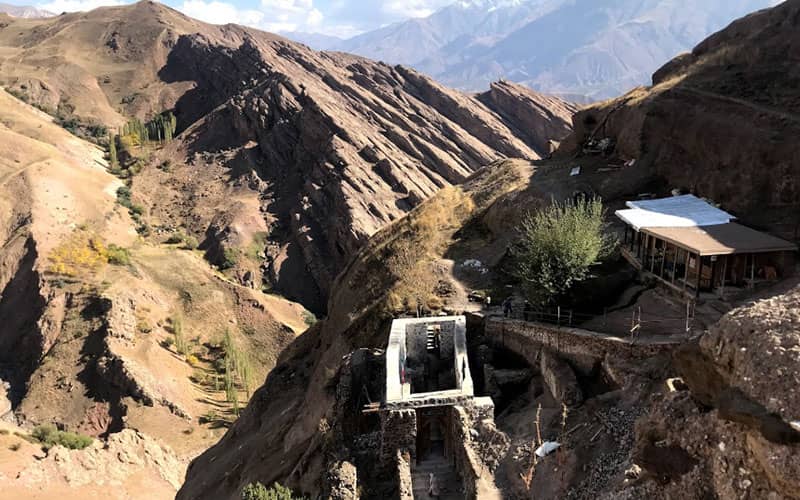
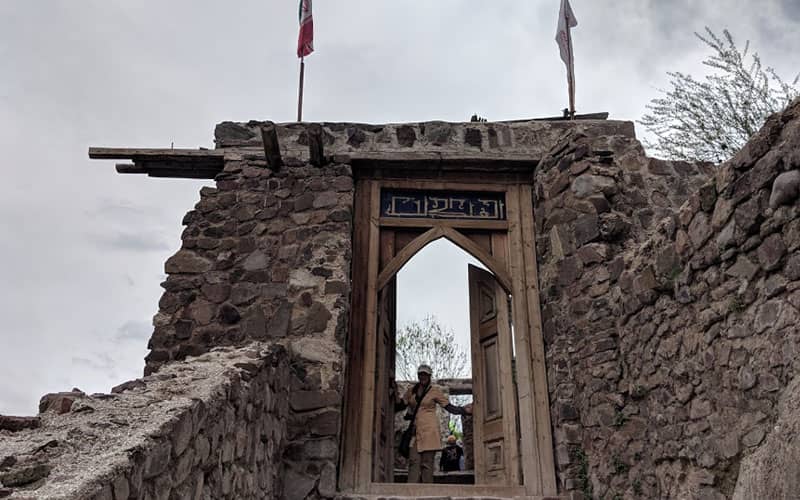
What survives today is still impressive. The castle stretches roughly one hundred and twenty metres in length, with walls varying from ten to thirty-five metres in width, following the contours of the rocky ridge. Three of the original four watchtowers still stand at the eastern, northern, and southern corners. The entrance, at the northeastern end, opens into a tunnel carved through the rock, six metres long and two metres wide and high. Beyond the tunnel, visitors can see the southern tower, the southwestern wall, and rooms cut into the living rock that likely served as guard posts.
Architecture and engineering
The castle was actually two fortresses, upper and lower, connected along the ridge. The walls were built to match the natural rock formations, using stone, brick, tile, wooden frames, ceramic pipes, and gypsum mortar. The Ismailis engineered a water system that remains one of the most ingenious features of the site. Cisterns carved into the rock collected rainwater, and an aqueduct brought water from a spring on the northern slope of the mountain into the castle. On the southern face, a moat two metres wide and fifty metres long was cut into the rock and filled with water draining from inside the fortress, creating an additional defensive barrier.
A hand-carved pool, eight by five metres, still fills with rainwater today. In the southwestern section, an ancient grapevine grows that local tradition attributes to Hassan Sabbah himself. Near the western end, an old cemetery called Asbeh Koleh Chal marks the boundary of the fortress, and on the adjacent hill, the remains of several brick kilns can still be seen.
The stone staircase that visitors climb today was added during the Qajar period. Before that, the only way to reach the castle was on mule back, along a path that followed the same steep contours.
The climb to the castle
Reaching Alamut Castle is part of the experience. From the parking area near Gazorkhan village, a trail of roughly four hundred stone steps leads up the mountainside to the fortress entrance. The climb takes between forty-five minutes and two hours, depending on fitness and how often you stop for photographs. The slope is steep in places, around thirty-five degrees, and the steps can be uneven, so proper hiking shoes are essential.
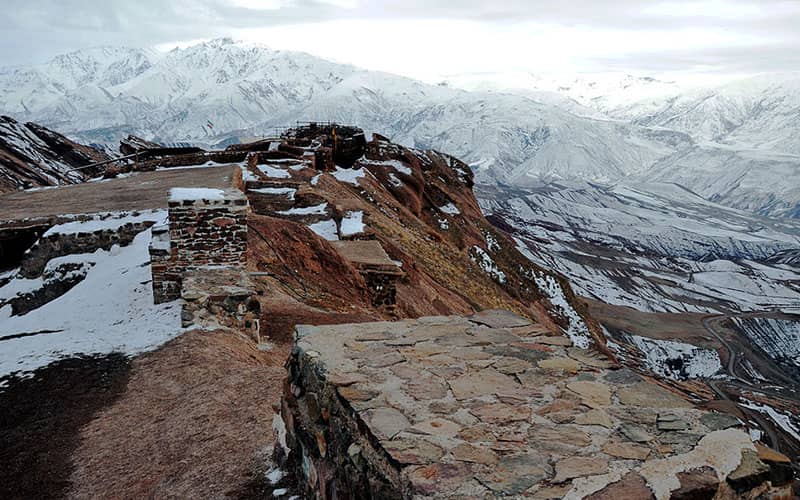
The effort is rewarded at every turn. In spring, the mountainside is green with wildflowers and the valley below is lush with orchards. In summer, the air is cool and clear, and the views from the top stretch across the entire Alamut Valley to the snow-capped peaks beyond. In autumn, the forests turn gold and russet. Winter is beautiful but the trail is often closed due to heavy snow, and reaching the summit requires mountaineering experience and equipment.
At the top, visitors rest on the flat rocks and terraces, take photographs of the panoramic views, and explore the ruins. Canvas roofs protect some sections, and informational signs introduce Hassan Sabbah and the history of the site. Entry to the inner chambers is restricted to preserve the fragile remains, but the views from the outer walls are the real reward. From the summit, you can see the vast Gazorkhan plain, the winding Alamut Valley, and the Andaj River threading through the landscape below.
How to get there from Tehran
The journey from Tehran to Alamut Castle is a full-day commitment, and most visitors treat it as a long day trip or an overnight excursion.
By car. Take the Karaj-Qazvin freeway northwest from Tehran. Before reaching Qazvin city, follow the signs for the Alamut road. From the freeway turnoff to Moallem Kalayeh is about 85 kilometres of mountain road, winding through forested valleys and past small villages. The drive takes roughly two and a half hours from Qazvin, or about four hours from Tehran in good conditions. Locals warn that the mountain road can stretch a one-and-a-half-hour journey to four hours in poor conditions, so allow plenty of time.
Ten kilometres past Moallem Kalayeh, a side road branches off to Ovan Lake, a popular swimming and camping spot. Continue another ten kilometres to the fork for Garmarud and Alamut. The Alamut road passes through forest and mountain terrain with many curves. From the road's end near Gazorkhan, the castle is visible on its ridge above.
By Mehyar Taxi. Open Mehyar and choose Taxi for the most flexible option. A private car from Qazvin or Tehran lets you stop at viewpoints along the mountain road, wait while you hike the castle, and continue to Ovan Lake or other sites in the valley on the same trip. The return journey from the castle in the evening can be difficult without a pre-arranged ride.
By shared taxi or local transport. From Qazvin, shared taxis and minibuses run to Moallem Kalayeh, the main town of the Alamut region. From there, you can hire a local taxi for the final stretch to Gazorkhan and the castle trailhead. Negotiate the fare and return pickup in advance, as mobile coverage in the valley can be unreliable.
By organised tour. Several tour operators run day trips from Tehran that include Alamut Castle, often combined with Ovan Lake and other Alamut Valley attractions. These tours handle transport and provide a local guide, which is useful for understanding the history of the site.

Where to stay in the Alamut region
Moallem Kalayeh is the most practical base for exploring the castle and the wider valley. The town sits between the castle and Ovan Lake, with gardens and orchards that make it a pleasant place to spend a night. Local families rent out small suites and rooms to visitors, and several eco-lodges operate in the surrounding villages, offering traditional meals alongside accommodation.
Gazorkhan, the village closest to the castle, also has rooms for rent if you want to be near the trailhead for an early morning hike. For a more comfortable hotel stay, the Novdezh Hotel in Garmarud Sina is the nearest proper hotel, about twenty kilometres from the castle.
If you prefer camping, the shores of Ovan Lake, nineteen kilometres from Moallem Kalayeh, offer swimming, boating, and campsites in a scenic setting.
When to visit
The Alamut region is mountainous and cold, with long winters and short, mild summers. The best time to visit is late spring and early summer, when the weather is moderate, the valleys are green, and the mountain road is clear. Late May through June is ideal.
Summer is also pleasant, with warm days and cool nights. Even in July and August, evenings at this altitude require a warm layer. Autumn brings spectacular colours to the forests but the days grow shorter and cooler. Winter, from December through March, closes the trail to the castle under heavy snow. The site is accessible only to experienced mountaineers with proper equipment during this season.