
Iran is a country of celebrated monuments and famous cities, but its most unforgettable places are often its smallest. Scattered across deserts, mountains, and forests are villages where people lived half underground, spoke a language no neighbor understood, produced a generation of twins, or never poured a cup of tea until a few decades ago. These are the strangest villages in Iran, and each one tells a story about geography, isolation, and human ingenuity that no museum can replicate. Here are ten of the most remarkable.
Makhunik: The Village of the Little People
Deep in the desert of South Khorasan, about 130 kilometers from Birjand near the Afghan border, lies Makhunik, a village so unusual that locals long called its residents "Lilliputs." For generations, many inhabitants grew to less than 140 centimeters tall, a phenomenon linked to genetics, chronic malnutrition, and generations of marriage within the village. The houses are as strange as the story: built half a meter to a full meter below ground level to trap coolness and escape the brutal desert sun, with low doorways that even a short adult must stoop to enter.
Until roughly fifty years ago, Makhunik practiced an ascetic lifestyle born of scarcity. Its people did not drink tea, did not smoke tobacco, and refused to eat meat or hunt animals. The village remains a living lesson in how far human adaptation can go, and walking its sunken lanes feels like stepping into another century.
Esta: A Village Frozen in Time
High in the Alborz mountains of the Taleqan region, about 95 kilometers from Karaj, the village of Esta seems to have simply stopped in time. There are no cars, no electricity lines, and no gas pipes; life here is still organized around stone houses, wood fires, and the slow rhythms of farming seasons. The village has another peculiarity that travelers must respect: by local custom, it is a male-only settlement, and women are traditionally not permitted to enter. Visitors describe an atmosphere of profound silence broken only by the wind, a rarity in the connected modern world and precisely the reason this place survives in the memory of everyone who reaches it.
Darkesh: The Oak Forest Village
About 30 kilometers southwest of Ashkhaneh in North Khorasan, Darkesh guards something almost nowhere else in eastern Iran can offer: the region's only genuine oak forest. The village sits inside a protected zone that is home to the endangered red deer, and botanists have counted around 380 species of medicinal plants here, 80 of them rare. The forest, the springs, and the traditional lifestyle of the local Turkmen and Kurdish communities make Darkesh as much an ecological destination as a cultural one.

Zargar: The Village That Speaks Romano
Fifty kilometers east of Qazvin and about 100 kilometers west of Tehran, the village of Zargar holds one of Iran's strangest linguistic treasures. Its people speak "Zargari," a dialect derived from Romani, the language of the Roma people who migrated westward from Persia centuries ago. The dialect evolved as a secret code, letting the community communicate beyond the understanding of surrounding villages. Linguists study it, and travelers who hear it realize how many hidden worlds exist inside one country.
Chaharborj: The Village of the Blind
The most heartbreaking entry on this list is Chaharborj, about 35 kilometers west of Esfarayen in North Khorasan. For generations, roughly ninety people in a village of one thousand were born blind or lost their sight early in life, the result of genetic conditions amplified by generations of intermarriage in an isolated community. Since 1391 on the Persian calendar, health authorities have intervened with genetic counseling and screening, and the tragic pattern is now under control. The village stands as a sober reminder of what isolation costs, and of how science can undo even long-held misfortunes.
Sarch: Life at the Edge of the Lut
Sixty kilometers east of Kerman, the village of Sarch lives in the shadow of one of the hottest places ever recorded on the planet: the Gandom Beryan plateau in the Lut Desert, less than 40 kilometers away. Despite this furnace at its doorstep, Sarch survives on hot springs, agriculture, and a remarkable natural monument, a cypress tree believed to be around two thousand years old. The contrast between the lethal desert and the stubborn green village is one of the most striking sights in southeastern Iran.
Shahrabad: The Village of Twins
On the plain near Abarkuh, in the Bahman district, the village of Shahrabad has earned a curious reputation: among its roughly 240 residents, about 40 are twins. The rate is extraordinary by any global standard, and doctors have debated the causes, from genetics to local water and diet. Families with twins are so common here that the village has become a small destination for researchers and curious travelers alike.

Meymand: Twelve Thousand Years of Cave Life
Thirty-eight kilometers from Shahr-e Babak in Kerman Province, Meymand is a village of hand-dug cave houses continuously inhabited for an estimated twelve thousand years, a claim so extraordinary that UNESCO inscribed it on the World Heritage list in July 2015. Unlike the famous troglodyte settlements built by carving downward into volcanic rock, Meymand's homes were carved directly into soft conglomerate stone on the hillside, each with chambers for living, sleeping, and storage. A handful of families still spend winters in the caves, and the small anthropological museum and rock carvings nearby hint at a way of life older than agriculture itself.
Ab Esk: Springs, Caves, and an Ancient Ritual
Eighty kilometers from Amol in Mazandaran, the village of Ab Esk climbs through the Alborz foothills with its caves, hot springs, and waterfalls. Beyond the scenery, it preserves two remarkable customs. On one day each year, traditionally called the day of the women's king, local women take charge of the village while men stay home and manage the household. The village also maintains the ancient "barf-chal" ritual, in which snow is packed into deep covered pits in early winter and dug out in summer as clean drinking water, a natural refrigerator carved into the mountain.
Abyaneh and the Stepped Villages
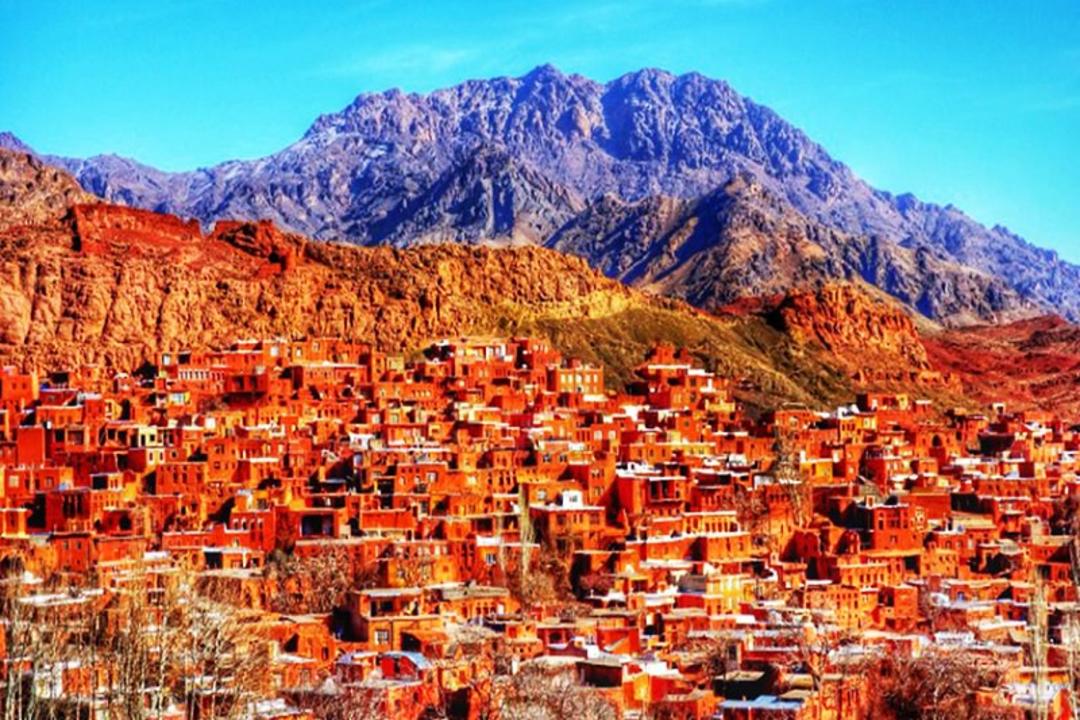
No list of unusual Iranian villages is complete without Abyaneh, about 40 kilometers from Natanz in Isfahan Province. On the slopes of Mount Karkas, the village's houses of red clay rise in terraces, each rooftop doubling as the courtyard of the home above. Registered as a national heritage site in 1975, Abyaneh preserves its own dialect, its distinctive costume, and the white floral scarves of its women. The same stepped logic appears elsewhere: in Hajij, 30 kilometers north of Paveh in Kermanshah, every house is built entirely of stone, even the roofs, with no brick at all, and in Sar Aqa Seyyed in Chaharmahal-Bakhtiari, where villagers in traditional dress climb stone stairways between tiers of homes above a river gorge.

Why These Villages Matter
Together these villages form a map of human resilience. Some, like Makhunik and Chaharborj, show the price of isolation. Others, like Meymand and Abyaneh, show how communities can hold a thread of continuity for thousands of years. All of them reward the traveler willing to leave the highway, and all of them are disappearing faster than anyone would like, as young people move to cities and old ways fade. Visiting responsibly, spending locally, and listening more than photographing is the best way to help ensure these places outlast us. Iran is full of famous sights, but its strangest villages are where the country keeps its most surprising secrets.
