Masuleh does not announce itself gradually. You park beside the road, walk past a small ticket point, and then the ground itself changes character. What looked from a distance like a yellow-brown hillside resolves into houses, and the flat surfaces between those houses turn out to be rooftops. You are standing on someone's ceiling, and a woman is hanging laundry two levels up, and a boy is carrying bread along a path that is also the roof of the shop where you will later drink tea.
This is the strangest and most beautiful thing about Masuleh, and no photograph fully prepares you for it. In this village in Gilan province, northern Iran, the roof of one house is the courtyard, the alley, and the front yard of the house above. There are no cars inside the historic core because no car could physically enter it. There are staircases instead, and ramps built for wheelbarrows, and the whole settlement climbs a slope so steep that buildings had to be stacked rather than spread.
This guide covers where Masuleh is, how to reach it from Rasht and Tehran, when to come for mist or for green, what to see on foot, what to eat, and how to decide between a day trip and an overnight stay. It is written for travelers who want to understand the place, not just photograph it.

Where is Masuleh?
Masuleh sits in the county of Fooman, in Gilan province, in the forested mountains of northern Iran. It lies roughly 60 kilometers southwest of Rasht, the provincial capital, and about 32 to 35 kilometers from the town of Fooman itself. The road distance from Tehran is around 370 to 380 kilometers, which translates into a long but entirely doable drive of five to six hours in normal conditions.
The village occupies a pocket of the Alborz range at around 1,050 meters above sea level. It faces east over a green valley, while mountains rise behind it to the north, south, and west. Because it is built on terraces, there is roughly 100 to 120 meters of vertical difference between the lowest and highest points of the settlement. What looks like a short walk on a map becomes a climb in practice.
Administratively and culturally, Masuleh belongs to Gilan, but its character is not purely Caspian. The local language is Talysh, and the architecture, the dry-stone base, and the wooden detailing set it apart from the lowland villages of the plain. The village borders, or comes very close to, the provinces of Zanjan and Ardabil: the boundary with Zanjan is only about two kilometers away, and the Ardabil side begins around ten kilometers off.
For orientation purposes, treat Masuleh as a mountain village reached from the Gilan plain, not as a Caspian seaside destination. The sea is in the same province, but it is not visible from the village.
How to get to Masuleh
There is no airport and no railway station in Masuleh. Every route ends with a road climb from Fooman or from the Khalkhal side, and the last stretch is the part that matters most.
From Rasht
Rasht is the natural base for a Masuleh trip. The distance is about 60 kilometers, and with the road in good condition the drive takes roughly one hour to ninety minutes depending on traffic leaving the city.
If you are driving yourself, take the Rasht to Fooman road and continue through Fooman toward the Masuleh road. The route passes rice fields and tea gardens before the terrain folds upward into forest. Signage is adequate but not dense, so it is worth keeping a map application open.
If you do not have a car, open Mehyar, choose Taxi, and set Masuleh as your destination. A private or shared ride from Rasht is the simplest door-to-door option, and it removes the need to negotiate with drivers at a terminal in a language you may not speak. For travelers who prefer to move by stages, the classic pattern is a shared taxi or minibus from Rasht to Fooman, then a second shared taxi or minibus from Fooman up to Masuleh. The Fooman to Masuleh leg is the one where patience is required, because vehicles fill up and departure times are informal.
From Tehran
Most international visitors begin in Tehran. The overland route runs from Tehran west and north via Qazvin and then toward Rasht, after which you follow the Fooman road. Allow five to six hours of driving in good conditions, and more on weekends or during holiday periods when the whole of Tehran seems to be heading for the Caspian.
Three practical approaches exist:
- Private car or hired driver: the fastest and most comfortable, and the only option that lets you stop at viewpoints along the way.
- Bus to Rasht, then onward: intercity buses to Rasht leave from the main Tehran terminals, and the journey takes roughly five to six hours. From Rasht, continue to Masuleh by Mehyar Taxi or by the shared-taxi chain through Fooman. When you book your onward bus or your return, Mehyar Buses lets you compare departures without standing in a queue at a terminal.
- Train to Rasht, then road: there is a rail connection between Tehran and Rasht, but departures are limited and the station is outside the center, so you still need road transport for the final leg. Check Mehyar for current options before committing.
From Ardabil and Khalkhal
A second, more scenic road approaches Masuleh from the northwest through Khalkhal and the village of Majalan. Parts of this route have historically been rougher and occasionally unpaved, and in winter it can close after heavy snow. It is a beautiful approach in summer, but if you are traveling between October and April, the Fooman road is the reliable choice.
The last mile, and the parking reality
Cars cannot enter the historic core of Masuleh. You will park in the designated area near the entrance, pay the small entry fee for the protected village zone, and continue on foot. This is not a minor detail: it shapes your packing. Anything you bring must be carried up staircases, sometimes for ten or fifteen minutes, sometimes more depending on where your accommodation sits.
Two consequences follow. First, pack light and use a backpack rather than a wheeled suitcase. Second, if you are arriving late or in rain, arrange your accommodation in advance through Mehyar Hotels and confirm whether someone can meet you at the entrance to help with bags. Some guesthouses do this, and it transforms the arrival experience.
A short history of Masuleh
The settlement you walk through today is not the original Masuleh. The older site, known as Kohneh Masuleh, or Old Masuleh, lies a few kilometers to the northwest and is now an archaeological area with little standing above ground. Excavations there revealed iron smelting furnaces and pottery that point to a working metal industry between roughly the fifth and eighth centuries of the Islamic calendar, with material culture reaching into the Seljuk period.
The move to the present site is usually explained by a combination of disasters, a major earthquake and a plague epidemic being the two most cited. What is clear is that by the fourteenth century the community had re-established itself on the slope where it stands now, and that it grew around two things: water and trade.
Masuleh sat on a route linking the Caspian lowlands with the interior, and caravans moving between Gilan and the Azerbaijan region passed through. The bazaar became a small commercial hub, with workshops producing metal goods and leather, and caravanserais serving travelers. When newer roads bypassed the village in the twentieth century, that commercial role faded, and Masuleh's population fell as families moved to larger cities.
What remained was the architecture, and eventually that architecture became the reason people came back. Masuleh was registered as a national heritage site in 1975, recognized as a living historic town rather than a museum piece. A UNESCO nomination has been under discussion for years. Today the village economy rests almost entirely on visitors, which is worth remembering when you decide where to spend your money.
What to see in Masuleh
The architecture itself
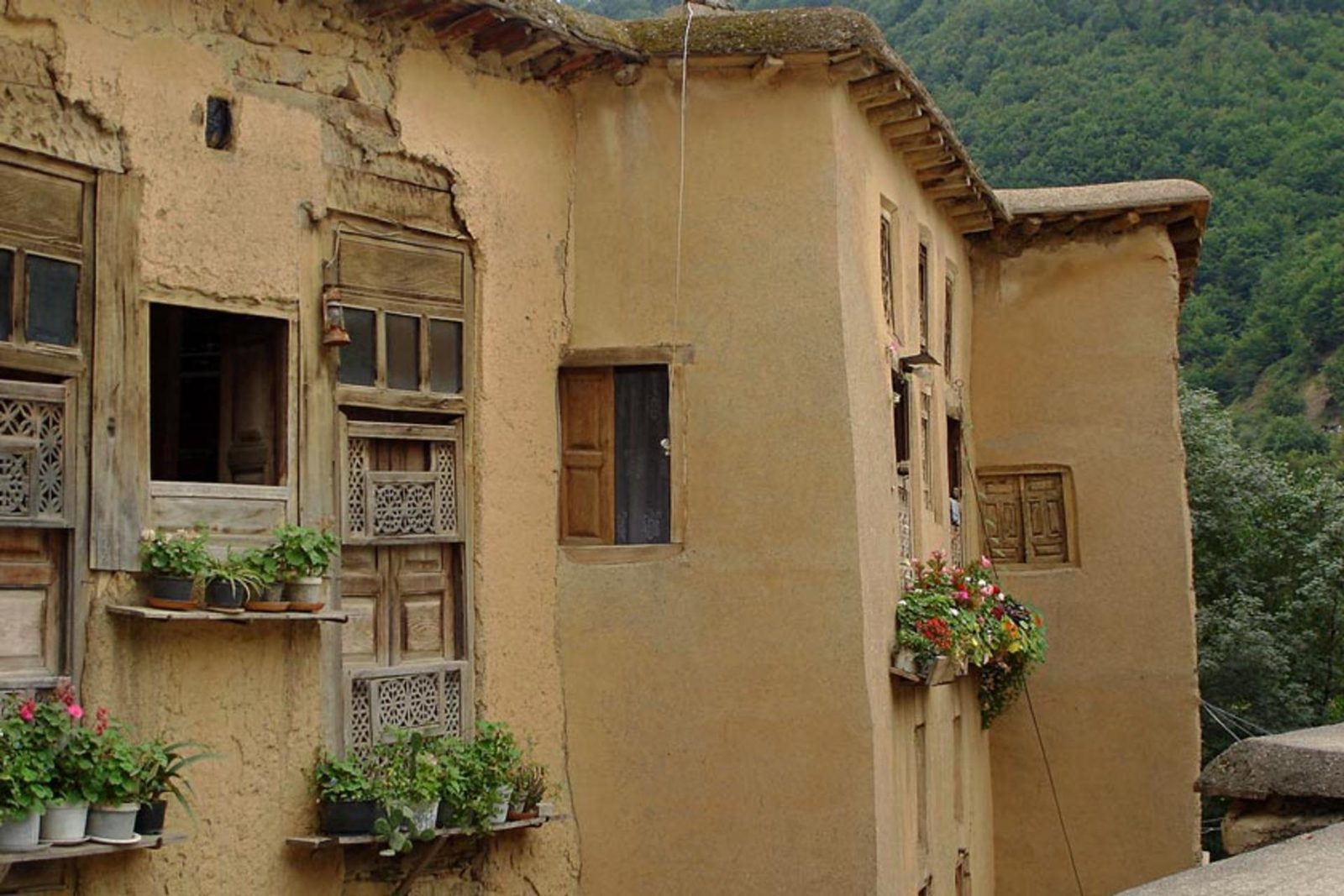
There is no single monument in Masuleh that justifies the journey. The village is the monument. Houses are built of wood, stone, and adobe, with natural rock forming foundations and a thick retaining wall at the back of each structure. The slope is close to 60 degrees in places, and this is why the terraced system developed: instead of carving flat plots, builders let each roof serve the level above as a yard and a path.
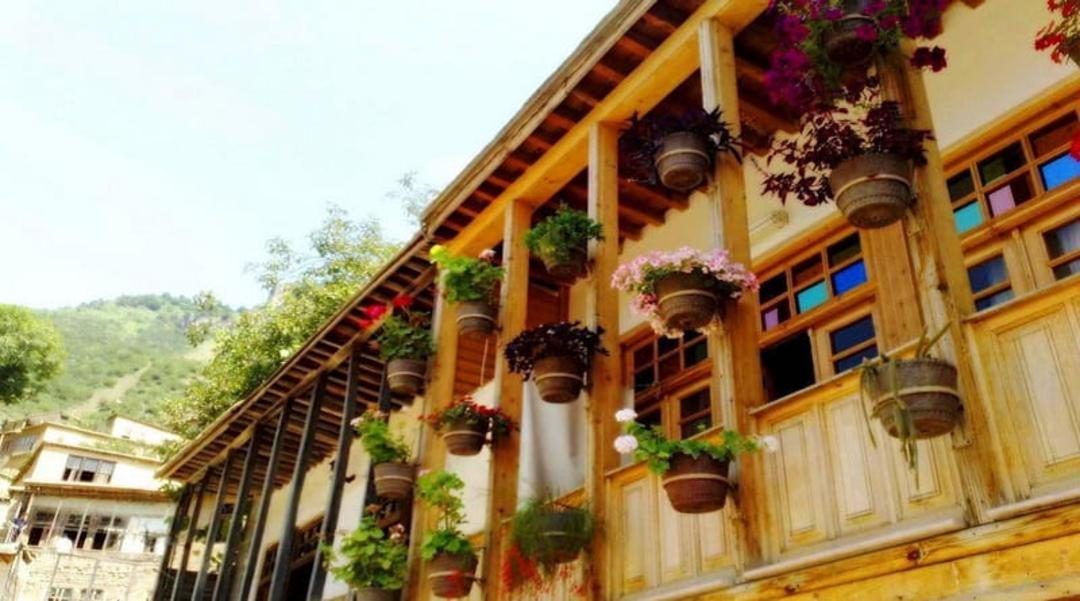
Look for the wooden lattice windows on the south-facing facades, where the craft of gereh-chini turns a plain opening into a screen of interlocking geometry. Look also at the doors, which are often split into two leaves, and at the way the summer and winter quarters of a house are arranged. The small, dark rear room known locally as the soumeh was the winter living space, heated by a central hearth, while the brighter front rooms served the warm months.
Walk slowly and look at how daily life organizes itself around this structure. A doorway opens directly onto a public path. A roof becomes a place where children play. Privacy is maintained not by walls but by levels, angles, and long-established courtesy.
The bazaar
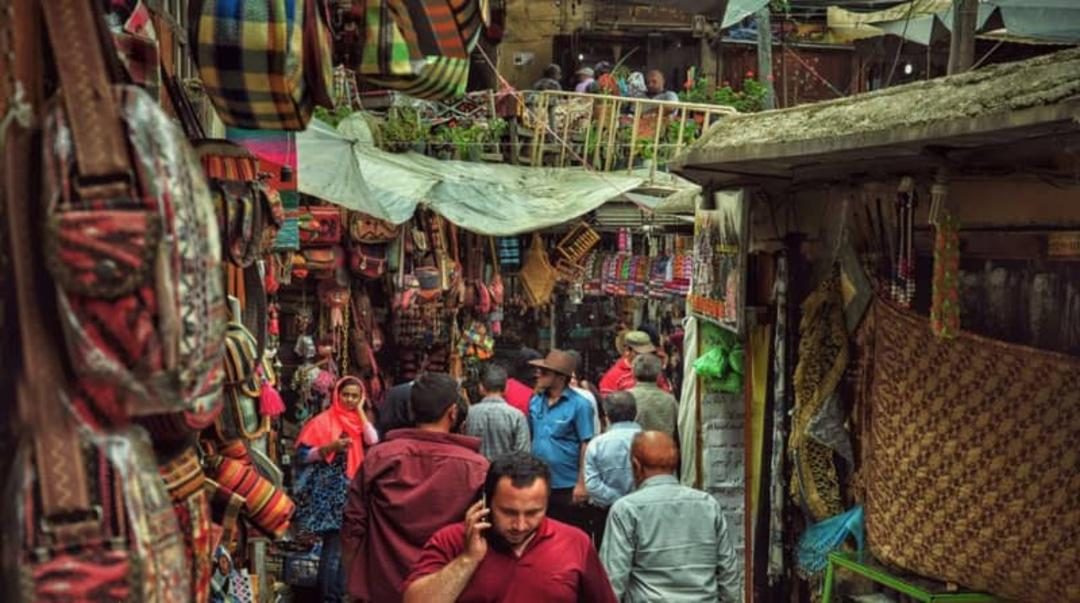
The bazaar is the spine of the village, arranged in tiers along the slope. It is small compared with the covered bazaars of Isfahan or Tabriz, but it is dense with activity: handicrafts, honey, pickles, dried herbs, copper and brassware, knitted dolls, woven bags, and a surprising number of small kitchens.
This is also where you will find the local bookshop, a tiny place packed with old and rare volumes, and where the smell of kebab, cooked broad beans, and herb soup drifts across the path in the late afternoon. Some shops rent local Gilani clothing for photographs, which is a lighthearted way to spend twenty minutes.
Imamzadeh Awn ibn Ali
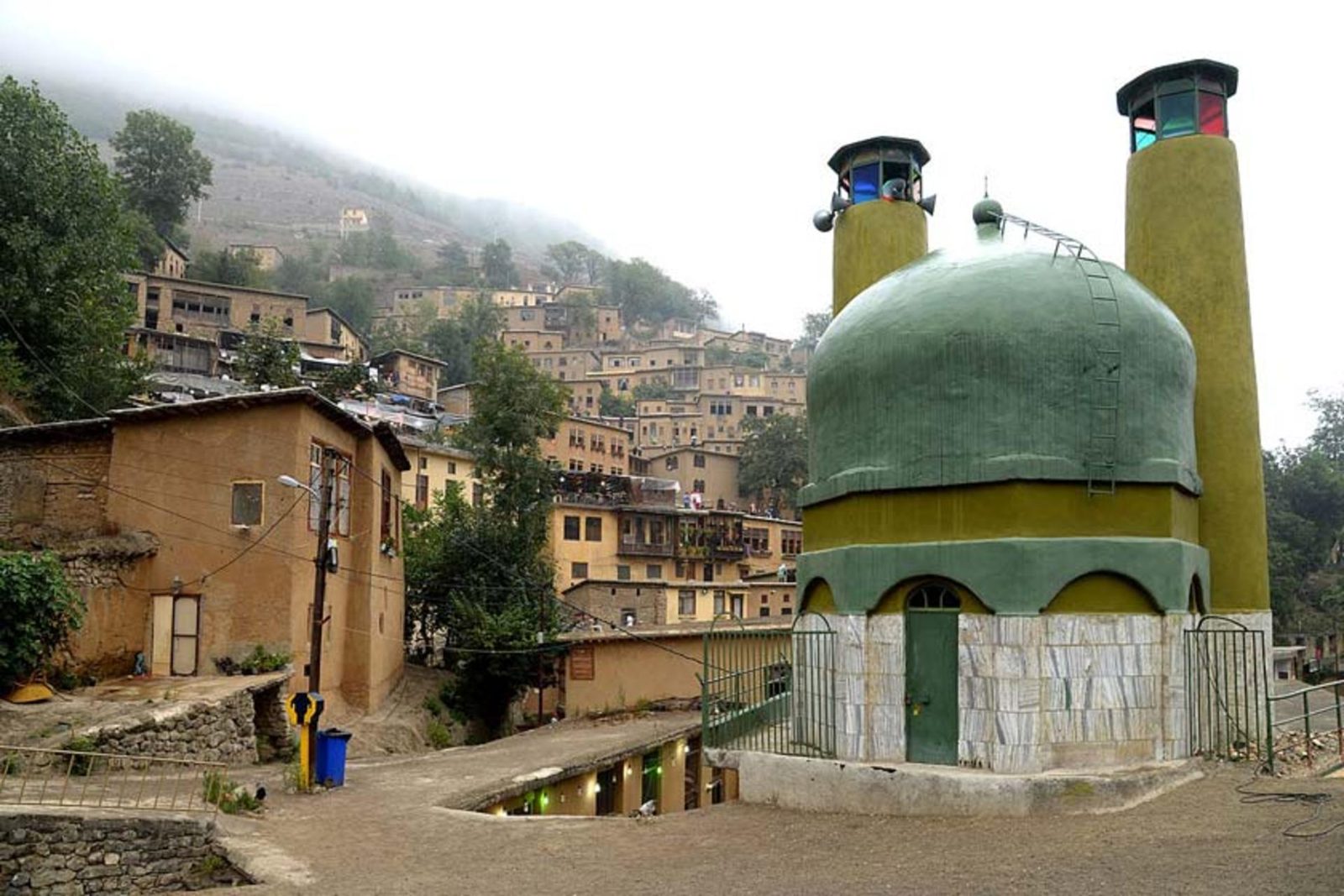
The shrine of Awn ibn Ali sits at the center of the village and serves as its spiritual anchor. The building has a green dome and two substantial minarets, and the surrounding courtyard is a calm place to sit, particularly in the middle of the day when the paths are crowded. The shrine is associated with a descendant of Imam Ali and has been a pilgrimage point for surrounding villages for centuries. A small museum beside it holds old gravestones, manuscripts, and objects from the Timurid and Safavid periods.
The small museums
Masuleh has several modest museums rather than one large institution. The wildlife museum near the bazaar displays taxidermy of the animals native to these forests. The cultural heritage museum, housed in a historic building in the Kaseh Sar neighborhood, gathers Qajar-era objects and military items. None of these will occupy more than twenty minutes, but together they add context to what you are walking through. An hour total is a reasonable allocation.
Waterfalls and the river
Masuleh Rudkhan, the river that gives the village its water, runs through the valley below and along the road. Several waterfalls are within walking distance, and the most rewarding is Kousham, roughly a one-hour walk along the stream through forest. The route is not technically difficult, but it is uneven and often damp, so footwear matters. Tirishoum and Khorambo are further out and better suited to travelers with a full day and a taste for longer hikes.
Viewpoints and the upper village
The higher you climb, the better the view and the quieter the paths. The upper terraces give you the classic composition: stacked roofs cascading down toward the valley, with forest pressing in on both sides. Late afternoon light is the most flattering, and early morning, before the day visitors arrive, is the most peaceful.
Above the village, the terrain opens into summer pastures. Local names such as Lalandiz and Zoodel Sar refer to high meadows used seasonally by herders, and they are reachable on foot in a couple of hours by travelers who are comfortable with elevation gain.
When to visit Masuleh
Masuleh has four genuinely distinct seasons, and the one you choose changes the trip more than any other decision.
Spring, from April through May, brings green slopes, wildflowers, and frequent mist. The fog is part of the village's identity, and photographers actively hope for it, but it also means wet paths and limited views on some days. Expect cool mornings and mild afternoons.
Summer, from June through August, is the driest and warmest period, with daytime temperatures often reaching the high twenties and low thirties Celsius. This is also the busiest season, especially on weekends and public holidays, when domestic visitors arrive in large numbers. If you come in summer, aim for a weekday and book accommodation through Mehyar Hotels well in advance.
Autumn, from late September through November, is arguably the most beautiful period, with golden foliage and softer light, but it is also the wettest. October and November bring the heaviest rainfall of the year. Mud is a genuine factor, and waterproof shoes are not optional.
Winter, from December through February, transforms the village into a quiet, snow-covered scene. Many businesses reduce their hours, some guesthouses close, and the roads can be icy. If you come in winter, check conditions before departure and carry warm layers, a waterproof outer shell, and footwear with real grip. The reward is Masuleh without crowds.
One caution that applies in every season: mountain weather changes quickly. A clear morning can turn into fog and rain by early afternoon. Carry a light rain jacket even in July.
Where to eat and what to try
The food in Masuleh is Gilani food, which means herbs, walnuts, pomegranate, smoked fish, and rice. Look for baghala ghatogh, a stew of broad beans, dill, and egg; torsh-e tareh, a sour herb soup; mirza ghasemi; and freshly grilled trout from local rivers. Kebab is everywhere and usually good. Breakfast in a guesthouse often includes local bread, honey, walnut preserves, and strong tea.
Tea houses and small restaurants are distributed along the bazaar terraces. The pleasure here is not fine dining. It is sitting on a covered platform with a glass of tea and a view down over the rooftops while mist moves through the valley. Most places are cash-oriented, so keep some rials on hand.
This is where Mehyar Wallet is genuinely useful. Top up before you leave Rasht or Tehran and you can pay for meals, small purchases, and taxis without hunting for an ATM in a village that does not have many. Where card terminals exist, they can be unreliable in bad weather.
Day trip or overnight?
Masuleh can be visited in a day from Rasht, and many people do exactly that. You arrive mid-morning, walk the bazaar, see the shrine, eat lunch, and leave by late afternoon. It works, but it is a rushed way to experience a place whose main attraction is atmosphere.
Staying one night changes the texture of the visit. Day visitors leave, the bazaar quiets, and the village returns to its residents. Evening light on the terraces, the sound of the river below, and morning mist before the first buses arrive are the memories most travelers keep. If your schedule allows, one night is the right minimum, and two nights let you add a waterfall hike or a high pasture walk.
Accommodation ranges from simple guesthouse rooms to small hotels and apartments, and quality varies considerably. Use Mehyar Hotels to compare options, check recent reviews, and confirm the walking distance from the parking area. In peak season, book early.
Nearby and combining your trip
Masuleh works well as part of a wider Gilan itinerary.
Rudkhan Castle is about 45 kilometers away, roughly an hour and fifteen minutes by road, and makes a natural pairing. The fortress sits in dense forest and requires a climb of well over a thousand steps, so it is best done on a separate day or as a morning excursion before an afternoon arrival in Masuleh.
Rasht deserves at least a day on its own for its bazaar, its food culture, and its museums. If you are building an itinerary, see our guide to Rasht for what to do with twenty-four hours in the city.
Fooman is the practical service town for the area, with banks, pharmacies, and more reliable shopping than the village.
High pastures and hiking such as Lalandiz and the slopes toward Shah Moallem peak suit travelers who want a full day on foot. These routes are not waymarked consistently, so ask locally or hire a guide.
If Masuleh is part of your first visit to the country, our first trip to Iran guide covers the logistics that apply across the whole journey, and best time to visit Iran helps you place a northern mountain stop in the right month. Travelers starting from the capital should also read our Tehran guide for transport terminals and orientation.
Practical notes
Money. Bring cash. ATMs are scarce, and connectivity can drop in bad weather. Load Mehyar Wallet before you arrive.
Connectivity. Mobile coverage exists but is inconsistent in the narrow lanes. A Mehyar SIM arranged on arrival in Iran removes a layer of stress, particularly if you are relying on maps for the drive.
Footwear. This is the single most important packing decision. The paths are stone, often wet, frequently stepped, and sometimes steep. Shoes with grip and ankle support are far better than fashion sneakers.
Luggage. Backpacks only. You will carry everything up stairs.
Accessibility. Masuleh is difficult for travelers with limited mobility. The village is a continuous staircase, and there is no vehicle access to the core. Travelers with heart or respiratory conditions should also pace themselves, given the altitude and the climbing.
Respect. People live here year-round. Keep voices low in the early morning and late evening, ask before photographing individuals, and dress modestly at the shrine.
Prices and hours. Small businesses in the village adjust their hours with the season and the weather. Treat any specific opening time as a guide rather than a guarantee, and confirm locally.
Start your Masuleh trip with Mehyar
Masuleh rewards preparation more than most places in Iran, because the logistics are unusual: no cars inside, limited accommodation, weather that shifts quickly, and a last stretch that has to be walked. Handled well, it is one of the most memorable stops in the country.
Open Mehyar to book a hotel in Rasht or a guesthouse in the village, arrange a Mehyar Taxi from Rasht or Fooman, compare Mehyar Buses if you are coming from Tehran, and top up your Wallet before you lose signal in the mountains. Plan the rest of your northern route with our Rasht guide, and if you are still deciding when to travel, start with best time to visit Iran.