
High in the Alborz Mountains of Mazandaran, near the border with Semnan Province, there is a geological phenomenon that exists in only a handful of places on Earth. Badab-e Surt is a group of natural mineral springs whose waters have been flowing for thousands of years, building stepped terraces of travertine rock in a gradient of colours: yellow from sulfur, red from copper, black from iron, and white from salt and lime. The place looks like an abstract painting that the earth made for itself. This guide covers what Badab-e Surt is, how to reach it from Tehran or other cities, what to see when you arrive, and how Mehyar can handle the logistics.
What Is Badab-e Surt?
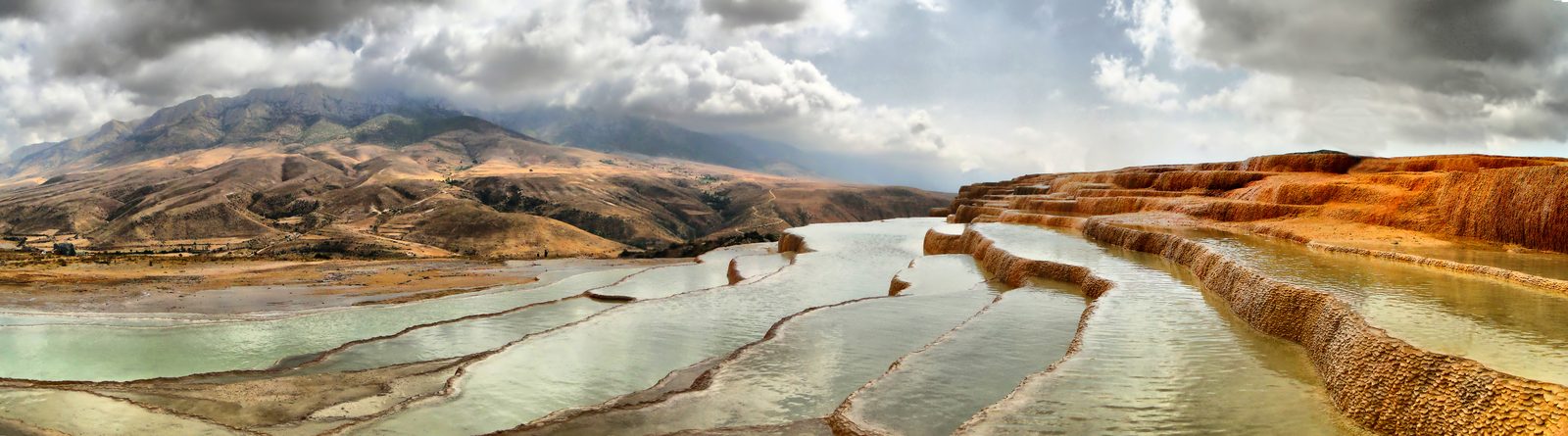
Badab-e Surt is a Persian name that translates roughly to "the waters of Badab." It refers to a cluster of hot mineral springs that flow from a mountainside in the Alborz range, at an elevation of about 1,841 metres above sea level. The site sits in Mazandaran Province, near the border with Semnan Province, and roughly an hour and a half by car from Sari, the provincial capital.
The water emerging from these springs is rich in multiple minerals: sulfur, copper, iron, salt, and lime. Over thousands of years, these minerals have deposited layer upon layer, forming stepped terraces of travertine stone. Each mineral gave its terrace a distinct colour: yellow and red sit next to black and white, in gradients that do not repeat. Travertine is the same rock that forms the famous terraces at Pamukkale in Turkey, Huanglong in China, and Mammoth Hot Springs in Yellowstone. Badab-e Surt belongs to that small global family, and it is the only site of its kind in Iran and the Middle East.
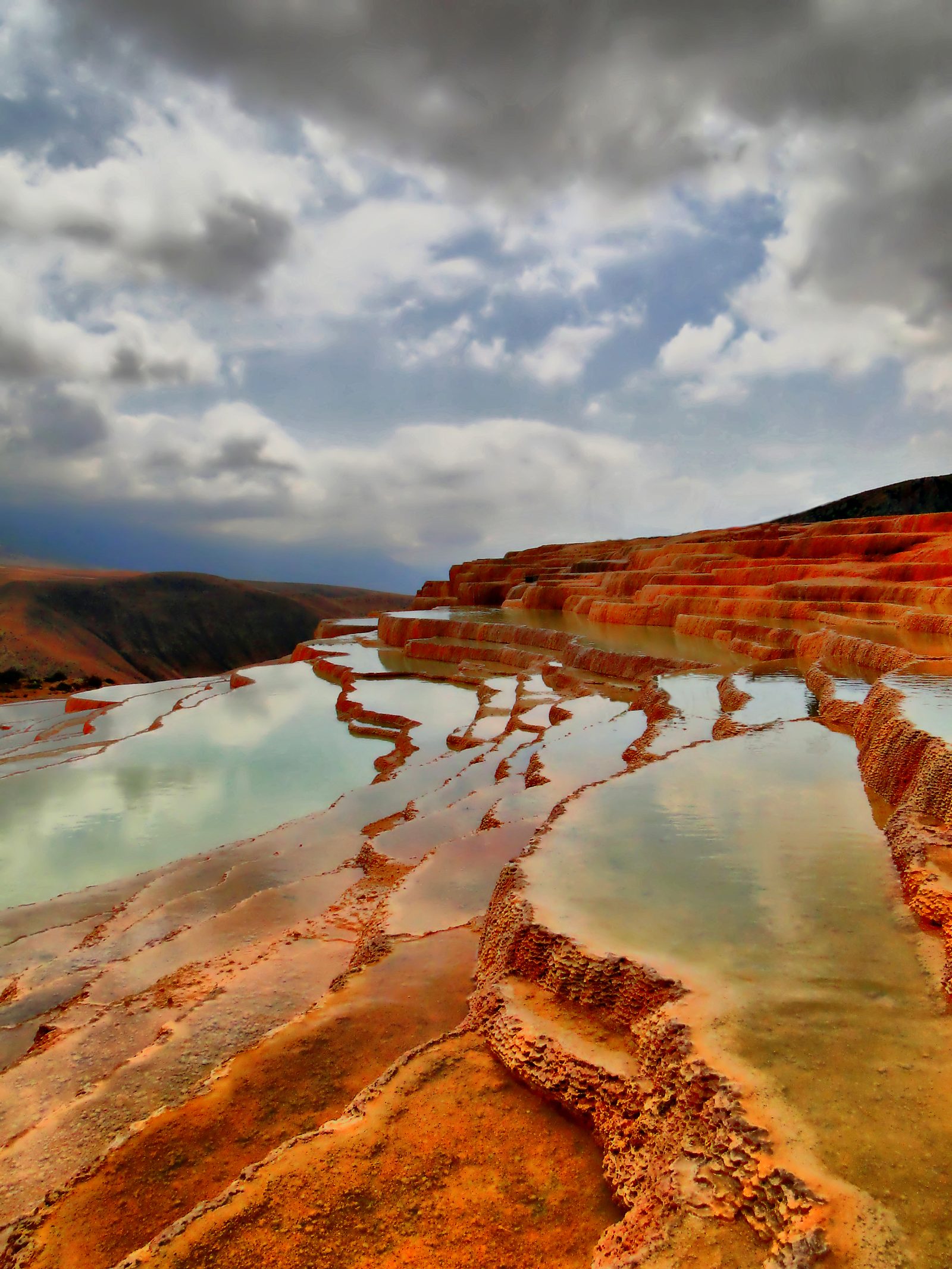
In winter, a special phenomenon adds to the spectacle. Bacteria that become active in the cold water interact with the minerals and turn some pools a deep red colour, which stands in striking visual contrast against the white snow that covers the surrounding mountains. Photographers travel from across Iran for that shot alone.
How to Get to Badab-e Surt
From Tehran
The distance from Tehran to Badab-e Surt is roughly 280 kilometres, and the drive takes about three and a half to four hours. The route passes through Firuzkuh and Qaem Shahr, then turns south toward the village of Orost. The mountain road in its final section is narrow and winding, but it is paved and suitable for ordinary cars.
The simplest approach is to book a flight through Mehyar from Tehran to Sari or Semnan, then hire a car or book a Mehyar Taxi from the city to the site. You can also drive from Tehran, which is a good option if you enjoy mountain roads.
From Sari and the Caspian Coast
If you are staying in Sari or any city on the Caspian coast, Badab-e Surt is about an hour and a half to two hours south by car. Book a driver through Mehyar Taxi for a full day, so you can stop at villages along the way and enjoy the mountain scenery.
From Semnan
The road from Semnan to Badab-e Surt is shorter, about two hours by car, and passes through attractive mountain passes. If you are driving from Tehran through Semnan, you can make Badab-e Surt a stop on your way north.
What to See at Badab-e Surt
The Main Terraces
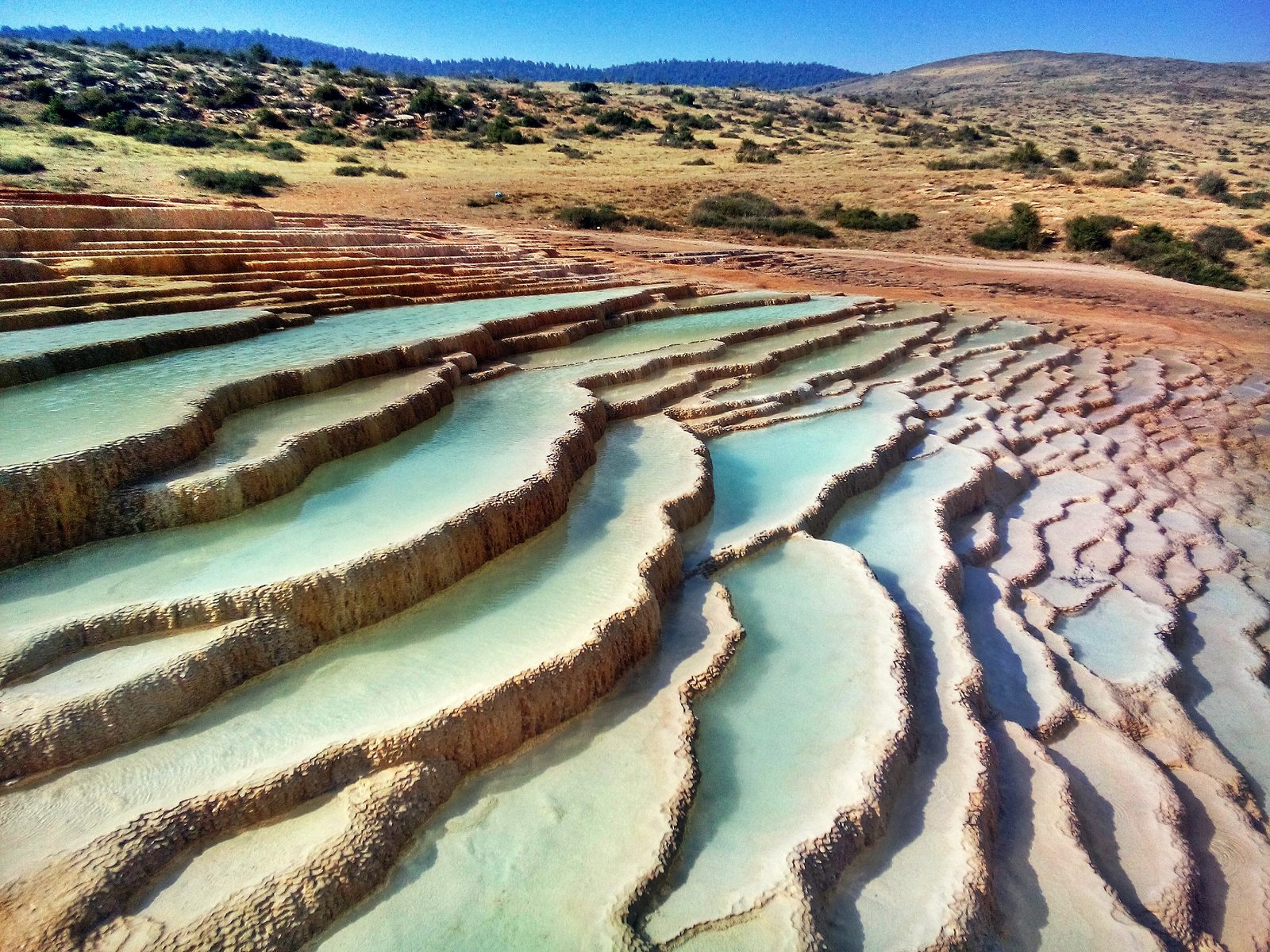
The travertine terraces are the heart of the visit. They spread across roughly 74 hectares, now fenced for protection. Each terrace differs from the next in colour, size, and shape. Some are wide and flat, holding mineral water in shades of green or pale blue. Others are narrow and tilted, with red and yellow sediment accumulating in their channels. Water flows continuously from one level to the next, and the quiet sound of the flow is part of the experience.
The Coloured Pools
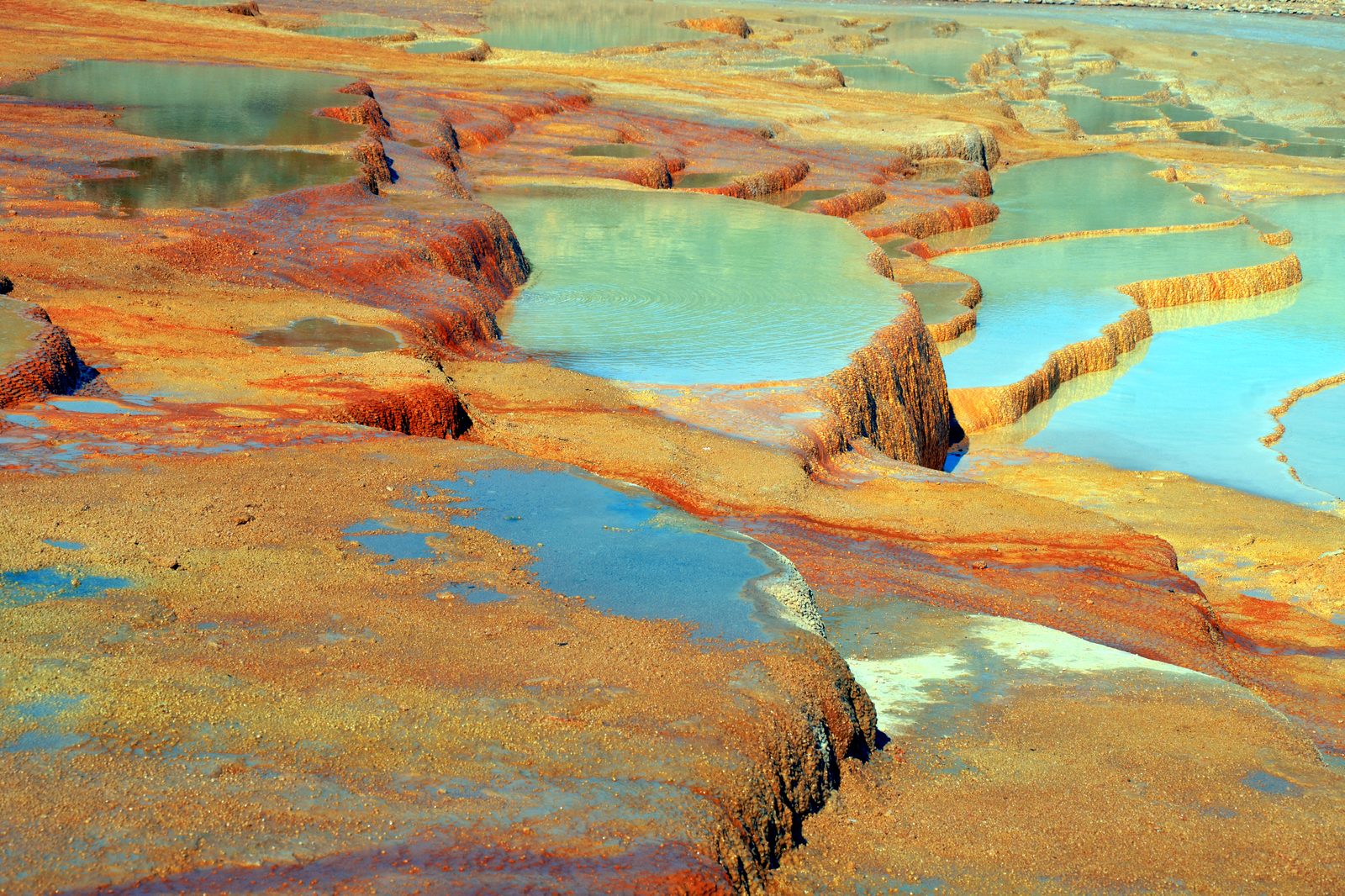
At the upper pools, where mineral concentration is highest, the colours are most intense. Copper pools lean toward red and orange. Sulfur pools are pale yellow. Salt and lime pools are bright white. The contrast between these colours, especially under direct midday sunlight, creates a view that resembles nothing else in Iran.
The Red Winter
If you visit in winter, you will find an additional phenomenon: bacteria that thrive in cold water interact with the minerals and turn some pools deep red. That colour stands in stark contrast against the white snow covering the surrounding peaks. The combination is unique to Badab-e Surt and draws photographers from all over the country.
Conservation Status and Threats
Badab-e Surt is a fragile site, and it has suffered serious damage in recent years. The most significant threats have been:
- Driving on the terraces: Some visitors drove their vehicles directly across the travertine rock, breaking layers that had formed over thousands of years.
- Swimming in the pools: The mineral water is chemically sensitive, and swimming disrupts its balance and damages the deposits.
- Mining: A local mining company was extracting travertine stone from the surrounding area, threatening to extend the damage to the main terraces.
- Drought: Falling groundwater levels in the area have reduced the flow of some springs.
The good news is that local authorities have now fenced the site across 74 hectares, and access to the main terraces is on foot only. The people of the two nearest villages, Malvakhest and Orost, act as guardians of the site and alert visitors to the preservation rules. When you visit, stay on the marked paths, do not touch the terraces, and do not swim in the pools.
When to Visit
The ideal time to visit Badab-e Surt is spring (April and May) and early summer (June), when the weather is mild and the colours are at their peak thanks to snowmelt and strong water flow. Winter (December to February) offers the spectacle of red pools against snow, but the mountain road can be rough and may require snow chains. Summer (July and August) is relatively hot but still manageable, and the site is less crowded.
If you are planning your trip, check the best time to visit Iran guide for seasonal weather patterns across northern Iran and other regions.
Accommodation and Food Near Badab-e Surt
The area around Badab-e Surt is mountainous and rural. There are no large hotels near the site. The closest accommodation options are in the city of Sari (to the north) or in the Kelardasht and Chalus area (to the west). You can search for hotels in Sari through Mehyar and book a room that fits your budget.
The food available in the area is simple and local. The neighbouring villages serve traditional mountain food: local rice, grilled chicken, mountain herbs, and fresh dairy products. There are no formal restaurants at the site, so bring water and a light snack with you.
Plan Your Trip with Mehyar
Mehyar covers every stage of a Badab-e Surt visit. Search for flights to Sari or Semnan, book a hotel in the nearest city, arrange a taxi with a driver for a full day trip from the city to Badab-e Surt and back, and browse experiences available in the region. Top up your Mehyar wallet and pay for everything from one place.
If you are interested in Iran's geological nature, Badab-e Surt opens the door to other wonders: Ali Sadr Cave in Hamedan, the waterfalls of Mazandaran along the Caspian coast, and the rock formations of Qeshm Geopark in the Persian Gulf. For visitors combining geology with cultural sightseeing, the city of Isfahan is within driving distance to the south.