
Kermanshah is the capital of Kermanshah province and the largest and most populous Kurdish city in Iran. It sits in the Zagros in western Iran, on one of the oldest roads in the country, carved and rebuilt by whoever controlled that road. The result is a city where a Sassanian royal relief stands in a public park with a pool in front of it, where a Qajar memorial hall is covered inside with hand-painted tile, and where the mountains either side hold a cave and a wetland that both made Iran's national natural register. Most travellers cross this province on the way from Tehran to Hamadan or Iraq and never stop. Two days here is not generous; it is the minimum.
How do you get to Kermanshah?
Kermanshah lies on the westward corridor that leaves Tehran through Hamadan, the same road that carries you past the Achaemenid mountain at Bisotun. For the distance involved, Mehyar Flights are the honest answer: flying saves the better part of a day, and the airport is close to town. Mehyar Buses run the corridor constantly, cost less, and drop you near the centre. Inside the city, the monuments cluster along one axis and are walkable. Outside it, they do not: Bisotun is 40 kilometres east, the lotus spring 25 kilometres west, Hesilan 40 kilometres north, so book a Mehyar Taxi with a driver for those days.
What is the first thing to see?
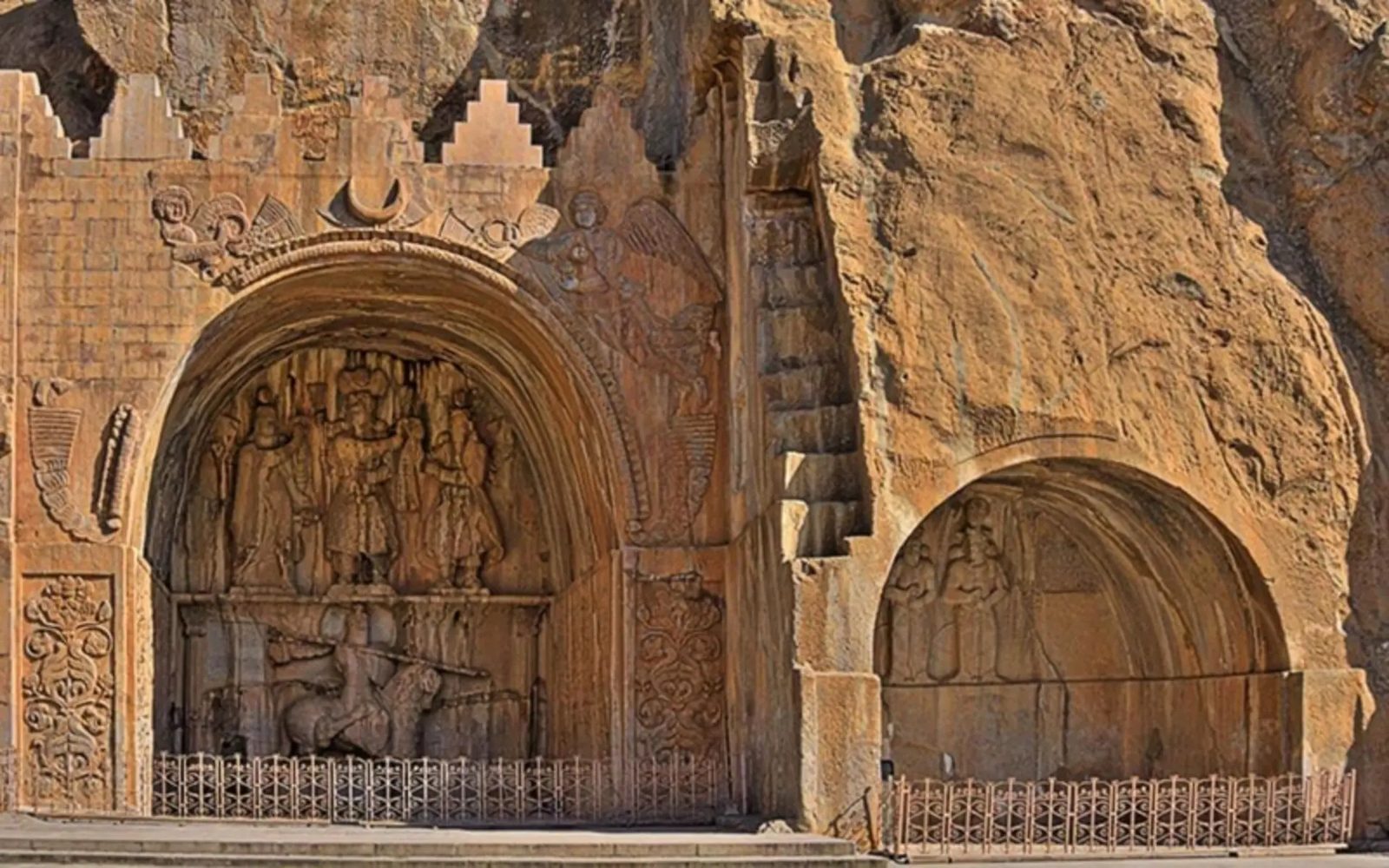
Taq-e Bostan, in the northwest of the city off University Boulevard, at Pedar Square on Taq-e Bostan Street. It is a complex of Sassanian rock reliefs and rock inscriptions, two carved arches, one large and one small, set into the cliff with several inscriptions around them. What is cut into the stone is royal propaganda of the highest order: the coronation scenes of Khosrow Parviz, Artaxerxes II and Shapur II and III, with their attendants, horses and symbols. Iran registered the site on its national heritage list in January 1932.
What makes it work as a visit rather than as an archaeological report is that a mountain spring comes out at the foot of the reliefs, which is why the spot has been a pleasure ground since antiquity: you walk the monuments along the water. Hours are 9 to 21, and the ticket in 1404 costs 30,000 tomans. One regrettable detail: Taq-e Bostan was meant to reach the UNESCO world list, and the kebab houses and dwellings grown up around it have blocked that bid.
Why do people drive out to Bisotun?

Because one cliff there does the work of three museums. Bisotun sits in Harsin county, south of the town of Bisotun at the foot of Mount Bisotun, on the Hamadan to Kermanshah road, 40 kilometres east of the city and about 45 minutes by car. Hours are 8 to 18 and the ticket is 30,000 tomans.
The mountain was considered sacred long before the kings arrived, the climate is good, and the road beneath it was one of the great routes of the world, part of the Silk Road. Every ruler who passed left something. The complex carries 28 nationally registered monuments, with more than 150 historical sites identified in its precinct, running from Elamite carving through Median, Achaemenid, Parthian and Sassanian layers. The centrepiece is the relief and long inscription of Darius the Great, cut high into the rock where no one could reach it, and it is the reason cuneiform could be read at all; that inscription earned Bisotun its UNESCO listing in 2006. Go early, since the site is open stone with little shade.
Which tekyehs should you not skip?

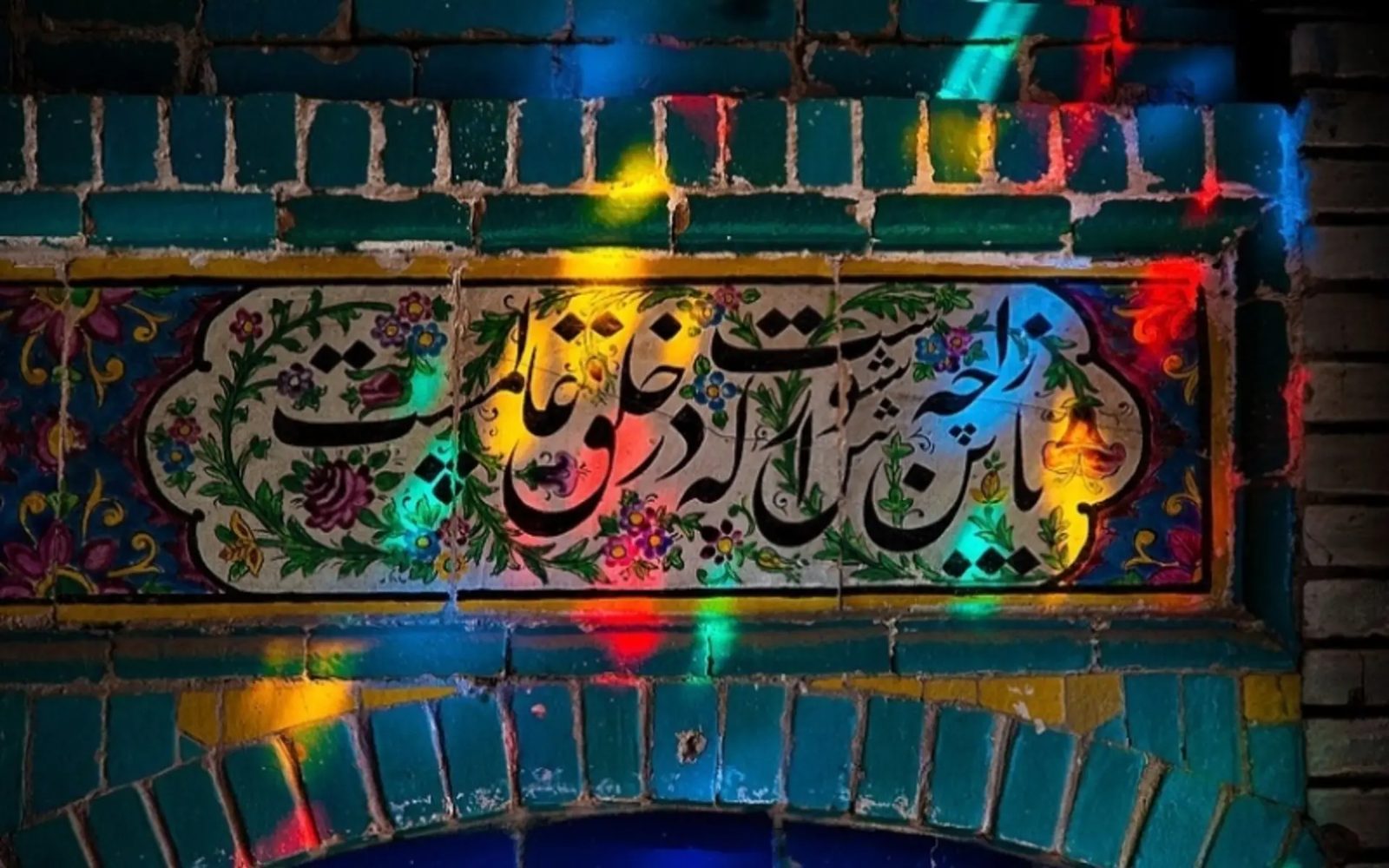
Tekyeh Moaven ol-Molk, on Modarres Street just before Sabze Meydan Street. It is a little over a century old: Hossein Khan Moaven al-Raya began it 114 years ago and Hasan Khan Moaven ol-Molk completed it. The complex has three parts, the Husseiniyeh, the Zeinabiyeh and the Abbasieh, and its tilework is accurately described as without equal anywhere. The colours are natural pigments, which is why the tiles read as painting rather than as pattern. It was built to host the mourning ceremonies of the city, and its internal logic is worth noticing: the Zeinabiyeh was made for women and given two doors, one in the upper level, so they could enter and take part without crossing the men's space. Most of the tile panels are there, so look up first. Hours are 9 to 14 only, and the ticket is 20,000 tomans. Plan your morning around it.
Tekyeh Biglarbeigi is in the old Feyzabad quarter and belongs to the Qajar period. Where Moaven ol-Molk is a tile building, this is a mirror building, with mirror work unmatched among the tekyehs of the city. The great mirror hall on the west side of the courtyard is known as the Husseiniyeh and carries inscriptions from the reign of Mozaffar al-Din Shah. It now houses the city's museum of calligraphy and the written word, including documents of the Biglarbeigi family.
Where does the deeper past live?
In two small museums that share the same street. The Anthropology Museum of Kermanshah occupies a hall on the south side of Tekyeh Moaven ol-Molk, which is convenient: one visit covers both. It opened in May 1990 and is among the most visited spots in the city, with 29 display cases of old objects, handicrafts and clothing, plus the everyday tools of farming, herding and hunting, the equipment of giveh weaving, writing implements, lamps and textiles.
The Zagros Palaeolithic Museum, on Modarres Street at Tekyeh Biglarbeigi, is the first Palaeolithic museum in the Middle East and one of the world's specialised prehistory museums. Fereidoun Biglari and Moradi Bisotuni founded it in 2007, and it holds stone tools and human bone from the Palaeolithic, from Iran and from other countries. Hours are 9 to 19.
What if you want landscape instead of stone?

Park Kohestan on Farrokhshad Boulevard, at Mountaineers' Square, is the easiest hour in the city. It sits in the north near Taq-e Bostan, is one of the largest parks in the city, and is the rooftop of Kermanshah: the view back over the town is why locals bring guests here. Two artificial waterfalls and good lighting make it work after dark, and the Do Ashkift cave opens inside the park grounds, so a cave is part of the walk.
Parav Cave is the serious one, 21 kilometres northeast of the city, about 50 minutes by car, between Mount Taq Bostan and Mount Bisotun, roughly 300 metres below the Sheikh Ali Khan summit. It was found about 40 years ago and was at that moment the largest vertical cave on earth, which is why cavers still call it the Everest of caves. Later surveys pushed it to about 221st deepest in the world, but its mouth sits at 3,000 metres, the highest entrance of any cave on the planet, and Iran registered it in 2009 as the province's second national natural monument. Access is for professional climbers only, so see it from below.
Sarab Niloufar, the lotus spring, is 25 kilometres west on the Kermanshah to Kuzeran road, a 30-minute drive. It is a small lake packed with blue water lilies, and in the warm months the buds and leaves break the surface. It entered Iran's national natural register in March 2009, the 55th such site in the country, and there are visitor facilities around its edge now. Come late in the morning, when the flowers are open.
Hesilan wetland is about 40 kilometres north, an hour by car to Hesilan village in the Miandarband district, in the central part of the county. It is a protected hunting-free zone, and its strangest feature is that the water carries roughly 110 islets, from about 100 square metres up to a hectare, some of which disappear under the surface in winter and on rainy days. The name is Kurdish and literal: heshi means snake and lan means home, so this is the house of snakes, named for the water snakes and vipers living in it.
When should you go?
Spring is the best all-round answer, with mild air, green country and full rivers, and the season to put the lotus spring and the wetland in one day. Summer is warm in the city, and the escape is altitude: the highlands and springs around Kermanshah are where the province goes to be comfortable. Autumn brings colour and the best light for the reliefs. Winter is cold and sometimes snowy, which changes the landscape entirely, though cave and wetland visits get harder.
What is there after dark?
The lighting at Taq-e Bostan is the main event, and the reason that site stays open until 21: the walk between the pool and the cliff, arches lit behind you, is the pleasanter half of the day. Beyond it, this is a western city of long lively streets and quiet cafes.
How many days do you need, and where do you stay?
Two is the practical number: one day for the city axis, Taq-e Bostan in the morning and afternoon light, the two tekyehs and the museums in between, and the mountain park at dusk; one day for the road, Bisotun early, then either the lotus spring or the wetland depending on the season. Add a third day if you are pushing on to the Kurdish highlands toward Sanandaj and Uramanat. Book through Mehyar Hotels on the university or Modarres Street side, where the tekyehs and museums are within reach, and use Mehyar Taxi for the day trips out. Everything can be arranged in the Mehyar app.