
There is a stretch of land in the centre of Tehran, wedged between the Hemmat and Modarres expressways, where thirty years ago nothing grew and nothing happened. Today, 68 hectares of those hillsides hold planetariums, forest trails, art galleries, a 300-metre pedestrian bridge, the largest bookshop in Iran, and a museum dedicated to the eight years of the Iran-Iraq War. Families picnic under fifty-year-old oaks. Students argue about poetry in waterfront cafes. Skaters drop into the largest skate park in the Middle East. The whole complex, known as the Abbas Abad Cultural-Recreational Complex, is one of the most ambitious urban regeneration projects in the Middle East, and it is free to walk through.
This guide covers what the complex actually contains (ten distinct attractions, each with its own character), how to reach it by metro and car, which sections deserve a morning and which a full day, and how to combine a visit with the rest of central Tehran. It is written for travellers who want to understand the place, not just photograph the Nature Bridge at sunset.
Where is Abbas Abad?
The complex occupies the Abbas Abad hills, a ridge of land in central-north Tehran bounded by the Hemmat Expressway to the south, the Modarres Expressway to the east, and the Hakani Expressway to the north. The total area is 68 hectares. The complex opened in 2005 (1384 in the Iranian calendar), though individual attractions have been added over the following decade and a half. The most recent major additions, the Art Garden and Art Lake, opened in 2019.
In practical terms, Abbas Abad is not a single park you enter through one gate. It is a network of parks, bridges, gardens, and cultural buildings connected by pedestrian paths, wooden walkways, and shared cycling lanes. You can spend a full day moving between them, or you can pick two or three and do them well.
How to get there
The complex is one of the most accessible green spaces in Tehran, precisely because it sits at the intersection of three major expressways and two metro lines.
By metro
The Shahid Hemmat Metro Station (Line 1) is the best stop for the western attractions: Nowruz Park, Bandar Park, and the Minoo Dome planetarium. Electric shuttle carts run from the metro exit to the park entrances.
The Shahid Hakani Metro Station (Line 1, sometimes listed as Mirdamad) serves the central attractions: Water and Fire Park, the Silk Bridge, and the Art Garden. From the station, walk fifteen minutes west along the Hakani Expressway service road, or take a short taxi ride.
The Shahid Hakani Metro Station (Line 1) is also the closest stop for the eastern half of the complex, including Taleghani Park, the Nature Bridge, and the Sacred Defense Museum. From the station, it is a five-minute walk north to the park entrance.
Open Mehyar and choose Taxi from anywhere in Tehran for a direct ride to any of these entrances. The complex is large, so tell the driver which specific attraction you want, not just "Abbas Abad."
By car
From anywhere in Tehran, take the Hemmat Expressway and exit at the Abbas Abad / Hakani interchange. Parking is available at multiple points around the complex, though spaces fill quickly on weekends and holidays. The largest car parks are near the Hakani metro station and at the northern entrance to Taleghani Park.
From other cities
If you are visiting Tehran as part of a longer trip, Mehyar Buses connects the capital to every major Iranian city, and Mehyar Flights serves Imam Khomeini Airport and Mehrabad Airport, both of which are a taxi ride from Abbas Abad. For the classic Iranian loop (Tehran, Isfahan, Shiraz, Yazd, Kashan), Abbas Abad works well as a first or last day in the capital. For more on planning your trip, see our Tehran city guide and our guide to the best time to visit Iran.
The ten attractions of Abbas Abad
Each of the ten sections has its own character, its own entrance, and its own best time of day. Here is what each one offers.
Nowruz Park
Nowruz Park is the largest park in the western section of Abbas Abad. It opened in 2013 on the site of the former ECO cultural grounds, and its centrepiece is a lake shaped like the Caspian Sea, covering 15,500 square metres. The lake is split into a northern basin (3,500 square metres) and a southern basin (12,000 square metres), with cycling and walking paths along both shores.
The park is named for Nowruz, the Iranian New Year, and twelve platforms around the lake represent the twelve member states of the Economic Cooperation Organization, with two additional platforms for Iraq and Bahrain. Each platform introduces the traditions and customs of its country. A flower garden borders the lake, and a Hall of Fame plaza (4,200 square metres) features a grand entrance gate inspired by classical Iranian architecture, stone paving patterned after Persian carpet motifs, and pedestals for busts of historical and contemporary Iranian figures.
Bandar Park
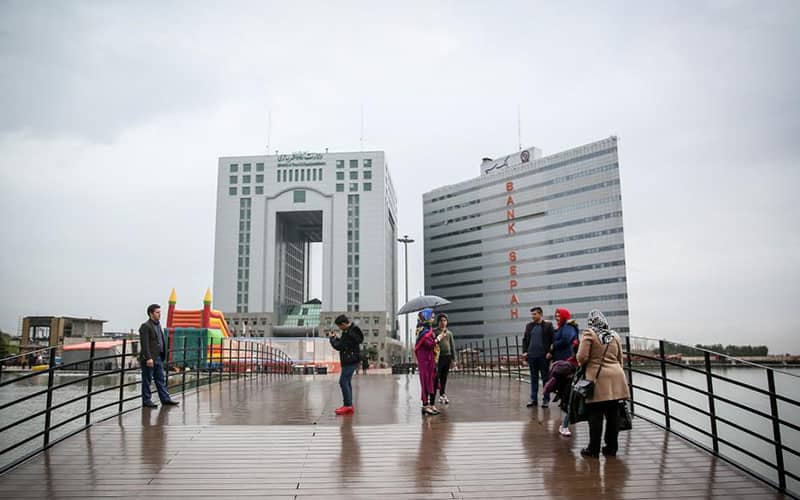
Bandar Park, at 24,000 square metres, is the maritime-themed section of the complex. It sits east of the Iranian Ports and Maritime Organization building, and everything in it, from the lighthouse to the ship-shaped food court, evokes the southern coast of Iran. The park includes a ship pavilion, an anchor pavilion, a lighthouse pavilion, a horse-drawn carriage station, a dovecote, walking and cycling paths, and a rappelling tower. The food court is designed to resemble old wooden sailing ships, and the whole area has the feel of a coastal town dropped into the middle of Tehran.
Art Garden and Art Lake
The Art Garden (3.2 hectares) and Art Lake (2,500 square metres) opened in 2019 as the largest art project in the heart of the capital. The garden is designed as a cultural corridor, positioned between the Sacred Defense Museum and the Book Garden to connect them into a single artistic axis. Four art houses, dedicated to poetry, music, visual art, and architecture, sit on the four sides of the garden and link to each other through a classical Iranian garden layout.
The garden includes an open-air amphitheatre (200 seats), a central pavilion, a gallery for master works of visual art, a second amphitheatre (250 to 350 seats) for conferences and workshops, six smaller meeting halls, an artists' club, a cafe, and a restaurant. The lake has a pier that doubles as a performance stage, with an exhibition space underneath for visual art displays.
Minoo Dome (Gonbad-e Mina)
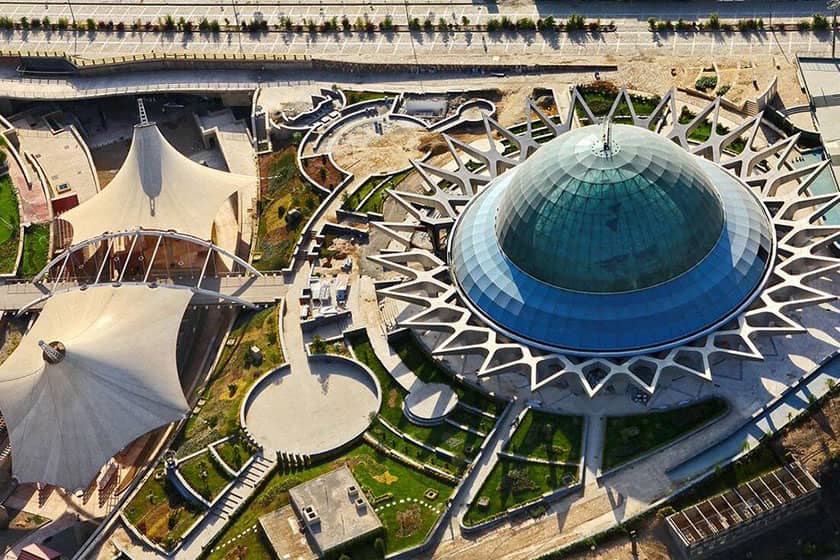
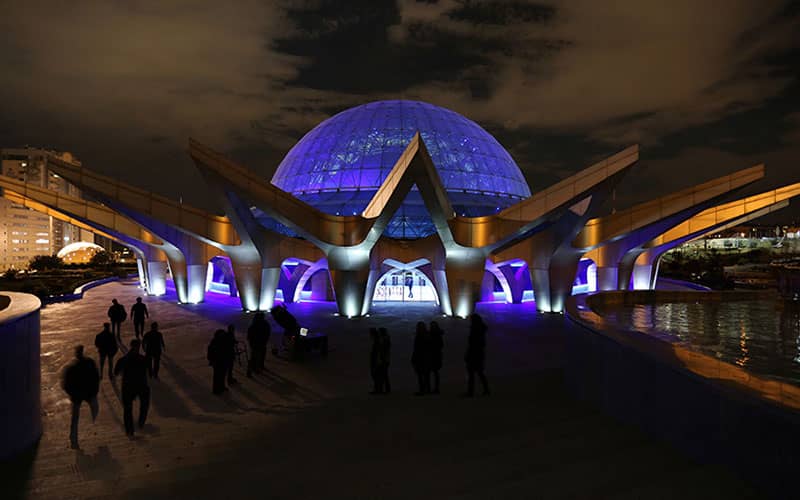
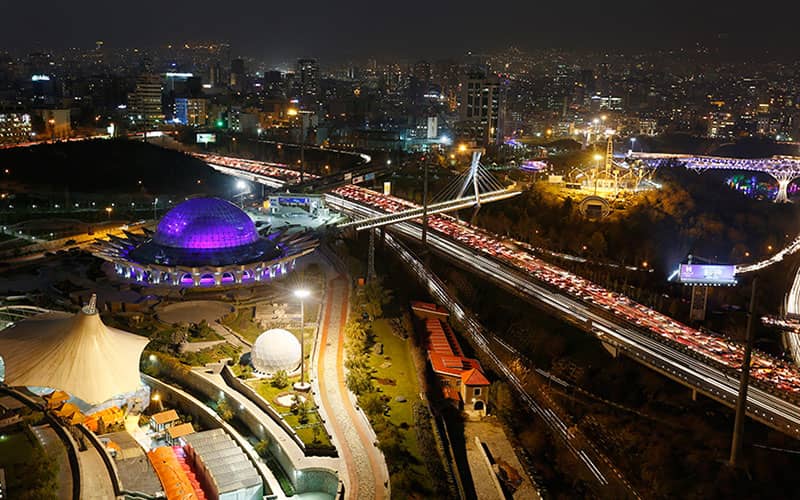
Minoo Dome is a planetarium and astronomy centre with 11,000 square metres of floor space and a spherical building 30 metres in diameter, inspired by the shape of the sun. It sits at the edge of the Hemmat Expressway, where it is visible from the Hemmat, Modarres, and Hakani expressways, and its distinctive globe shape has made it one of the most recognisable modern landmarks in north Tehran.
Inside, the dome houses a 180-degree projection theatre, a gallery on the history of science, and educational spaces for astronomy events, scientific tourism tours, and training courses. The planetarium projects the sky, stars, planets, and celestial phenomena using individual projectors for the sun, moon, planets, and stars, each driven by precision motors. A children's play area doubles as an outdoor astronomy classroom.
Water and Fire Park (Ab-o-Atash)
Water and Fire Park, also known as the Garden of Abraham, opened in 2009 and covers 24,000 square metres. Its name comes from the four 10-metre fire towers on the eastern side of the park, which ignite flames into the sky every half hour after sunset, while water dances in fountains nearby. The reference is to the story of Abraham and the fire of Nimrod, and five steel relief panels around the park depict scenes from the life of the Prophet Abraham.
The park is multi-purpose: a place for walking, skating, cycling, cinema, and cultural events. It includes the largest skate park in the Middle East, built with technical input from German specialists, a cinema hall, a cafe, restaurants, a food court, a dovecote, a carriage ride, and an amphitheatre. The southern section has multiple restaurants and food stalls.
Silk Bridge and Nature Bridge
Two pedestrian bridges connect the sections of Abbas Abad that are split by the expressways, and both are attractions in their own right.
The Silk Bridge is roughly 200 metres long and crosses the Hemmat Expressway, connecting Water and Fire Park (to the north) with Nowruz Park (to the south). Despite its metal structure, the bridge is finished to look like wood, and standing on it, you look down on the traffic of the Hemmat Expressway far below, with Milad Tower and the Tehran skyline in every direction. The name echoes the ancient Silk Road, which connected Asia to Africa; this bridge connects two parks.
The Nature Bridge is the most famous structure in the entire complex. At more than 300 metres long and 40 metres high, in three levels, it is the largest pedestrian bridge in Iran, built from more than 20,000 tons of steel. It connects Taleghani Park (to the east) with Water and Fire Park (to the west), and its design allows visitors to walk, sit, rest, and look out over the city from every level. The third-level terraces are surrounded by hanging gardens, and from them, you can see the Alborz mountains to the north and the endless Tehran plain to the south. During construction, from 2010 to 2014, not a single tree was cut down. The bridge is especially striking at night, when its creative lighting makes it one of the most photographed structures in Tehran.
Taleghani Park
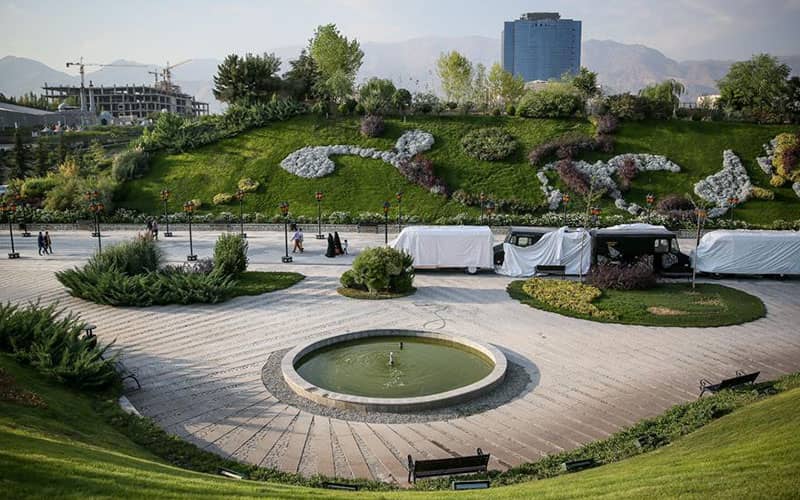
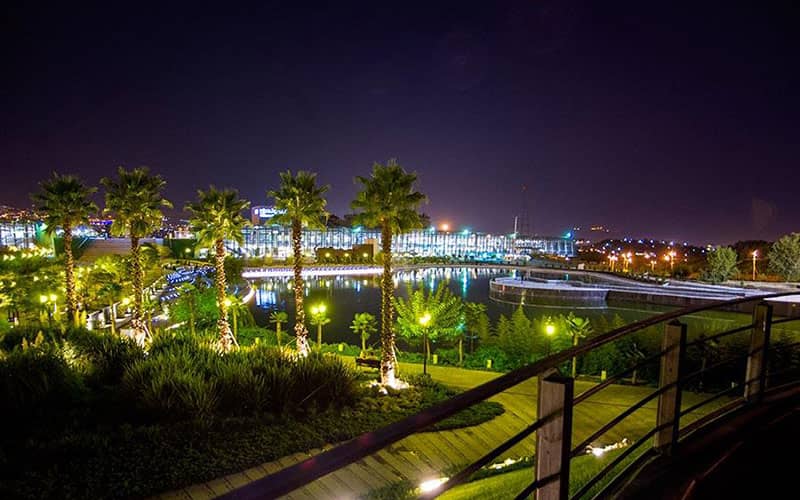
Taleghani Park, also known as Abbas Abad Forest Park, is the oldest and greenest section of the complex. Previously known as Jahane Koodak Park and the Davoodiyeh Hills, it is a true urban forest, with trees over fifty years old and vegetation that grows organically, without geometric planning. The southern section is designed in a spiral pattern and planted with Italian oaks, and the canopy is so dense that even on the hottest summer days, direct sunlight cannot reach the ground.
The park has more than 100 gazebos, fish ponds, clear streams, traditional pavilions, and barbecue pits. Wooden walkways wind through the trees toward the Nature Bridge. There are two children's playgrounds, a basketball court, ping-pong and chess tables, and numerous cafes, juice bars, and restaurants around the edges. The largest Iranian flag in the country flies from a 150-metre tower in Taleghani Park, with a flag measuring 42 by 24 metres (over 1,000 square metres). The tower, visible from anywhere in Tehran, also houses an indoor event hall and serves telecommunications and surveillance functions.
Sacred Defense Museum
The Museum of the Islamic Revolution and Holy Defense is one of the largest museum-gardens in Iran, with 205,000 square metres of floor space. The building's exterior is designed to resemble military camouflage, and the interior uses digital technology to present the history of the Islamic Revolution and the eight-year Iran-Iraq War (known in Iran as the Holy Defense).
The museum includes seven themed halls, an artificial lake, amphitheatres, and a panoramic cinema hall. The halls move visitors through the chronology of the war: the surprise of the Iraqi invasion, the resistance, the liberation of occupied territories, and the final victory. Annual film festivals, exhibitions, and cultural events take place in the museum grounds. The museum sits between Taleghani Park and the Book Garden, and a visit to it takes two to three hours.
Book Garden
The Book Garden is a 110,000-square-metre complex that functions as a bookshop, cultural centre, science playground, and cinema. Sixty-five thousand square metres are covered, with the remaining space given to gardens and an artificial lake. The interior is divided into four sections: Baharestan (children and young adults), Khayalestan (digital technology), Negarestan (cinema halls), and Servestan (general and adult).
The facilities include a children's science garden, a young adults' science garden, an adult bookshop, a robotics club, a Cessna 172 flight simulator, an escape room, a printing and publishing centre, a cafe, and a mother-and-child room. The rooftop is a 20,000-square-metre garden with cafes and a 500-seat open-air summer cinema. The Book Garden is bordered by the National Library of Iran, the Academy of Sciences, and the Academy of Persian Language and Literature, making it the intellectual heart of the Abbas Abad complex.
When to visit
Tehran has a continental climate with hot summers and cool winters, and Abbas Abad, being a largely outdoor complex, is best enjoyed in mild weather.
Spring (March to May) is the most comfortable season. The trees are green, the lakes are full, and the temperature is pleasant for walking between attractions. This is also the busiest period, especially around the Nowruz holidays in late March.
Summer (June to August) is hot, with daytime temperatures regularly above 35 degrees Celsius. The complex is popular in the evenings, when the Nature Bridge lighting, the fire towers of Water and Fire Park, and the rooftop cinema at the Book Garden all come into their own. Visit early in the morning or after sunset.
Autumn (late September to November) is arguably the best season. The heat has broken, the light is golden, and the crowds are thinner. The forests of Taleghani Park are at their most colourful.
Winter (December to February) is cold, with occasional frost and grey skies. The complex remains open, and the indoor attractions (Minoo Dome, the Sacred Defense Museum, the Book Garden) are warm and uncrowded. Dress warmly for the outdoor sections.
Practical details
The Abbas Abad Cultural-Recreational Complex is free to enter as a whole, though individual attractions such as the Minoo Dome planetarium, the Sacred Defense Museum, and the Book Garden cinema may charge separate entrance fees. Confirm locally or through Mehyar before you visit.
The complex is open daily from early morning until late evening. Hours shift with the season and with the religious calendar. The outdoor parks are at their best in the late afternoon and evening, when the lighting is most dramatic and the temperature is most comfortable.
Allow a full day to see all ten attractions at a relaxed pace. If you have only a morning, focus on the Nature Bridge, Water and Fire Park, and the Art Garden. If you have a full day, add the Sacred Defense Museum and the Book Garden, and end with the fire towers at sunset.
Money and food. There are cafes, restaurants, and food courts in multiple sections of the complex, particularly in Bandar Park, Water and Fire Park, Taleghani Park, and the Book Garden. Keep some cash on hand for small purchases. Mehyar Wallet is useful here: top up before you arrive and you can pay for food, tickets, and shuttle rides without hunting for an ATM.
Connectivity. Mobile coverage is good throughout the complex. A Mehyar SIM arranged on arrival in Iran covers you for maps, translation, and messaging across all ten attractions.
Dress and conduct. The complex is a public space, and the standards of dress that apply elsewhere in Iran apply here. Shoulders and knees covered, and a headscarf for women. The Sacred Defense Museum is a memorial as much as a museum; speak quietly and dress respectfully.
Start your Tehran trip with Mehyar
The Abbas Abad Cultural-Recreational Complex is one of the most ambitious urban regeneration projects in the Middle East, and it is one of the few places in Tehran where you can spend an entire day moving between forests, lakes, planetariums, museums, and bridges without ever leaving the complex. It is free to walk through, it is accessible by metro from almost anywhere in the city, and it is at its most beautiful in the late afternoon, when the fire towers ignite and the Nature Bridge lights up against the Tehran skyline.
For a complete Tehran city guide, explore the other parks, museums, and cultural attractions of Iran's dynamic capital. If you are planning your first trip to Iran, our first-trip guide covers everything from money and SIM cards to dress code and transport.