
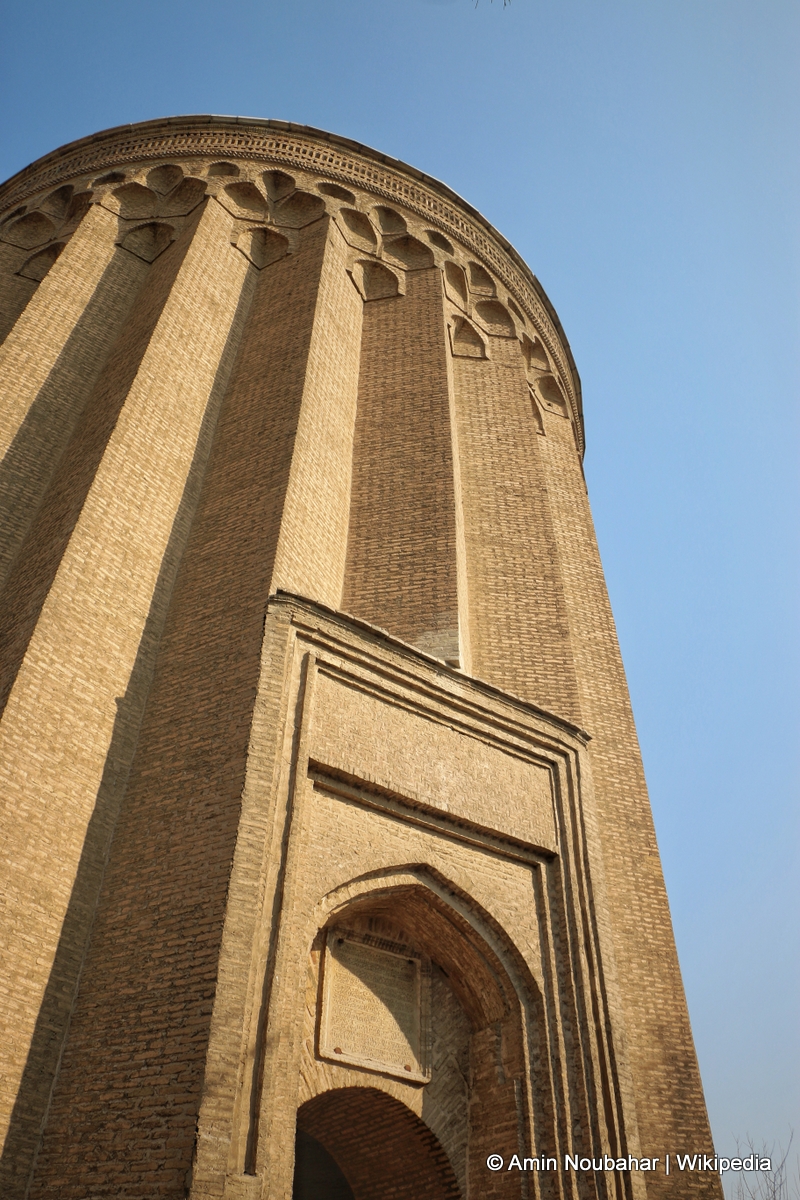
On the southern edge of Tehran, in the ancient city of Rey, a tower of red brick rises from a small park like a lighthouse stranded in a sea of suburbia. It is twenty metres tall and sixteen metres across at the base, and its form is unusual: not round, not square, but a twenty-four-sided polygon, each face of the brickwork angled slightly to catch the light at a different angle. At the top, where a conical dome once sat, the sky frames the broken edge of the walls like a crown. This is Borj-e Tughrol, the Tughrol Tower, and it is one of the most important surviving buildings from the Seljuk period in Iran.
The tower was built in the twelfth century, during the Seljuk era, when Rey was one of the great cities of the Islamic world and a key stop on the Silk Road. Rey, known in Arabic as al-Rayy, was older than Tehran by many centuries. It had been an important centre since pre-Islamic times, and under the Seljuks it flourished as a centre of learning, trade, and religious scholarship. The tower is believed to have been the tomb of Tughrol Beg, the founder of the Seljuk empire, though some scholars argue that it was built for a local governor or noble rather than for the sultan himself. What is not in dispute is that the tower served a dual purpose: it was both a mausoleum and a beacon, its height and distinctive shape making it visible from kilometres away across the flat plain south of Tehran, guiding caravans and travellers toward the city.
The twenty-four-sided plan is not merely decorative. It is a structural decision, designed to give the tower stability against earthquakes. Rey sits on a major fault line, and the city has been destroyed and rebuilt many times over the centuries. The polygonal form distributes the forces of a tremor more evenly than a circular or square plan, and this may explain why the tower has survived for nearly nine hundred years while much of the city around it has not.
Where is Tughrol Tower?
Tughrol Tower stands in the city of Rey (also spelled Ray), which is now part of the greater Tehran metropolitan area. Rey is located about ten kilometres south of central Tehran, and the tower sits in a small public park on the western side of the city, near the intersection of Shahid Rajaei Boulevard and Fahmideh Street. The coordinates are approximately 35.60 degrees north and 51.44 degrees east, at an elevation of about 1,100 metres above sea level.
Rey is one of the oldest continuously inhabited sites in Iran, with a history that stretches back at least to the Achaemenid period. The city was known to the Greeks as Rhagae, and it is mentioned in the biblical Book of Tobit. Under the Sassanids it was a centre of Zoroastrian learning, and under the early Islamic caliphate it became an important Shia centre, particularly after the burial of Fatima Masumeh, the sister of Imam Reza, in the city. The shrine of Fatima Masumeh in Qom grew out of this tradition, and the connection between Rey and Qom as Shia centres of learning runs deep.
Today, Rey is a district of Tehran, and the Tughrol Tower is one of the few surviving monuments of the medieval city. The park around the tower is well maintained, with paths, benches, and a small parking area, and it is a pleasant place to sit and contemplate a building that has outlasted empires.
How to get to Tughrol Tower from Tehran
The tower is easily accessible from central Tehran, since Rey is now a suburb of the capital.
By Mehyar Taxi. The most direct way to reach Tughrol Tower from central Tehran is to open Mehyar, choose Taxi, and set your destination to the tower or to Borj-e Tughrol. The drive takes about thirty to forty-five minutes from the city centre, depending on traffic. A private car gives you the option to combine the tower with a visit to the shrine of Fatima Masumeh in Rey, which is only a few kilometres to the east, and to continue to the bazaars and historic sites in the city.
By metro. Tehran Metro Line 1 (the red line) runs south from Tajrish to Kahrizak, passing through central Tehran and stopping at Shahr-e Rey station. From the station, it is a short taxi ride or a fifteen-minute walk to the Tughrol Tower. The metro is the fastest way to get there during rush hour, when the highways south of Tehran can be heavily congested.
By Mehyar Buses. If you are coming from outside Tehran, Mehyar Buses connects the capital to all major cities in Iran. Once you arrive in Tehran, you can use the metro or a Mehyar Taxi to reach Rey.
By private car. If you are driving, take the Tehran-Qom freeway south and exit at the Rey interchange. Follow signs toward the city centre of Rey, and then toward Borj-e Tughrol. Parking is available in the park around the tower.

What to see at Tughrol Tower
The tower is a single structure, and a visit does not take long. But there is much to appreciate in its details.
The exterior brickwork. Walk slowly around the tower and study the brick pattern. The bricks are a deep red-brown, laid in a herringbone pattern that creates a subtle texture on the surface. The twenty-four sides of the polygon mean that each face is relatively narrow, and the angles between them create deep shadows that give the tower a quality of fluted texture, like the folds of a column. In the early morning or late afternoon light, the contrast between the lit faces and the shadowed angles is striking.
High up on the walls, just below the broken edge where the conical dome once sat, you can see the remains of Kufic inscriptions in brick relief. Kufic is the oldest style of Arabic calligraphy, angular and monumental, and the inscriptions on the tower would have included Quranic verses and the name of the person for whom the tower was built. Much of the inscription has been lost over the centuries, but enough remains to give a sense of the original decoration.
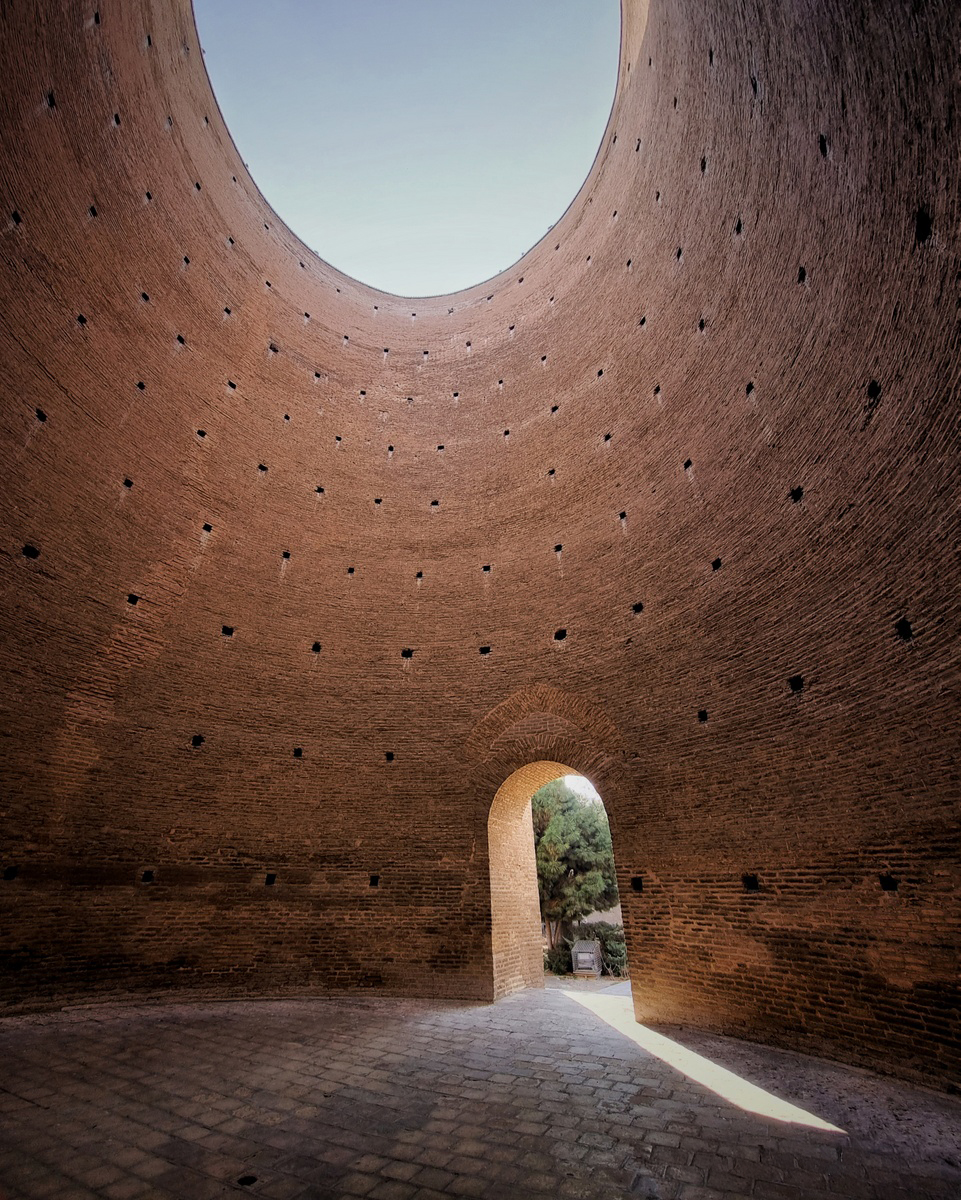
The interior. The tower is hollow inside, a single cylindrical space rising from the floor to the open top. The interior walls are plain brick, and the light enters from the broken edge above and from small openings near the top. Standing inside and looking up, you can see the full height of the tower and understand how the twenty-four-sided plan creates a space that feels almost circular but is subtly different at every angle. The acoustics are remarkable: a whisper at the base can be heard clearly at the top, and the space has a resonance that makes you aware of your own voice in a way that is unusual.
The original conical dome, which can be seen in photographs from the nineteenth century, has collapsed. The exact date of the collapse is not known, but it was probably the result of an earthquake. The top of the tower is now open to the sky, and the broken edge of the brickwork creates a ragged crown that some find more beautiful than the original dome would have been.
The park and the surroundings. The tower stands in a small park with old trees, paths, and benches. On a quiet day, it is a peaceful place to sit and read or to sketch the tower. The park is especially popular in spring, when the trees are green and the light is soft.
The Silk Road connection. The tower's role as a beacon for Silk Road travellers is part of its significance. Rey was a major stop on the route from Central Asia to the Mediterranean, and the tower would have been visible from a distance, its distinctive form and height making it a landmark for caravans crossing the plain. Standing beside the tower and looking north toward the mountains of Tehran and south toward the desert, you can imagine the landscape as it would have looked a thousand years ago: flat, open, and punctuated by the occasional tower or minaret guiding the way.
Best time to visit Tughrol Tower
Tehran has a semi-arid climate with hot summers and cool winters. The best time to visit the tower is in spring or autumn.
Spring (March to May) brings mild temperatures and occasional rain. The park around the tower is green, and the light is warm and soft. This is the best time for photography.
Autumn (September to November) offers clear skies, comfortable temperatures, and golden light that brings out the red-brown tones of the brick. The air is generally clear, and the views from the base of the tower toward the Alborz mountains to the north are sharp.
Summer (June to August) is hot, with temperatures regularly above thirty-five degrees. The tower has no shade, and a midday visit in summer is uncomfortable. Visit early in the morning or late in the afternoon.
Winter (December to February) can be cold and grey, with occasional snow. The tower is still accessible, but the park is less pleasant and the light is flat.