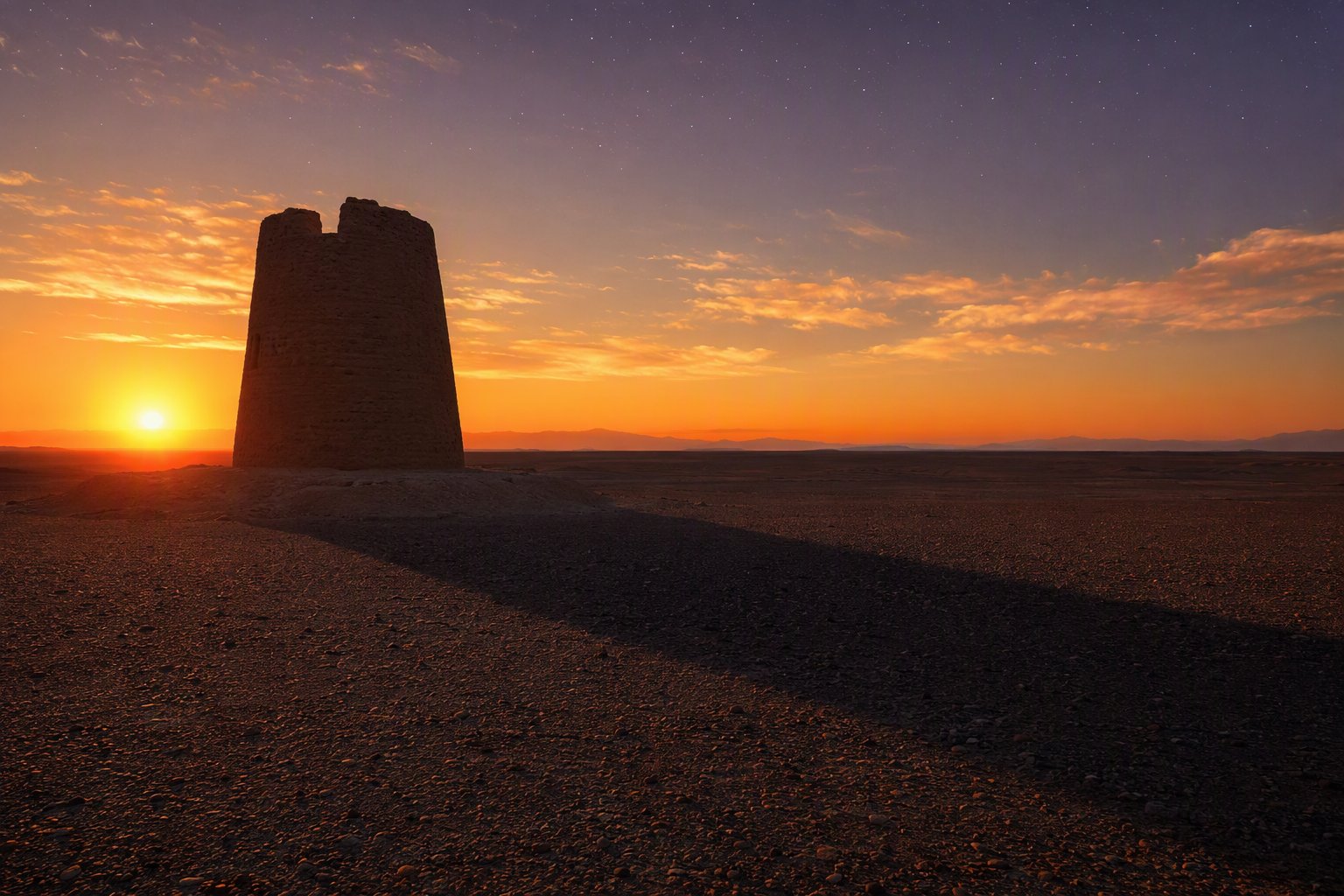
Cross the central desert of Iran east of Isfahan and you will eventually notice something rising from the flat plain. At first it looks like a natural formation, a pillar of wind-sculpted earth. Then you see another one, spaced at regular intervals along a line that stretches toward the horizon. Closer still, the shape resolves into something unmistakably built: a tower of brick and mud-brick, tapering slightly as it rises, with a doorway or niche on one face and the weathered remains of a domed top. These are the mile towers of the Iranian desert, known in Persian as mil-e rahnama, and they are among the most evocative survivals of the old caravan routes that once connected the cities of the plateau.
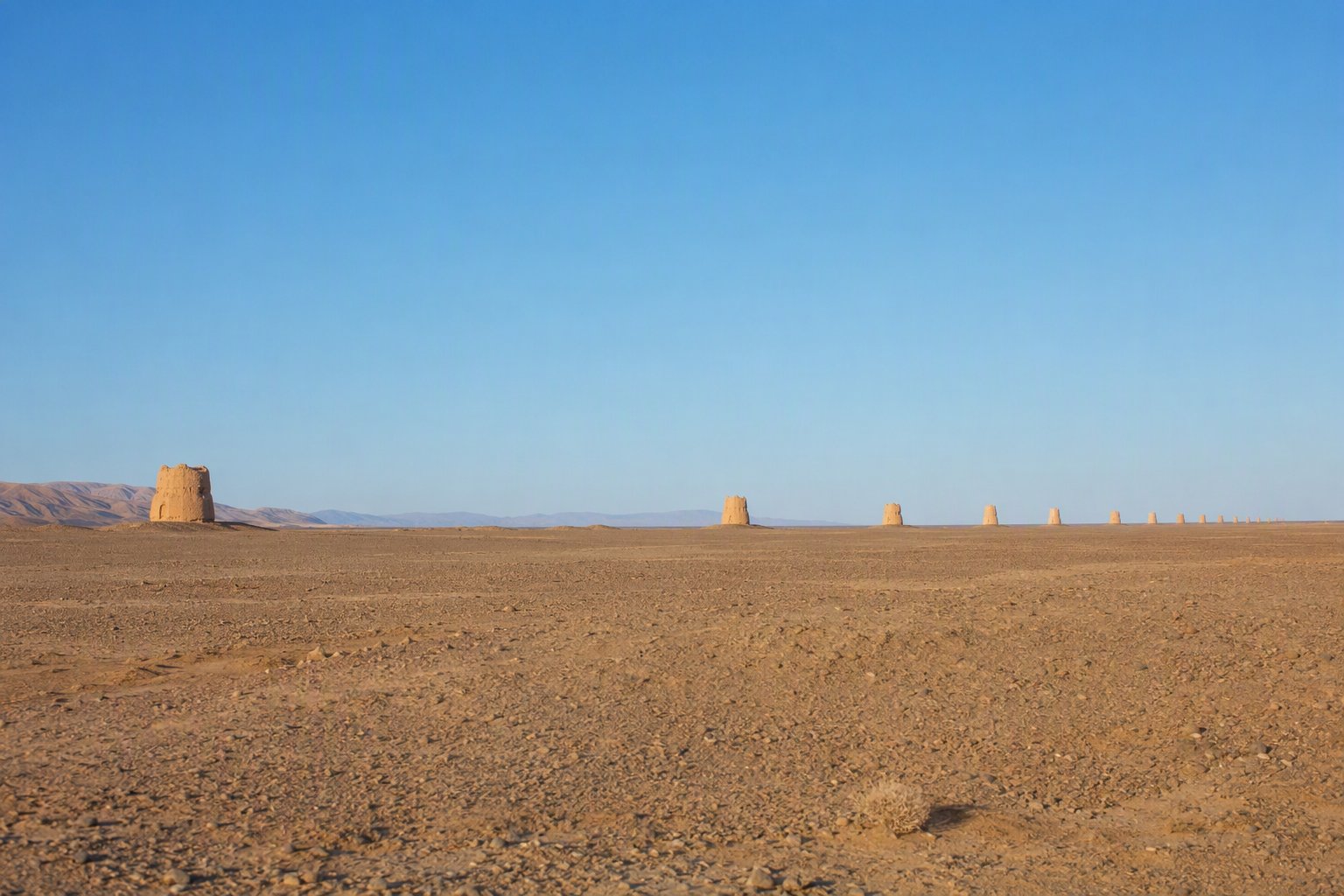
The mile towers served a purpose that is immediately practical once you understand the landscape. The central desert of Iran, the Dasht-e Kavir and its margins, is vast, flat, and largely featureless. Without landmarks, without roads marked in any modern sense, and without the kind of water sources that anchor navigation in wetter countries, a caravan crossing this territory needed fixed points of reference. The mile towers provided them. Placed at intervals roughly equivalent to a farsakh, the traditional Persian measure of distance equal to approximately five to six kilometres, the towers formed a chain of markers that told travelers where they were, how far they had come, and how much further they had to go.
This guide explains where the mile towers stand, what they looked like in their original function, how to reach them from Isfahan, and how to combine a visit to the towers with the wider landscape of the central desert. It is written for travelers who want to understand the logic of the old routes, not merely to photograph the towers as curiosities.

Where are the mile towers?
The mile towers of the central Iranian desert are concentrated in the region between Isfahan and the eastern desert towns, particularly along the old caravan route that ran from Isfahan toward Nain, Khur, and beyond to Khorasan. A cluster of surviving towers stands on the plain east of Isfahan, in the direction of Varzaneh and the salt marsh that marks the beginning of the true desert. Another line of towers can be traced further east, toward the town of Nain and the desert edge beyond.
The towers are not confined to a single site. They are distributed along the old routes, and the number of surviving examples depends on how far you are willing to travel from the paved road. The most accessible towers are those on the Isfahan to Varzaneh road, roughly eighty to one hundred kilometres east of Isfahan city. Here, several towers survive in reasonable condition, and they can be visited in the course of a half-day excursion from Isfahan.
The broader zone of the mile towers extends across the transitional landscape between the cultivated margins of the Isfahan plain and the open desert to the east. This is a landscape of gravel plains, dry watercourses, and scattered low hills, with the high peaks of the Zagros still visible to the west and the flat desert horizon stretching away to the east. The towers were placed to be visible from a distance, and in this flat terrain, they succeed. On a clear day, you can see one tower from the next, which was the entire point of their design.
How to get to the mile towers
The mile towers have no public transport of their own, as they stand in open desert without settlements nearby. Reaching them requires a private vehicle or an arranged transfer from Isfahan.
From Isfahan
Isfahan is the most practical base for visiting the mile towers. The city is well connected by road, air, and bus to the rest of Iran, and the drive from Isfahan to the nearest towers takes roughly an hour and a half to two hours. The road from Isfahan to Varzaneh runs eastward across the plain, and the towers are visible from the road or from tracks that lead north and south of the paved surface.
Open Mehyar and choose Buses to reach Isfahan from Tehran, Yazd, Shiraz, or Kashan. The bus terminal in Isfahan handles frequent services on all these routes. From the city, Mehyar Taxi can arrange a private car and driver for the excursion to the towers, with the flexibility to stop at other desert sites along the way, including the Varzaneh salt marsh and the historic bridges of the region.
From Yazd or Kerman
Travelers coming from the southeast can approach the towers from the direction of Nain, which sits between Yazd and Isfahan on the main trans-desert road. The towers east of Nain are less well known than those near Varzaneh, but they are equally evocative and often less visited. The road from Yazd to Isfahan passes through Nain, and a detour of twenty to thirty kilometres north or south of the main road will bring you to several surviving examples.
Mehyar Buses covers the Yazd to Isfahan route via Nain, and Mehyar Taxi can arrange a transfer from Nain to the towers if you are traveling by bus and need the last stretch covered.
A short history of the mile towers
The exact date of the mile towers is not known with certainty, but they are generally attributed to the Seljuk and Ilkhanid periods, roughly the eleventh through fourteenth centuries CE. This was a time when the caravan routes of the central plateau were heavily used, connecting the agricultural wealth of western Iran to the markets of Khorasan in the east and the trade routes to Central Asia beyond.
The Seljuk dynasty, which ruled Iran from the eleventh to the twelfth century, invested heavily in road infrastructure. Caravanserais, bridges, and roadside markers were built or maintained along the major routes, and the mile towers are part of this tradition. The Ilkhanid period, the Mongol successor state of the thirteenth and fourteenth centuries, continued this investment, and some of the towers may have been repaired or rebuilt during this time.
The function of the towers was straightforward. Each tower marked a specific distance along the route, measured in farsakhs. A caravan leader who knew how many towers he had passed could calculate his position and the distance remaining to the next caravanserai or water source. In a landscape where getting lost could mean death, this information was vital. The towers also served as visual landmarks that could be seen from a distance, helping travelers maintain their bearing when the flat terrain offered no other reference points.
Some towers had additional functions. A few of the larger examples contain a small interior chamber that may have served as a shelter for guards or as a place to store supplies. Others have niches that may have held lamps or fires, visible at night, which would have made the towers useful as navigation aids in darkness as well as daylight. This night function may be the origin of the romantic term sometimes applied to them in travel literature, though the towers were always markers of distance first and everything else second.
What to see
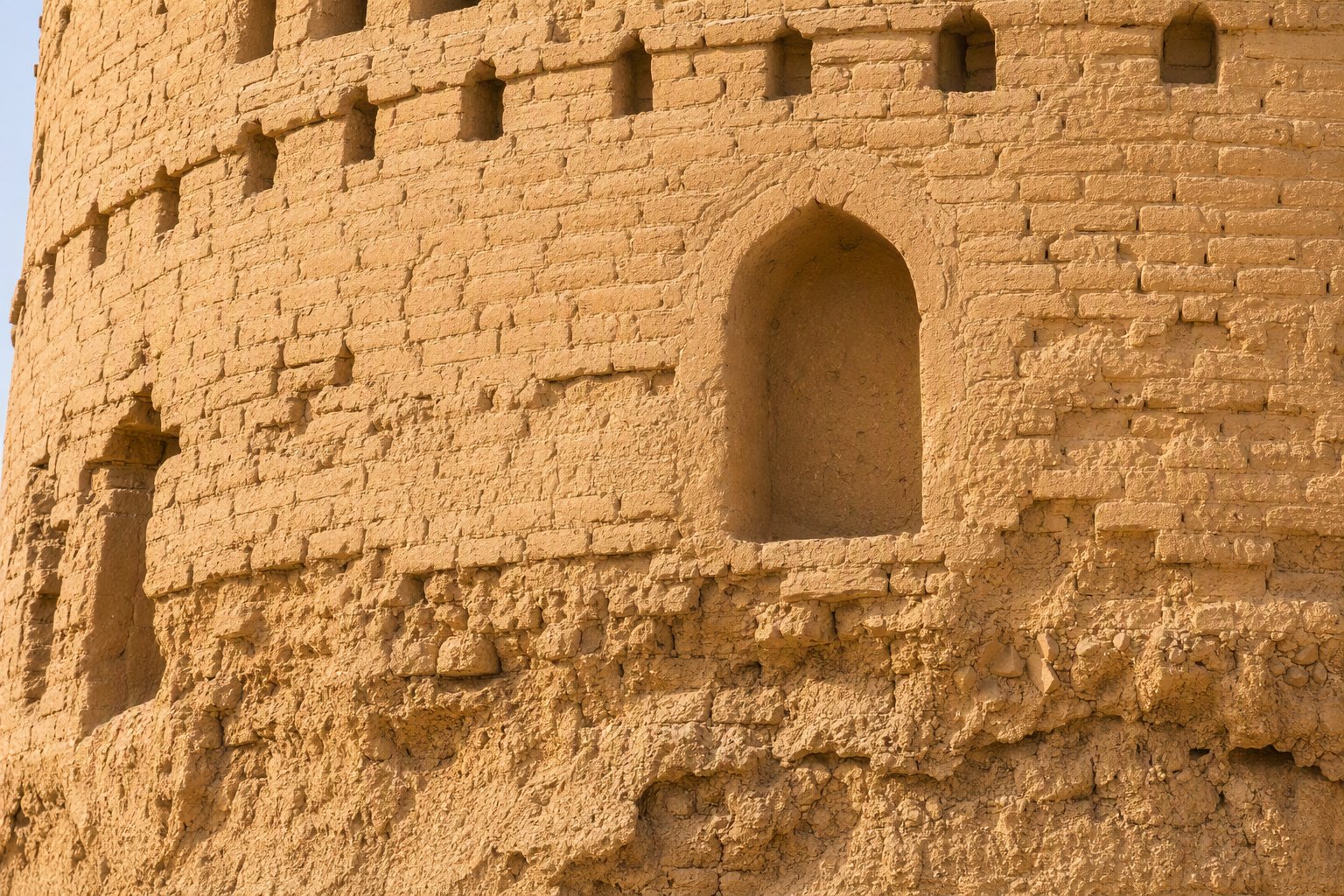
The mile towers are not large structures by the standards of Iranian architecture. Most stand between five and ten metres tall, with a base diameter of roughly three to four metres. They are built of mud-brick and fired brick, materials available in the surrounding landscape, and their construction is simple and functional. The typical tower is slightly tapered, with a solid base and a doorway or niche on one face. The top, where it survives, is domed or flattened.
The visual impact of the towers comes not from their individual grandeur but from their relationship to the landscape. Standing beside one tower and looking along the line to the next, you understand immediately why they were placed where they are. The desert is flat and featureless, and the towers break the monotony of the horizon at regular intervals, creating a rhythm that guided travelers for centuries.
The best time to visit the towers is in the early morning or late afternoon, when the low sun casts shadows from the towers and the desert floor glows with warm light. The silence of the place is remarkable. The central desert is one of the quietest regions in Iran, and the absence of modern noise creates an atmosphere that is closer to what a caravan traveler would have experienced than almost any other surviving landscape in the country.
The broader landscape
A visit to the mile towers is also an opportunity to explore the wider landscape of the central desert margin. The plain east of Isfahan, between the city and the salt marsh near Varzaneh, is a transitional zone where the cultivated land gives way to desert grazing and the settlements become smaller and more widely spaced.
The Varzaneh salt marsh, or Gavkhuni wetland, sits at the end of the Zayandeh Rud river, which flows from Isfahan and disappears into the desert. In the wet season, the marsh holds water and attracts migratory birds. In the dry season, it is a white expanse of salt crust that stretches to the horizon. The contrast between the wetland and the surrounding desert is striking, and it is worth visiting regardless of the season.
The town of Varzaneh itself has a historic bridge over the Zayandeh Rud and a small but attractive old quarter with traditional desert architecture. The town is a good stopping point on the way to or from the towers, and it provides a sense of the settled landscape that existed alongside the open desert through which the caravans passed.
Best time to visit
The central desert margin of Isfahan has a continental climate, with hot summers and cool winters. Summer temperatures regularly exceed forty degrees Celsius in the shade, and the desert surface, with no vegetation to provide relief, is dangerously hot. Winter days are cool to mild, with occasional frost at night.
The best time to visit the mile towers is between late October and early April. During these months, daytime temperatures range from the mid-teens to the mid-twenties, and the light is clear and sharp. The winter months offer the most comfortable conditions for walking around the towers and exploring the surrounding plain.
Spring, from March to May, is also pleasant, with occasional wildflowers on the desert margin after a wet winter. By late May, the heat intensifies, and the summer window closes until autumn.
Safety and practical details
The mile towers stand in open country with no facilities nearby. There is no shade, no water, and no mobile phone coverage in many sections of the desert plain. Bring adequate water, sun protection, and a means of communication. A private vehicle is essential, and you should inform someone of your planned route and expected return time.
The ground around the towers is uneven and can be soft in places, particularly after rain. Wear sturdy shoes and do not climb on the towers themselves, as the mud-brick structure is fragile and unstable. The towers are unprotected heritage sites, and their preservation depends on visitors treating them with care.
For travelers who prefer the safety of a guided excursion, several operators in Isfahan offer desert tours that include the mile towers along with other sites in the region. Mehyar Taxi can arrange private transfers with a driver who knows the routes and the conditions. Mehyar Buses covers the intercity connections to Isfahan, and from there, a taxi is the most practical way to reach the towers.
Nearby and combining with other desert sites
The mile towers can be combined with a visit to the historic city of Isfahan, the salt marsh at Varzaneh, and the desert towns of Nain and Khur. A two-day itinerary based in Isfahan can comfortably include the towers, the wetland, and the old quarter of Varzaneh, with time left for the major monuments of Isfahan itself.
For travelers continuing east, the road from Isfahan through Nain to Tabas and the Dasht-e Lut passes through some of the most dramatic desert landscape in Iran. The caravanserais along this route, built to serve the same trade that the mile towers marked, are worth visiting in their own right, and together they tell the story of how Iran's desert was crossed and connected for centuries.
For more on Iran's desert heritage, see our articles on the [desert plains of Iran](../drafts/desert-plain-of-iran.en.md) and the [historic caravanserais of the central plateau](../drafts/abshar-aj-ramsar.en.md).