
The City of Firsts
Tabriz has long held a special place in Iranian history. Known as the City of Firsts, it was the first city in Iran to establish a modern school, a modern library, a municipality, a fire station, and a theater. Located in the northwest of the country in East Azerbaijan province, Tabriz sits at an altitude of about 1,400 meters, bordered by the Sahand and Eynali mountains. The climate is pleasant in spring and summer, with cool mountain breezes that have drawn travelers for centuries.
The city has served as the capital of Iran during several dynasties, most notably under the Safavids, and has been a vital stop on the Silk Road for over a thousand years. Today, Tabriz blends that deep history with the energy of a modern metropolis of over 1.7 million people. For travelers, the rewards are rich: UNESCO heritage sites, one of the most magnificent mosques in the Islamic world, a park that feels like a retreat from the city, and a cultural depth that rewards every visit.
Mehyar makes exploring Tabriz straightforward. Book your hotel through Mehyar, arrange airport transfers with Mehyar Taxi, and use the app to navigate between sights with confidence.
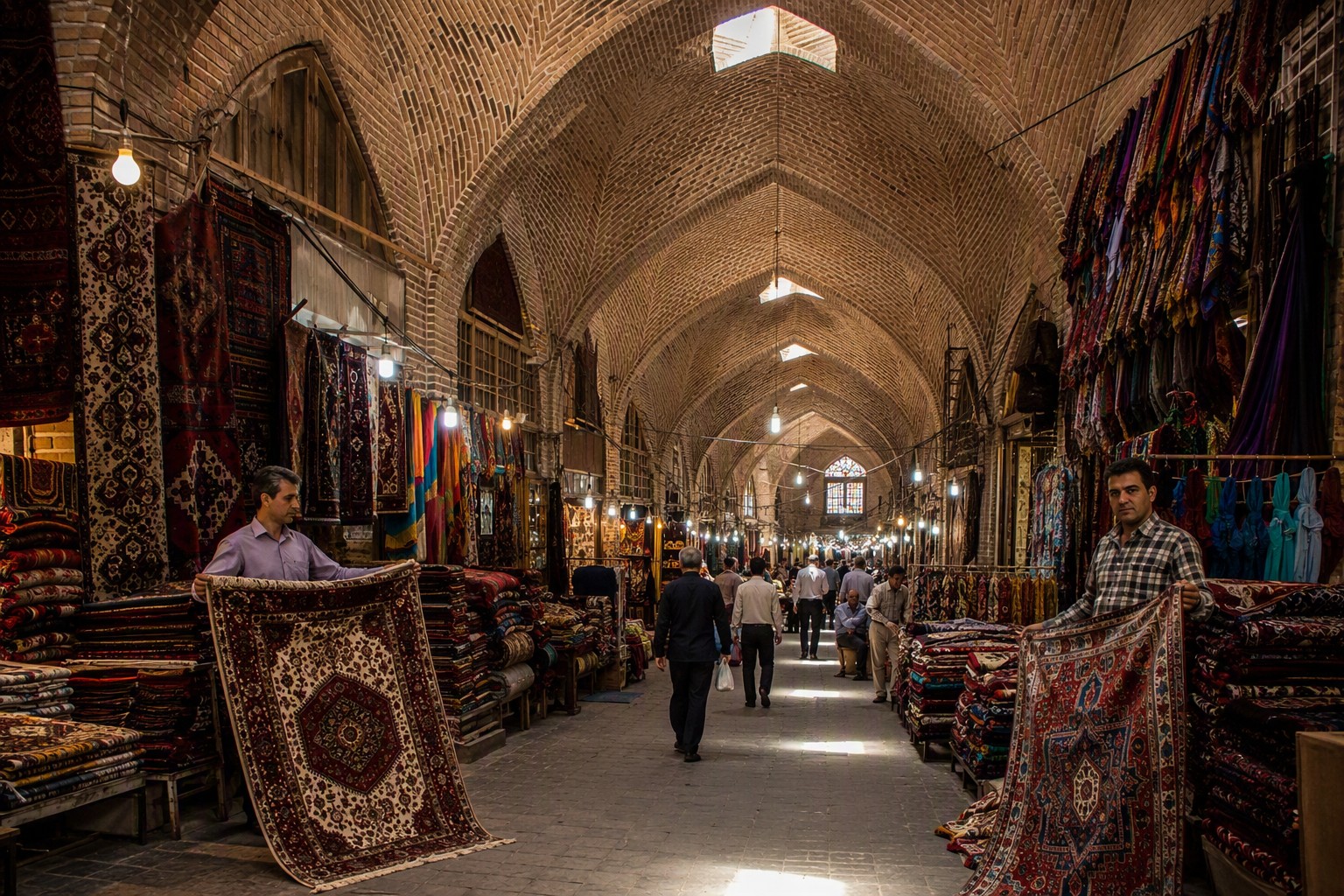
The Grand Bazaar of Tabriz: A UNESCO Treasure
The Grand Bazaar of Tabriz is the crown jewel of the city and one of the most important commercial buildings in the Islamic world. In 2010, UNESCO inscribed it on the World Heritage List, recognizing it as the largest covered bazaar in the world and a masterpiece of Islamic commercial architecture. The bazaar has functioned as a commercial hub for over a millennium, its roots stretching back to at least the 13th century, though the current structures largely date from the 18th and 19th centuries.
The complex spans roughly 7 square kilometers and contains a network of covered corridors, courtyards, caravanserais, and specialized sections for different trades. You will find the carpet sellers in one wing, the gold and silver jewelers in another, the spice merchants in yet another. The Amir Bazaar, dedicated to textiles, and the Mozafarieh, where handwoven carpets are sold, are particularly atmospheric. Light filters through openings in the vaulted brick ceilings, creating dramatic pools of illumination amid the shadowed corridors.
Walking through the bazaar is a sensory experience. The scent of saffron and cardamom mingles with leather and tea. The hammering of coppersmiths echoes from their workshops. Shopkeepers offer you tea and will negotiate with good humor. Allow at least half a day to explore the main corridors, and do not miss the Saray-e Rosh, a caravanserai where silk merchants once stored their goods.
The bazaar is open daily from approximately 09:00 to 18:00, though many shops close on Friday afternoons. There is no entrance fee. Wear comfortable shoes, as the corridors stretch for kilometers. Use Mehyar Taxi to reach the entrance from your hotel; the bazaar sits in the heart of downtown Tabriz, near the municipal square.
The Blue Mosque: A Turquoise Masterpiece
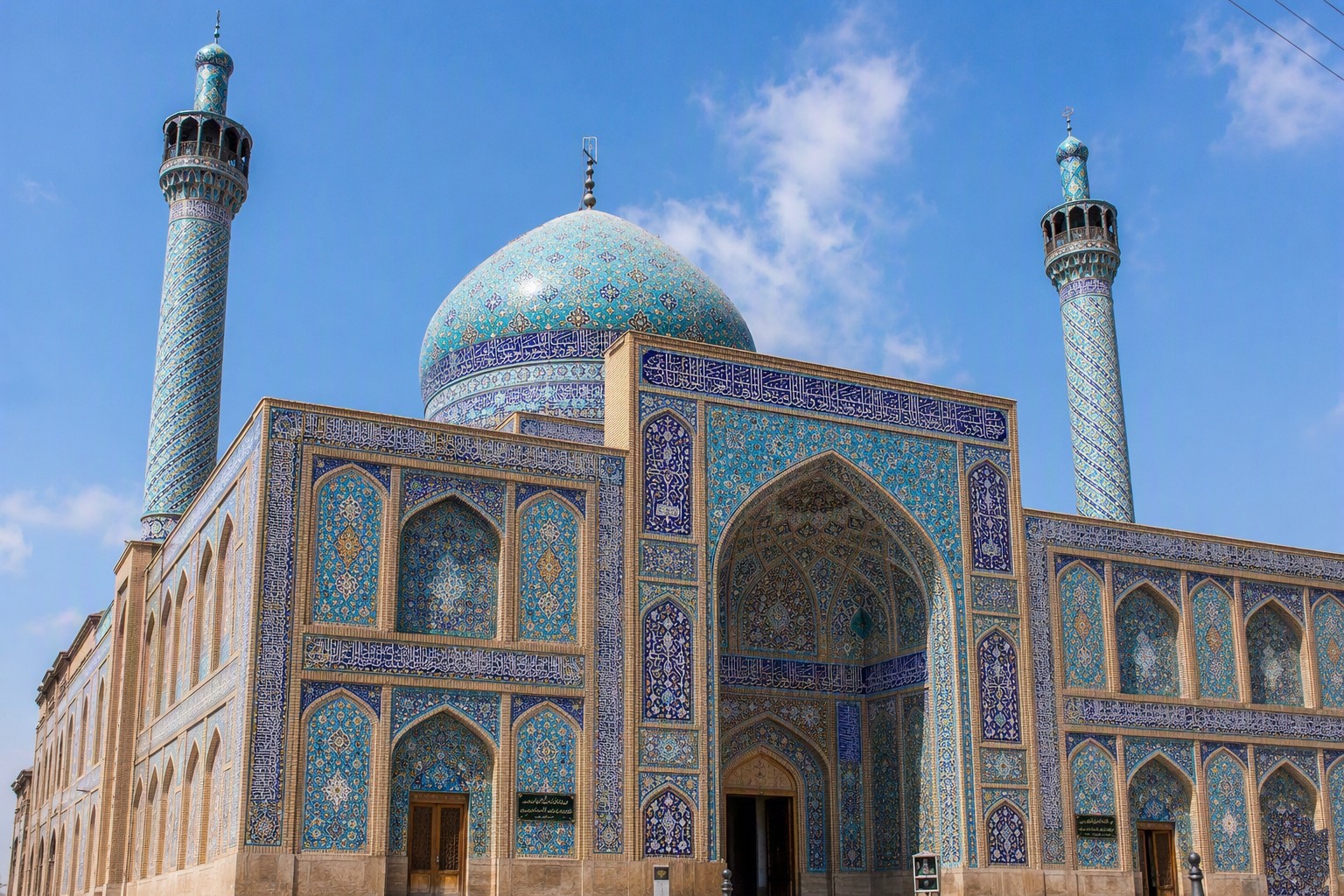
The Blue Mosque, or Masjed-e Kabud, is one of the most exquisite examples of Islamic tilework in the world. Built in 1465 under the orders of Jahan Shah, the ruler of the Qara Qoyunlu dynasty, the mosque was originally part of a larger complex that included a mausoleum, a library, and gardens. An earthquake in 1779 destroyed most of the complex, but the mosque itself survived with much of its extraordinary decoration intact.
What makes the Blue Mosque remarkable is its tilework. The exterior and interior are covered in intricate mosaics of cobalt, turquoise, white, and gold, arranged in geometric and floral patterns of astonishing complexity. The dominant color, a deep lapis lazuli blue, gives the mosque its name. Inside, the mihrab, the prayer niche indicating the direction of Mecca, is framed by bands of calligraphy in the Thuluth script. The ceiling retains original painted and gilded decoration that catches the light beautifully.
The mosque has undergone extensive restoration since the 1970s, and today visitors can walk through the prayer hall, examine the surviving tilework up close, and visit the small museum on-site that displays archaeological finds from the original complex. The Blue Mosque is located in the center of Tabriz, a short walk from the municipal square. Opening hours are typically 08:00 to 18:00, and admission is free or a nominal fee. Photography is permitted, and the detail on the tiles rewards close examination and a zoom lens.
El Goli Park: The Jewel of Tabriz
El Goli, also known as Shah Goli, is the largest and most beloved park in Tabriz. Located in the southeast of the city center, the park is built around a large artificial pool at the center of which stands a two-story pavilion dating from the Qajar era. The park sits at a higher elevation than much of the city, and from its terraces you can look back across Tabriz with the mountains behind it, making it a favorite spot for evening strolls and weekend picnics.
The pool was originally a water reservoir for the city, and the pavilion was used as a summer residence by local rulers. Today, the pavilion houses a restaurant, and the surrounding grounds include walking paths, flower beds, playgrounds, and a small zoo. In the warmer months, paddle boats operate on the lake, and families gather on the grass in the late afternoon to escape the heat of the day. In winter, when the pool freezes, the park takes on a quieter, crystalline beauty.
El Goli is free to enter and open around the clock. It is most atmospheric at sunset, when the pavilion reflects in the dark water and the city lights begin to glow on the surrounding hills. You can reach El Goli easily by Mehyar Taxi from any point in the city. The park is also a short bus ride from the central terminal.
Maqbarat-ol-shoara: The Tomb of Poets
Tabriz has always been a city of letters. Maqbarat-ol-shoara, the Mausoleum of Poets, is a cemetery and memorial dedicated to the great poets and literary figures of Azerbaijan and Iran. The site honors dozens of celebrated writers, including Qeysar Aminpour, Mohammad-Hossein Shahriar, the poet of the famous Turkish-language masterwork "Heydar Babaya Salam," and many others.
The mausoleum was designed by the architect Yahya Foghvazi and completed in the early 2000s. Its architecture blends traditional Persian and Azerbaijani motifs with a modern sensibility. The exterior features carved stone and elegant calligraphic inscriptions. Inside, the tombs are arranged around a central hall, each marked with portraits and biographical details of the poets interred there. The atmosphere is contemplative and dignified, and for lovers of Persian and Azerbaijani literature, it is a deeply moving place.
The mausoleum is located in the Surkhab area of Tabriz, near the eastern edge of the city. Opening hours are roughly 09:00 to 17:00, and admission is free. Plan about an hour for your visit. A Mehyar Taxi from the city center takes roughly 15 minutes.

The Azerbaijan Museum: A Treasury of Art and History
The Azerbaijan Museum, located adjacent to the Blue Mosque, is the largest and most important museum in northwestern Iran. Founded in 1934, it houses an extensive collection of artifacts spanning from the prehistoric era to the Islamic period, including ceramics, textiles, coins, manuscripts, and metalwork. The museum is a vital complement to a visit to the Blue Mosque, as it provides historical context for the region's cultural development over thousands of years.
The highlight of the museum is the collection of Bronze Age and Iron Age artifacts excavated from sites in East Azerbaijan, including weapons, jewelry, and ceremonial vessels that demonstrate the sophistication of ancient civilizations in this part of Iran. The Islamic section features Qurans with exquisite calligraphy, ceramics from the Seljuk and Ilkhanid periods, and examples of the tilework tradition that reached such heights in Tabriz.
The museum is open Saturday through Wednesday from 09:00 to 16:00 and on Thursday mornings. A small entrance fee applies. Allow about 90 minutes for a thorough visit. The museum is within walking distance of the Blue Mosque and the Grand Bazaar, making it easy to combine all three in a single morning.
Getting to Tabriz
Tabriz is served by Tabriz International Airport (TBZ), with regular flights from Tehran, Mashhad, Kish Island, and other Iranian cities. The airport is located about 10 kilometers southwest of the city center, and Mehyar Taxi can arrange your transfer in roughly 20 minutes. Intercity buses also connect Tabriz with Tehran (roughly 8 hours), Isfahan, and other major cities. For a more scenic approach, the train from Tehran passes through the mountains of Zanjan province and offers spectacular views.
Within Tabriz, Mehyar Taxi covers all major attractions. The city is relatively compact, and most sights are within 15 to 20 minutes of the center by car. The bazaar, Blue Mosque, and Azerbaijan Museum form a walkable cluster in the old city. El Goli is a short ride to the southeast, and Maqbarat-ol-shoara is easily accessible from the eastern neighborhoods.
When to Visit
The best time to visit Tabriz is in spring (April to June) and early autumn (September to October), when temperatures range from 15 to 25 degrees Celsius and the mountain air is fresh and clear. Summer days can be warm but the altitude keeps evenings comfortable. Winter brings snow and cold, with temperatures dropping below freezing, though the city remains vibrant and the park takes on a quiet beauty under a blanket of white.
Mehyar has everything you need to plan your Tabriz trip. Search for hotels, book flights, arrange taxis, and explore our city guide for more ideas on where to eat, what to see, and how to make the most of your time in this remarkable city.