
Ardakani House stands as one of Mashhad's finest surviving historical residences, a rare glimpse into the domestic life of wealthy merchants during the late Qajar period. Also called Dowlabian House, after the family that once called it home, the building occupies a quiet alley off Boulevard Vahdet, just steps from the western approaches to the Imam Reza Holy Shrine. The house was registered on Iran's National Heritage List in 2005, recognizing its architectural and historical significance. Today it welcomes visitors free of charge, offering a peaceful retreat from the bustling streets of Iran's second-largest city.
For travelers interested in the cultural layers of Mashhad beyond the shrine itself, Ardakani House provides a compelling stop. Its rooms, corridors, and courtyard tell the story of a city that grew enormously during the nineteenth and twentieth centuries, attracting pilgrims, scholars, traders, and artisans from across the region. The house preserves the atmosphere of that era with remarkable clarity.
Where Is Ardakani House?
The house sits on Boulevard Vahdet, in Vahdet 21 Alley, in the central district of Mashhad. Mashhad is the capital of Razavi Khorasan Province in northeastern Iran. Its location so close to the Imam Reza Haram is no coincidence. During the Qajar period, prominent families built their residences near the shrine to combine the convenience of pilgrimage access with the prestige of a central address.
The neighborhood around Boulevard Vahdet retains much of its historical character, with older buildings, narrow alleys, and a sense of permanence that contrasts with the modern development spreading across Mashhad's suburbs. Walking from the Haram to Ardakani House takes only a few minutes, and the route passes through streets that have served pilgrims and residents for well over a century.
Mehyar arranges visits to Ardakani House as part of broader Mashhad cultural itineraries that include the Holy Shrine, the Goharshad Mosque, the Nader Shah Tomb Museum, and the historic bazaar. Combining these sites into a single day gives visitors a rounded picture of the city's heritage.

How to Reach Mashhad
Mashhad is one of Iran's best-connected cities. Mashhad International Airport (Hashemi Nejad) receives flights from Tehran, Isfahan, Shiraz, Tabriz, and other major Iranian cities, as well as seasonal international services. The flight from Tehran takes roughly 90 minutes.
Rail links connect Mashhad to Tehran, with a journey time of approximately 12 hours, and to other cities including Isfahan and Bandar Abbas. The railway station is located in the south of the city and is reachable by taxi or metro.
Road connections are excellent, with regular bus services from most major cities. Within Mashhad, the public transport system includes buses and a metro line that serves key areas. Taxis are widely available and affordable, and the house is a short ride from most central hotels.
Mehyar provides private airport transfers and can arrange guided visits to Ardakani House alongside a full Mashhad itinerary. A private transfer from the airport to the house takes roughly 30 minutes depending on traffic.
The Architecture of Ardakani House
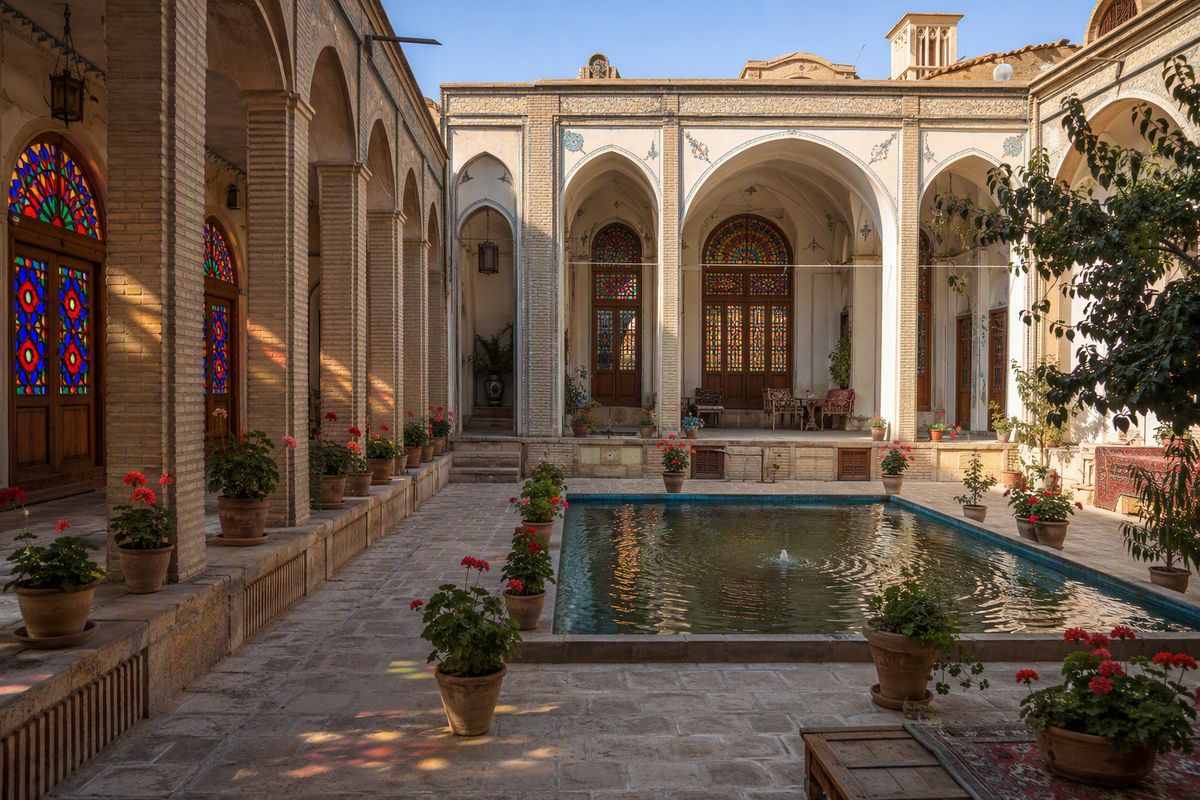
Ardakani House follows the classic plan of a prosperous merchant's residence from the late Qajar era. The layout revolves around a central open courtyard, a design principle that provided light, ventilation, and a private outdoor space for the household. The courtyard is flanked by iwans, vaulted recesses that serve as transitional spaces between the open air and the enclosed rooms.
The main reception rooms are located on the northern side, facing the courtyard and benefiting from the best light. These rooms were designed to receive guests and to host gatherings, and they display the most elaborate decorative treatment in the house.
The structural system is load-bearing brick with timber beams, and the roof structure uses traditional timber joists. The overall form is compact and inward-looking, as was customary for domestic architecture of this period, with the principal facades facing inward toward the courtyard rather than outward toward the street.
Ornamental Craftsmanship
What distinguishes Ardakani House from other historical houses in the region is the quality and variety of its decorative elements. Several craft traditions are represented in the building, each demonstrating the skill of Qajar-era artisans.
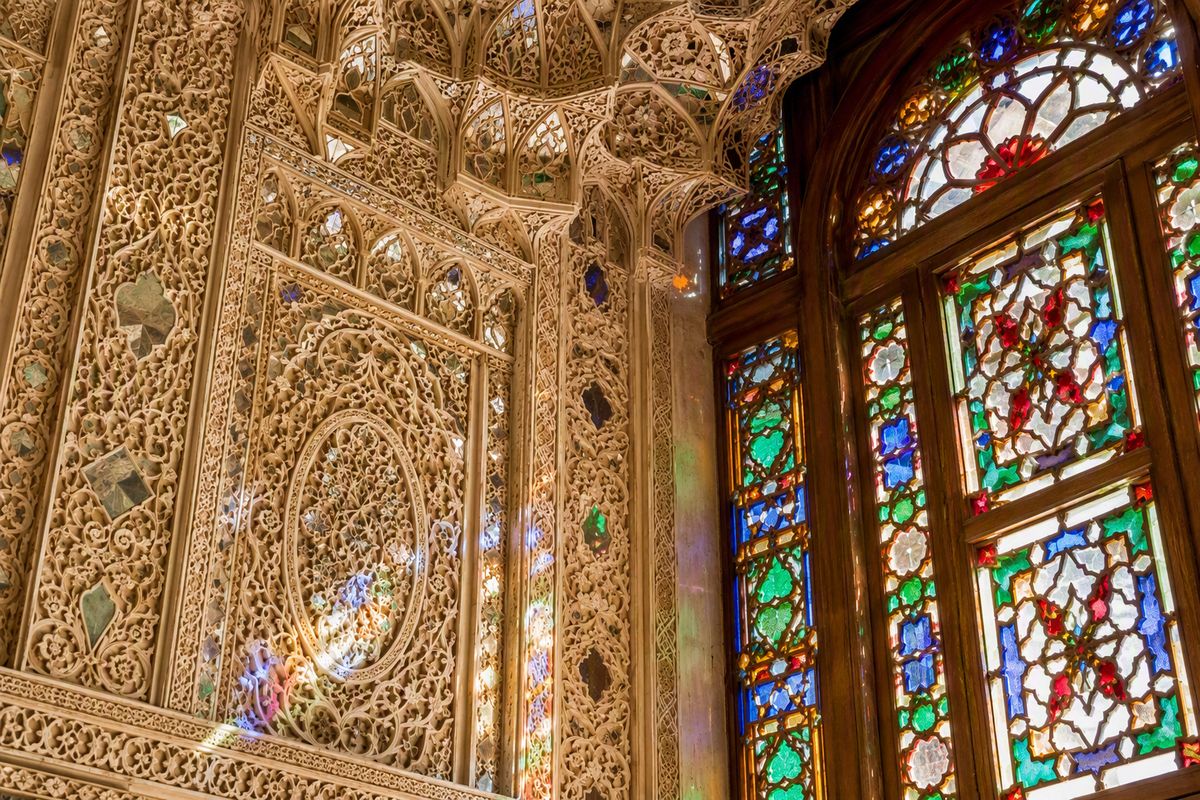
Plasterwork (Gach-bori). The walls and ceiling niches feature elaborate carved plaster in geometric and floral patterns. This technique involves carving wet plaster into intricate designs, a process that requires considerable patience and precision. The plasterwork in Ardakani House includes muqarnas, or stalactite vaulting, in the iwan headers, as well as framed panels of interlocking geometric patterns in the main reception rooms.
Mirrorwork (Ayeneh-kari). Some of the rooms contain mirrorwork, in which small fragments of mirrored glass are set into plaster to create dazzling reflective surfaces. This technique was popular in Qajar architecture for both religious and domestic buildings, and it catches the light beautifully, making even dimly lit rooms feel bright and expansive.
Stained Glass (Orsi). The windows of the main rooms incorporate colored glass set into wooden frames, casting patterned light across the floor and walls. The colors include deep blues, emerald greens, amber yellows, and ruby reds, and their arrangement follows geometric patterns that complement the plasterwork below.
Wood carving. The doors throughout the house feature carved wooden panels with interlocking diamond and star patterns. Some doors are of the lattice type, allowing light and air to pass while maintaining privacy. The wood shows the natural patina of age, and the carving quality is consistently high.
Painted ceilings. Several rooms have painted wooden ceilings with floral motifs and geometric borders. The paint palette uses earth tones alongside blue and gold, reflecting the decorative tastes of the late nineteenth century.
The Dowlabian Family and the House's Origins
The house is also known as Dowlabian House, after the family who built and occupied it during the late Qajar period. The Dowlabians were among the established families of Mashhad, involved in trade and commerce. Their connection to the city's economic life gave them the means to commission a residence of this quality.
The original Ardakani family from whom the house takes its primary name came from Ardakan, a town in Yazd Province with a strong tradition of architecture and craftsmanship. Families from Ardakan were known for migrating to major cities such as Mashhad, Yazd, and Kerman during the nineteenth century, bringing with them building techniques and aesthetic traditions from central Iran. The blending of Yazdi architectural influence with the local Khorasani style is one reason this house has a distinctive character compared to other Qajar residences in Mashhad.
The building served as a family home for several decades before its heritage value was formally recognized. Its registration on the National Heritage List in 2005 ensured its protection and opened the way for restoration and public access.
Restoration and Public Access
Following its heritage listing, the house underwent careful restoration to address structural issues and to conserve the decorative surfaces. The restoration work followed established conservation principles, prioritizing the retention of original fabric and the use of traditional materials and techniques.
Today, visitors can walk through the main courtyard, enter the reception rooms, and examine the decorative details at close range. The house is furnished minimally, allowing the architecture and ornamentation to speak for themselves. Information panels provide context about the building's history and the craft techniques used in its decoration.
Entry is free, and the typical visit lasts about one hour. The house is open daily, and the morning light is the best for appreciating the stained glass and plasterwork. Photography is permitted, and the courtyard provides excellent opportunities for architectural photography.
Nearby Attractions
Ardakani House is ideally placed for combining with other Mashhad attractions. The Imam Reza Holy Shrine is the dominant landmark of the city and draws millions of pilgrims each year. Its architectural complex includes the Goharshad Mosque, built in the fifteenth century by the wife of Shah Rukh of the Timurid dynasty, which is a masterpiece of Islamic architecture in its own right.
The Nader Shah Tomb Museum, dedicated to the famous Afsharid conqueror, is a short drive away. The Mashhad Grand Bazaar, one of the oldest and largest covered bazaars in Iran, is within walking distance and offers a vivid experience of the city's commercial traditions.
For visitors with more time, the Kooh Sangi Park and the Torghabeh and Shandiz areas on the western outskirts of Mashhad provide green spaces and mountain scenery, along with restaurants serving local specialties such as shishlik kebabs.
Best Time to Visit Mashhad
Spring, particularly March through May, offers mild temperatures and pleasant conditions for walking between sites. Autumn, from September through November, is equally comfortable. Summers in Mashhad can be hot, with daytime temperatures frequently exceeding 35 degrees Celsius, although the house's thick walls and courtyard design provide natural cooling. Winters are cold, with occasional snow, but the house remains open and the indoor spaces are sheltered.
Mehyar can advise on the best timing for your visit and arrange a program that balances cultural sites with the practicalities of weather and travel logistics.
Practical Details
- Address: Boulevard Vahdet, Vahdet 21 Alley, Mashhad, Razavi Khorasan Province
- Era: Late Qajar (nineteenth century)
- Also known as: Dowlabian House
- Heritage status: National Heritage, registered 2005
- Entry fee: Free
- Recommended visit duration: Approximately 1 hour
- Opening hours: Daily, morning to early evening
- Nearby attractions: Imam Reza Holy Shrine, Goharshad Mosque, Nader Shah Museum, Mashhad Grand Bazaar