
You step off the metro at 15 Khordad Station, walk north past the first rows of the Grand Bazaar, and the character of the city shifts. The noise of traffic fades behind you, and a wall of painted tile and carved stone rises ahead. Beyond it, a garden of plane trees and marble fountains opens up, and at the far end, a building of such elaborate decoration that it looks more like a giant jewel box than a seat of government. This is the Golestan Palace, the oldest of Tehran's royal monuments and the only one that carries a UNESCO World Heritage designation. It has been the stage for some of the most consequential moments in modern Iranian history, and it remains, after more than four centuries, the most architecturally complete royal complex in the capital.
The Golestan Palace occupies 4.5 hectares in the centre of Tehran, though this is only about a tenth of its original extent. What survives today is a collection of buildings, gardens, and halls that span the Safavid, Zand, Qajar, and early Pahlavi periods, each dynasty adding to what the previous one had built. The complex reached its greatest extent under the Qajars, who made Tehran their capital and transformed the Golestan from a modest garden retreat into a full royal city. Today it contains eight major structures, each with its own character and history, along with courtyards, fountains, and a walled garden that offers a rare patch of green shade in the middle of one of the most congested cities in the Middle East.

A History Spanning Four Centuries
The story of the Golestan Palace begins in the late sixteenth century, during the reign of Shah Abbas I of the Safavid dynasty. Shah Abbas, who did more than any other ruler to shape the character of Tehran, ordered the construction of a garden and fortified enclosure on the site that is now the palace. The name Golestan means "garden of flowers" or "rose garden" in Persian, and the original complex lived up to its name, with planted grounds surrounded by high walls.
For the next two centuries, the Golestan was a secondary royal residence, overshadowed by the great Safavid capital of Isfahan. Its fortunes changed at the end of the eighteenth century, when Aqa Mohammad Khan Qajar chose Tehran as the capital of the new Qajar dynasty. The Qajar shahs made the Golestan their primary residence, and over the course of the nineteenth century, they expanded and embellished it into the complex that visitors see today.
The most important building campaigns took place under Fath Ali Shah Qajar and Naser al-Din Shah Qajar. Fath Ali Shah added the earliest of the surviving structures, including the foundations of what would become the Khalvat-e Karimkhani. Naser al-Din Shah, who reigned for nearly fifty years and was the most cosmopolitan of the Qajar rulers, commissioned the grandest buildings in the complex: the Shams al-Emareh, the Talar-e Salam, and the Talar-e Almas. These buildings, influenced by the European architectural styles that Naser al-Din Shah encountered on his trips to France and England, represent a distinctive moment in Iranian architecture, when local craftsmen and imported design ideas produced buildings that are neither wholly Persian nor wholly European but something unique.
The Pahlavi dynasty, which replaced the Qajars in 1925, used the Golestan for state ceremonies but shifted the centre of gravity of the monarchy to the Niavaran and Saadabad complexes in the northern part of the city. After the 1979 revolution, the Golestan was converted into a museum, and it is in this capacity that it has been preserved and opened to the public.

The Key Buildings
The complex contains several major structures, each worth a separate visit. They are arranged around a series of courtyards and gardens, and a single circuit through the palace takes in the most important of them.
Shams al-Emareh (The Sun Building)
The Shams al-Emareh is the most visually striking building in the Golestan Palace. Five storeys tall and thirty-five metres high, it was the tallest structure in Tehran when it was completed in 1866. Its facade is a composition of painted tile, carved stone, and arched windows, arranged in a symmetrical pattern that combines Persian decorative traditions with a European sense of massing and proportion. The building served as a royal residence and observation tower, and its upper floors offer views across the palace gardens and over the surrounding city.
Takht-e Marmar (The Marble Throne)
The Takht-e Marmar is the oldest surviving structure in the complex, dating back to the era of Karim Khan Zand in the eighteenth century. The marble throne itself, carved from a single block of yellow marble, was brought to Tehran when the Qajars made the city their capital. The hall that houses it is decorated with elaborate mirror work, painted ceilings, and marble columns. This is where the Qajar shahs held court, and it was the site of some of the most important ceremonies of the Iranian monarchy.
Talar-e Salam (The Hall of Salutations)
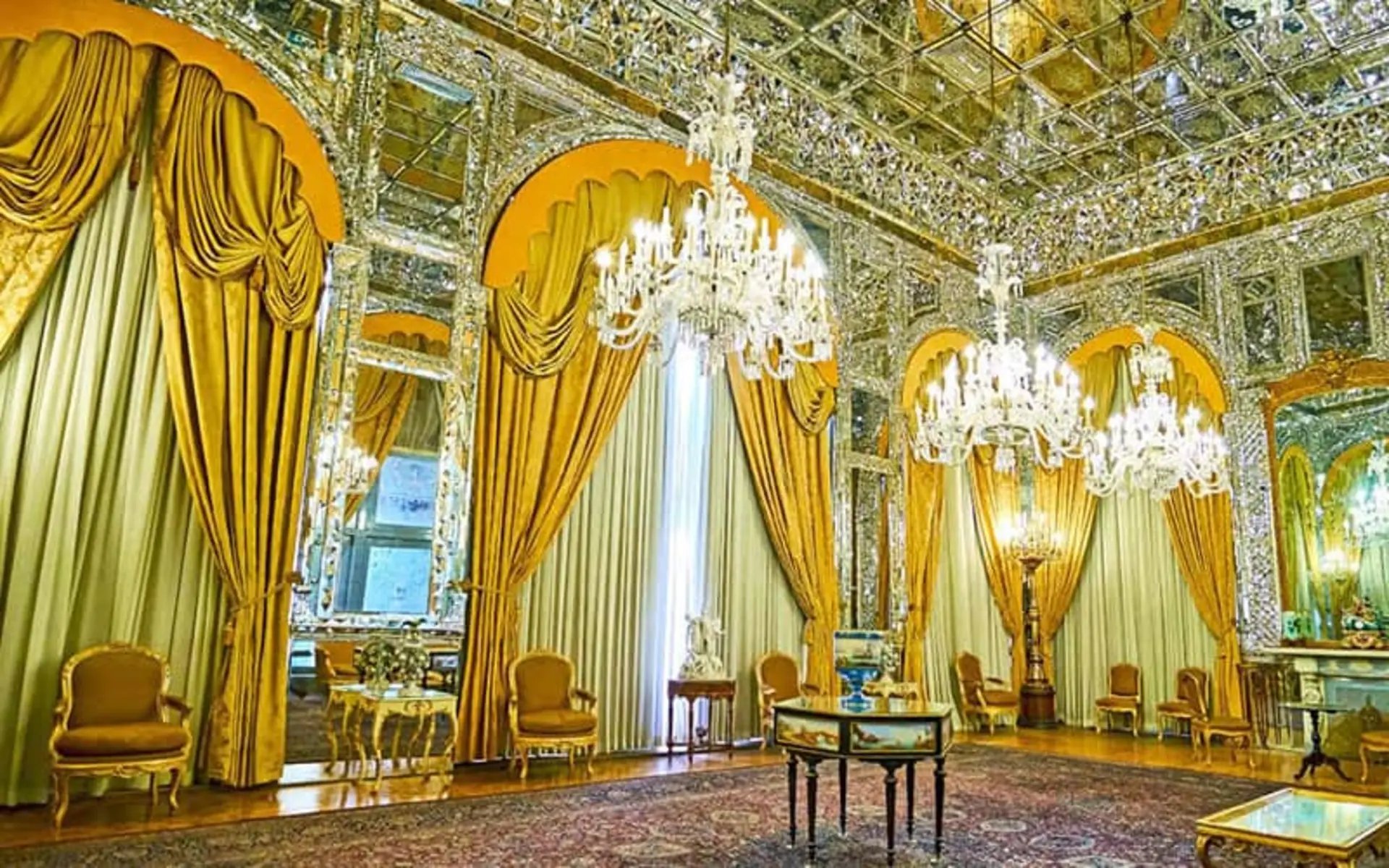
The Talar-e Salam is the most opulent interior in the Golestan Palace. Its walls and ceiling are covered in mirror work of extraordinary complexity, with thousands of small mirrors arranged in geometric patterns that reflect the light of the chandeliers into a thousand points. The hall was designed for state receptions, and the effect of the decoration is intended to overwhelm, to create an atmosphere of absolute splendour that would impress foreign ambassadors and domestic visitors alike.
Talar-e Almas (The Diamond Hall)
The Talar-e Almas is smaller than the Talar-e Salam but no less impressive. Its mirror work is even more intricate, with diamond-shaped mirrors set into the walls and ceiling, creating a sparkling effect that gives the hall its name. The hall was used for more intimate royal functions, and its decoration combines the finest work of the Qajar-era craftsmen with European-influenced furniture and fixtures.
Khalvat-e Karimkhani (The Karim Khan Retreat)
The Khalvat-e Karimkhani is one of the oldest parts of the complex, named after Karim Khan Zand, who built the original structure. It consists of a small, intimate garden pavilion with a wind tower, designed as a private retreat for the ruler. The simplicity of the building, after the ornate halls of the Qajar period, is a welcome contrast, and the garden around it is one of the most pleasant spaces in the palace.
Other Structures
The Badgir Mansion, named for its wind catchers, is an example of traditional Iranian climate-adapted architecture. Kaakh-e Abiyaz (The White Palace) houses an ethnographic collection. The museum of Qajar-era gifts and the photography museum round out the complex, offering a comprehensive view of the royal life and the artistic traditions that surrounded it.

UNESCO World Heritage Status
The Golestan Palace was inscribed on the UNESCO World Heritage List in 2013, making it one of Iran's most significant cultural sites. The designation recognized the complex's outstanding universal value as a masterpiece of Qajar-era art and architecture, its role as a witness to the modern history of Iran, and its preservation of the traditions of Persian decorative arts, including tile work, mirror work, stucco, and painting.
The complex was also listed as a national monument of Iran in 1955, providing legal protection for its structures and grounds.
Getting to Golestan Palace
The Golestan Palace is located on 15 Khordad Street, on the north side of Arg Square, in the historic centre of Tehran. It is one of the most accessible major monuments in the city, within walking distance of the Grand Bazaar and the Tehran Metro Line 1.
The closest metro station is 15 Khordad Station on Line 1, a five-minute walk from the palace entrance. Taxis and ride-hailing services can drop you directly at the gate. From the main commercial districts of Tehran, the palace is a short ride, though traffic in the area can be heavy during business hours.
Mehyar covers transport to and from the Golestan Palace. Mehyar Taxi is the most convenient option for getting directly to the entrance, and Mehyar Flights can arrange airport transfers for visitors arriving in Tehran who want to include the palace in their first-day itinerary. For those staying in Tehran, Mehyar Buses and Mehyar Trains connect from the intercity terminals to the city centre, from where the palace is a short metro ride or taxi journey.

Opening Hours, Tickets, and Practical Information
The Golestan Palace is open to visitors from morning until late afternoon, typically from around 9:00 to 17:00, though exact hours may vary by season. Tickets are available at the gate, with separate rates for Iranian and foreign visitors. Prices have changed frequently in recent years; as of the latest information, tickets range from 15,000 to 30,000 Toman for the basic entry, with additional charges for special exhibitions.
A full visit to the palace, including all the major buildings and the museum collections, takes between two and three hours. Visitors who are particularly interested in the decorative arts, the photography collection, or the ethnographic display may want to allow a full half day.
Photography is permitted in the courtyards and gardens. Inside the buildings, photography rules vary by room, and flash photography is generally restricted to protect the delicate mirror work and painted surfaces.
Combining Your Visit with Central Tehran
The Golestan Palace sits at the heart of the oldest part of Tehran, and it can easily be combined with visits to the Grand Bazaar, which lies immediately to the south, and to the historic mosques and caravanserais of the bazaar quarter. The complex is also within reach of the Golestan Park, the National Museum of Iran, and the remnants of the old city walls.
For visitors with a full day in central Tehran, a morning at the Golestan Palace followed by a walk through the bazaar and a lunch at one of the traditional restaurants in the area makes a rewarding itinerary. In the afternoon, the National Museum or the jewelry museum at the Central Bank offer further insight into Iran's cultural heritage.
Mehyar can help organize a full day in Tehran that includes the Golestan Palace, the Grand Bazaar, and other landmarks of the historic centre. Mehyar Hotels covers accommodation throughout the city, and Mehyar Buses, Mehyar Trains, and Mehyar Flights handle transport to Tehran from anywhere in Iran.
Important Note
Visitors should be aware that the Golestan Palace may occasionally close for restoration work or for other reasons. Before planning your visit, check the current status by contacting the palace directly or consulting recent travel reports. The official website is golestanpalace.ir, and the phone number is 021-33956662.
Why the Golestan Palace Still Matters
The Golestan Palace is not a frozen monument to a bygone era. It is a living record of the transformations that Iran has undergone over the past four centuries, from the Safavid garden retreat to the Qajar seat of government to the museum of the Islamic Republic. Each building in the complex tells a different story, and the combination of Persian decorative traditions with European architectural influences reflects the broader encounter between Iran and the West that shaped the modern Middle East.
For travelers to Tehran, the Golestan Palace offers something that no other site in the city can match: the chance to walk through the spaces where the decisions that shaped modern Iran were made, and to see those spaces as they were decorated and furnished by the people who inhabited them. It is a place of beauty, of history, and of a depth of cultural memory that rewards close attention.