
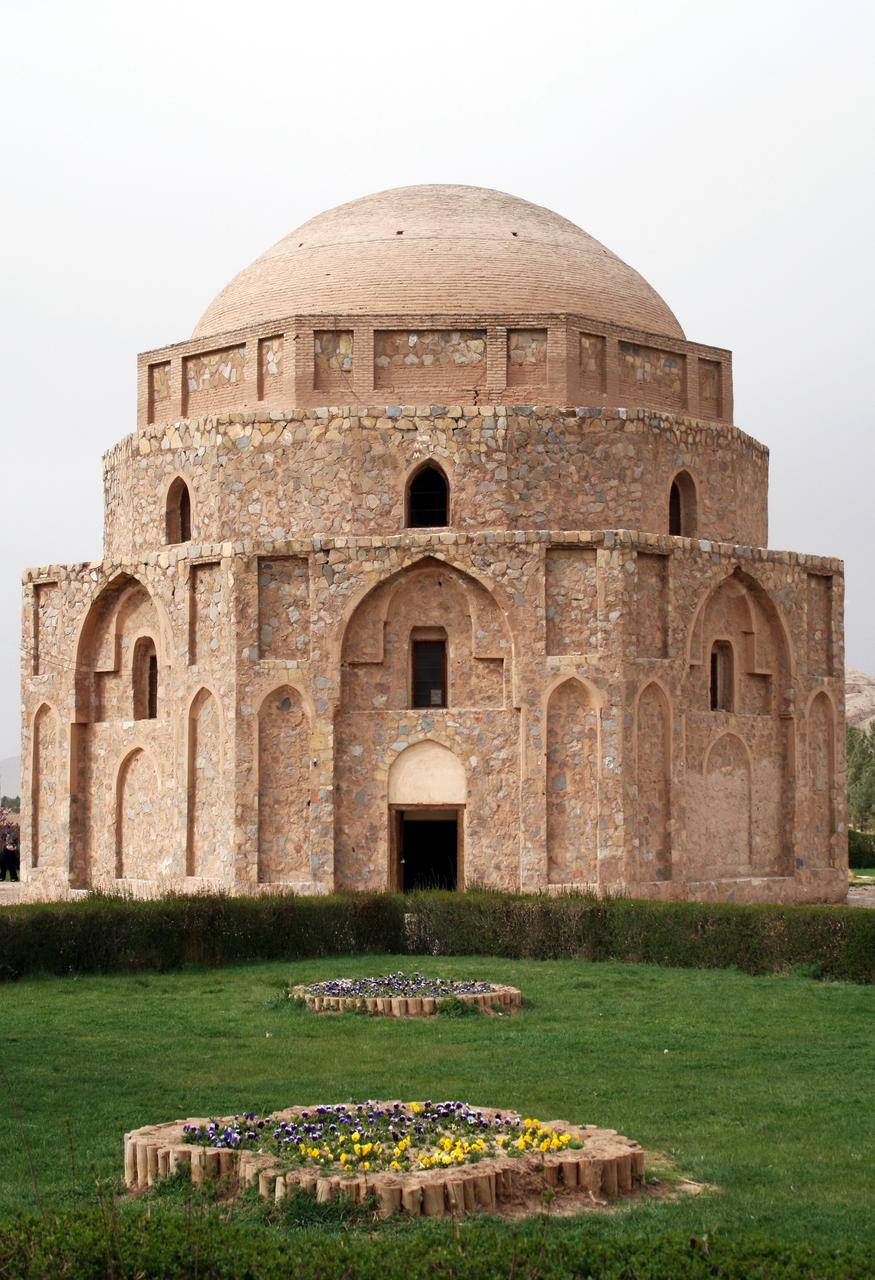
In the eastern outskirts of Kerman, a few kilometres beyond the last row of pistachio orchards, a dome of grey stone rises from the flat desert floor. It is not large, and from a distance it looks almost like a small fortress that someone placed on the plain and then forgot. But when you walk up to it, the form becomes clear: eight walls of roughly cut stone, each one slightly tilted inward, meeting at a circular drum that supports a brick dome. The joints between the stones are tight, the mortar is hard as concrete, and the whole structure has a solidity that speaks of great age. This is Gonbad-e Jabalieh, the Jabalieh Dome, and it is one of the most enigmatic buildings in all of Iran.
No one knows exactly when the Jabalieh Dome was built, and that is part of its appeal. The most common theory places it in the late Sassanid period, the centuries just before the Arab conquest of Iran in the seventh century. The architecture supports this dating: the octagonal plan, the use of stone rather than brick, and the transition from square base to circular dome all echo Sassanid building traditions found at sites like Firuzabad and Ctesiphon. But other scholars point to the brick dome, which is a feature more typical of the early Islamic period, and suggest a date in the ninth or tenth century, when Kerman was under the rule of the Buyid dynasty. The truth may lie somewhere in between, with the lower structure predating the dome by centuries.
What is not in dispute is that the building is unusual. Iran has thousands of domed structures, but most are brick or tiled, and most belong to mosques, mausoleums, or caravanserais. The Jabalieh Dome is made of stone, which is rare for a dome in this part of the world, and its octagonal shape sets it apart from the more common circular or square plans. It stands as a reminder that the history of Iranian architecture is full of experiments, false starts, and one-off structures that defy easy classification.
Where is the Jabalieh Dome?
Gonbad-e Jabalieh sits on the eastern edge of the city of Kerman, about five kilometres from the city centre. Kerman is the capital of Kerman Province in southeastern Iran, roughly 800 kilometres from Tehran by road. The province is the largest in Iran by area, and it stretches from the central desert plateau in the north to the shores of the Persian Gulf in the south.
The dome stands in a flat, open area on the outskirts of the city, near the road that leads east toward the town of Mahan and the garden of Shah Nematollah Vali. There are no other buildings immediately adjacent to it, which gives the structure an isolated, almost lonely quality. The surrounding land is used for agriculture, primarily pistachio orchards and fields of wheat and cumin, and the dome appears suddenly as you drive along the road, its grey stone walls catching the light against the brown of the desert plain.
The exact location is on the eastern side of Kerman, near the village of Jabalieh, from which the dome takes its name. The coordinates are approximately 30.29 degrees north and 57.08 degrees east, well within the central Iranian plateau at an elevation of about 1,750 metres above sea level.
How to get to Kerman and to the Jabalieh Dome
Kerman is remote by Iranian standards, sitting in the southeastern corner of the country far from the main tourist circuit of Isfahan, Shiraz, and Yazd. But it is accessible, and the journey there is part of the experience.
By plane. Kerman has an international airport, Ayatollah Hashemi Rafsanjani Airport, with regular domestic flights from Tehran, Mashhad, and Isfahan. The flight from Tehran takes about an hour and a half. From the airport, it is a twenty-minute taxi ride to the city centre, and the Jabalieh Dome is a further fifteen minutes by car to the east.
By Mehyar Buses. Mehyar Buses connects Tehran to Kerman with comfortable coaches that run daily. The journey takes approximately twelve to fourteen hours, crossing the central desert through towns like Nain and Anar. It is a long ride, but the landscape changes from the mountains south of Tehran to the flat, empty desert of the central plateau, and the experience is worth the time.
By Mehyar Taxi. Within Kerman, Mehyar Taxi is the easiest way to reach the Jabalieh Dome from your hotel. Set your destination to the dome or to the village of Jabalieh, and the driver will take you there. A private car also gives you the option to combine the dome with a visit to Mahan, which is only thirty kilometres to the east and home to the garden and mausoleum of Shah Nematollah Vali.
By train. Kerman is connected to the national rail network, with trains running from Tehran via Yazd and from Bandar Abbas on the Persian Gulf coast. The train from Tehran takes about sixteen hours and passes through some of the most dramatic desert scenery in Iran. From Kerman railway station, a taxi will bring you to the dome in about twenty minutes.
What to see at the Jabalieh Dome
The dome is small, and a visit does not take long. But there is more to appreciate than first meets the eye.
The exterior structure. Walk around the building slowly and look at the walls. The stone is a grey-green basalt or andesite, quarried locally and roughly dressed to fit together without the precision of cut ashlar but with a tightness that has kept the structure standing for centuries. The octagonal plan means that each face of the building is slightly angled, and the effect is to give the dome a quality of movement, as if it is not quite settled into the ground but is holding itself upright by an act of will.
The transition from the octagonal base to the circular dome is handled by a zone of squinches, the architectural devices that allow a circular structure to sit on a polygonal one. The squinches at Jabalieh are simple corbelled arches, and they are among the earliest examples of this technique in Iranian architecture. Above the squinches, the drum is built of brick, and the dome itself is also brick, laid in a herringbone pattern that is typical of the period.
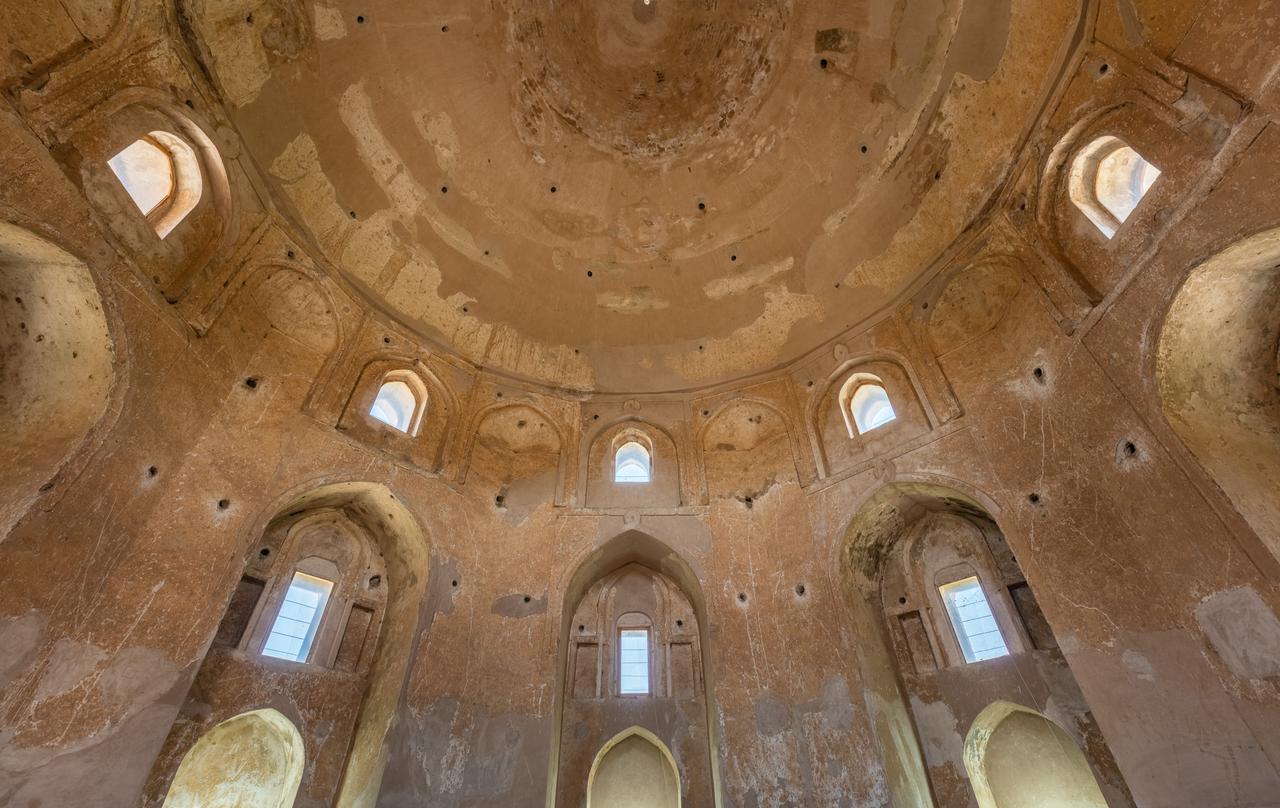
The interior and the museum. Since 2004, the interior of the dome has housed a small museum of local antiquities. The collection includes pottery, metalwork, and stone objects found during excavations in Kerman Province, ranging from the prehistoric period through the Islamic era. The objects are not displayed in glass cases but are arranged on simple shelves and plinths, with labels in Persian and occasional English translations. The lighting inside the dome is dim, filtered through the small windows in the drum, and the effect is to give the objects an intimate, almost sacred quality, as if they are being kept in a reliquary rather than a museum.
The ceiling of the interior is the underside of the brick dome, and it is worth looking up. The herringbone pattern of the bricks is clearly visible from below, and you can see how the weight of the dome is distributed through the squinches down into the stone walls. It is a masterclass in structural engineering, executed without the benefit of modern tools or calculations.
The surrounding landscape. The dome sits in open country, and the views in every direction are expansive. To the west, you can see the city of Kerman and the line of mountains that marks the northern edge of the central desert. To the east, the land stretches away toward the Lut Desert, one of the hottest and most desolate places on earth. In the early morning or late afternoon, when the light is low, the landscape takes on a golden quality that is hard to describe and impossible to photograph properly.

The mystery of the Jabalieh Dome
What was the Jabalieh Dome built for? This is the question that every visitor asks, and the honest answer is that no one knows for certain. Several theories have been proposed.
The most common theory is that it was a fire temple, a place of Zoroastrian worship from the Sassanid period. The octagonal plan and the stone construction both have parallels in known Sassanid fire temples, and the orientation of the building may align with astronomical observations that were important in Zoroastrian ritual. The dome itself, with its circular form, could represent the celestial vault, a common symbol in Zoroastrian cosmology.
A second theory suggests that the building was a mausoleum, perhaps for a local ruler or noble. The Sassanids built monumental tombs, and the Jabalieh Dome's size and solidity are consistent with a funerary function. The museum inside now contains objects from tombs in the area, which adds a certain irony to the building's current use.
A third theory, less widely accepted, holds that the dome was part of a larger complex, perhaps a palace or a caravanserai, of which nothing else survives. The isolation of the building makes this theory difficult to prove or disprove, but it is worth noting that the surrounding land is flat and open, with no obvious reasons for a standalone structure of this size to be built here unless it was part of something larger.
The truth may never be known, and that is part of the charm. The Jabalieh Dome is one of those places in Iran where the silence of the stones is louder than any explanation.
Best time to visit the Jabalieh Dome
Kerman has a desert climate, with very hot summers and cool winters. The best time to visit the Jabalieh Dome is in spring or autumn.
Spring (March to May) offers mild temperatures, clear skies, and the occasional green of the pistachio orchards in bloom. The light in spring is soft and warm, ideal for photography.
Autumn (September to November) is equally pleasant, with cool mornings, warm afternoons, and the golden light of the desert at its best. This is probably the most beautiful time to visit, when the landscape around the dome takes on tones of amber and gold that complement the grey stone of the building.
Summer (June to August) is hot, with temperatures regularly exceeding forty degrees. The dome has no shade, and a midday visit in summer is uncomfortable. If you must visit in summer, go early in the morning.
Winter (December to February) can be cold, with frost and occasional snow at this elevation. The dome is still accessible, but the days are short and the light is harsh.