
Why 25 Esfand Matters in Iranian Literary History
Every year on 25 Esfand (around March 14), literary circles, universities, and cultural institutions across Iran pause to honor the memory of Parvin Etesami, the most celebrated female poet in the country's modern history. Born Roshandeh Etesami on this day in 1285 SH (1907 CE), she reshaped Persian poetry at a time when few women dared to write publicly, and she did so with a voice that carried both compassion and fierce moral clarity. The commemoration is not merely ceremonial. It is a moment when Iranians revisit verses that still speak to questions of justice, dignity, and the human condition.

A Tabriz Birth and a Family Steeped in Letters
Parvin Etesami entered the world in the northwestern city of Tabriz, a place long regarded as one of Iran's great cultural centers. Her father, Yusef Etesami Ashtiani, known by his pen name Etesam al-Molk, was himself a prominent writer, scholar, and eventually a member of parliament. He had established the first printing press in Tabriz, a remarkable venture for the era, and his circle of intellectual friends included figures like Dehkhoda and Malek al-Shoara Bahar, two towering names in Persian letters. It was into this environment of serious literary engagement that Parvin was born, and the influence would prove decisive.
Her mother, Akhtar Fotouhi, came from an Azerbaijani family and provided the domestic warmth that balanced the household's intellectual intensity. When Parvin was six years old, the family relocated from Tabriz to Tehran, a move prompted by her father's growing professional commitments. That transition placed the young girl at the heart of Iran's constitutional movement, where she encountered the era's leading thinkers and reformers at an impressionable age.

Education and Early Artistic Awakening
Parvin's education unfolded both formally and informally. At home, she studied Persian, Arabic, and English under her father's direct tutelage. She attended the American School in Tehran, an institution run by American Presbyterian missionaries, where she excelled among her peers. By the time she completed her studies there in 1303 SH (1924 CE), she had already begun teaching English and literature at the same school, a testament to her command of language.
Her poetic output began astonishingly early. Her first verses appeared at age seven, and some of her most admired poems were composed between the ages of eleven and fourteen. Her father guided her technical development with disciplined exercises. He would assign her a classical poem, perhaps by Saadi or Hafez, and ask her to alter its meter, find a new rhyme scheme, or compose a response in a different form. He also translated passages from English, French, Turkish, and Arabic literature into Persian and encouraged her to rework those translations into original verse. These exercises built the technical mastery that would define her mature style.
Among the notable poems from this early period are "The Gem and the Stone," "O Little Bird," "The Orphan's Tear," "The Ambitious Child," and "The Sorrow of Poverty." That a teenager could address themes of social injustice with such conviction remains one of the remarkable features of her career.
The Structure and Innovation of Parvin's Poetry
Parvin Etesami's collected works, known as her Divan, contain 248 poems, of which 65 are written in the dialogue form that became her signature innovation. These debate poems, or monazereh, feature conversations between objects, animals, plants, or abstract concepts. A grapevine might argue with a gardener. A tear might confront a gemstone. Through these exchanges, she explored themes of social inequality, the suffering of the vulnerable, the transience of worldly power, and the moral responsibilities of the privileged.
This technique was not entirely new to Persian literature, but she elevated it to a level of sophistication and emotional force that made it distinctly her own. Her dialogue poems are not mere exercises in form. They are vivid dramatic scenes in which real human suffering finds a voice through allegory.
The thematic core of her work revolves around the urgency of seizing one's time, ethical conduct, criticism of oppression, and the impermanence of earthly existence. She drew freely on the classical tradition, weaving echoes of Saadi, Rumi, and Hafez into a modern sensibility that addressed contemporary concerns.
A Life Cut Short
Parvin Etesami's career was tragically brief. She married in 1319 SH (1940 CE) but fell ill with typhoid fever shortly afterward. She died on 15 Farvardin 1320 SH (April 4, 1941 CE) at the age of thirty-five, just as her brother was preparing the second edition of her Divan for publication. She was laid to rest in the shrine of Fatima Masumeh in Qom, in the family plot, where her grave remains a site of literary pilgrimage.
A fragment of poetry, apparently composed by her for her own gravestone, was discovered after her death. Its opening lines read: "Though she saw only bitterness from the days, her speech is sweet." The verse was carved onto her tombstone, completing a cycle that gave her final words a resonance beyond anything she could have anticipated.
Legacy and Physical Reminders Across Iran
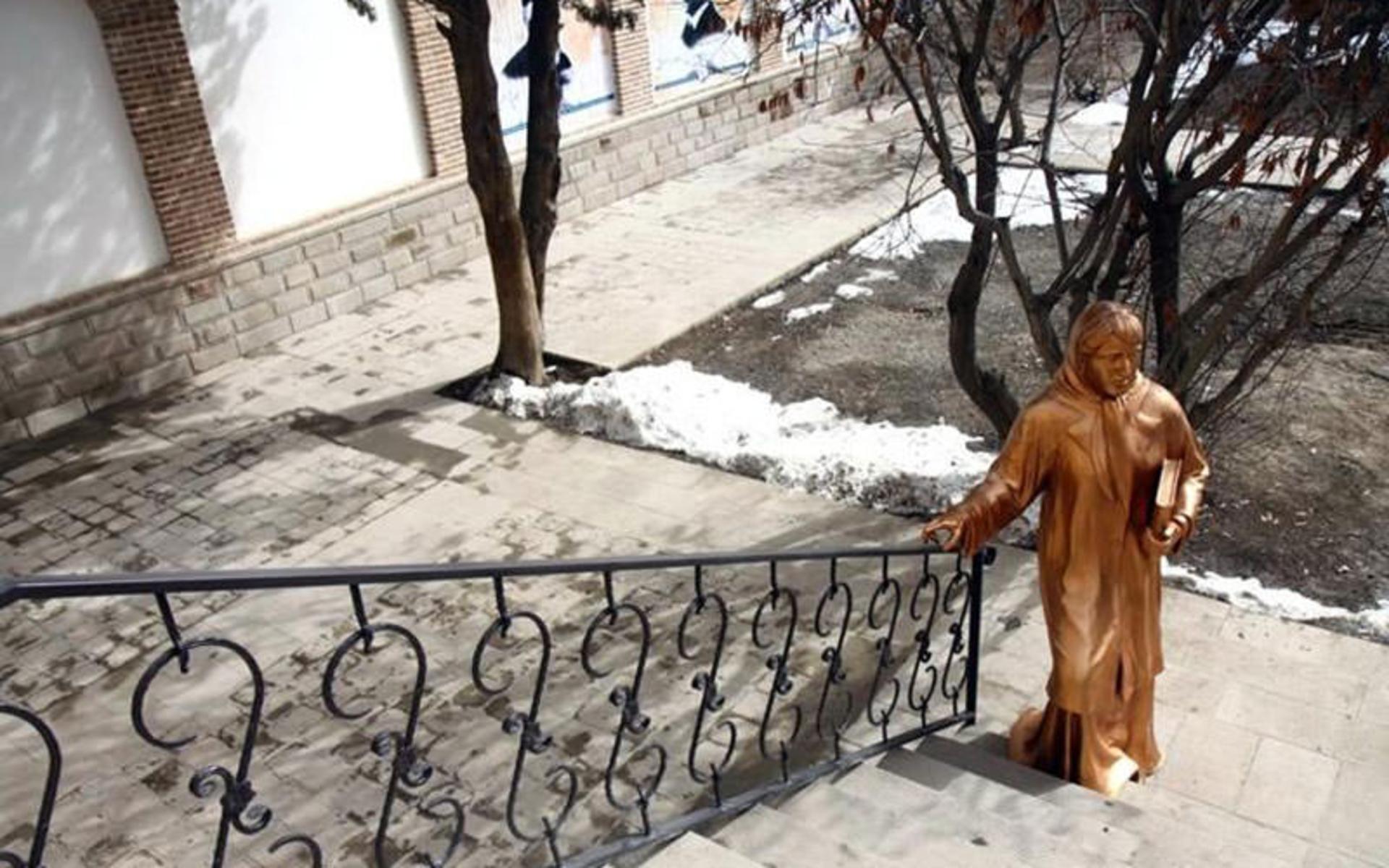
More than eight decades after her death, Parvin Etesami's presence is woven into Iran's cultural landscape. Statues of her stand in several cities. One notable example is the sculpture at the base of Milad Tower in Tehran. Another stands in the square named after her in the Valiasr district of Tabriz, her birthplace. A third marks the entrance stairway of her childhood home in Tabriz, located on Abbasi Street, adjacent to Mir Aqa Mosque, in the Savejblaghi Alley, number 6.
That house, which dates to the Qajar period, was registered as a national heritage site in 2007 with the registration number 18681. Today it functions as the Parvin Etesami Museum, displaying personal belongings, manuscripts, and books that belonged to the poetess. Visitors to Tabriz can walk through the rooms where she grew up and imagine the literary conversations that shaped one of Iran's most original poetic voices.
Her former residence in Tehran, by contrast, has been divided into a company office, a residential unit, and a furniture workshop, a fate that Iranian cultural commentators have often lamented.
The university now known as Kharazmi University was once the Darolmoallem-e Ali (Higher Teachers College), and Parvin is counted among its distinguished alumni and honorary figures.

Visiting the Parvin Etesami House Museum in Tabriz
For travelers interested in Iranian literary history, the Parvin Etesami House Museum in Tabriz is a compelling stop. The building itself is a fine example of Qajar-era domestic architecture, with the characteristic brickwork, courtyard layout, and proportional elegance of the period. Inside, curators have preserved a selection of Parvin's personal effects, including handwritten manuscripts, first editions of her Divan, photographs, and household items that offer a glimpse into early twentieth-century intellectual life in northwestern Iran.
The house is accessible from central Tabriz. Visitors coming to the city for its broader cultural riches, including the renowned Tabriz Bazaar and the Blue Mosque, will find the museum a natural addition to their itinerary. Mehyar can help travelers arrange transport within Tabriz and connect the visit with other stops on a literary or historical tour of Azerbaijan province.
Tabriz itself rewards several days of exploration, with its UNESCO-listed bazaar, the nearby Kandovan rock village, and the stunning Lake Urmia region all within reach.
The Commemoration Day Across Iran
On 25 Esfand each year, cultural centers, universities, and literary societies across Iran hold gatherings to read Parvin's poetry, discuss her contributions, and reflect on her continuing relevance. Schools incorporate her verses into lessons, and literary magazines publish special features. The day also serves as a broader occasion to discuss the role of women in Iranian letters and the ongoing struggle for artistic expression.
For visitors to Iran during this period, attending one of these gatherings offers an authentic encounter with Iran's living literary culture. The tone is typically one of quiet reverence mixed with intellectual enthusiasm, and travelers with an interest in poetry will find the experience deeply rewarding.

Why Parvin Etesami Still Resonates
What makes Parvin Etesami's work endure is its combination of technical mastery and moral urgency. She wrote at a moment when Iran was undergoing rapid transformation, caught between tradition and modernity, and her poetry reflects that tension without simplifying it. She could be devastating in her critique of social injustice while maintaining the formal beauty and rhythmic power that Persian readers expect from serious verse.
Her dialogue poems in particular continue to offer fresh insights. The voices she created for the voiceless, the way she used the natural world as a mirror for human behavior, and her refusal to accept easy answers all contribute to work that feels alive more than a century after it was written. For travelers seeking to understand the depth and diversity of Iranian culture, engaging with Parvin Etesami's poetry is not optional. It is essential.