
Iran's central plateau is a land of relentless summer heat, where daytime temperatures regularly climb above forty degrees Celsius. Long before electric air conditioning, Persian architects devised an elegant solution: the badgir, a tower that captures the slightest breeze and funnels cool air straight into the rooms below. These windcatchers stand as one of the most ingenious achievements in the history of passive climate control, and they still crown the rooftops of cities across the Iranian plateau today.
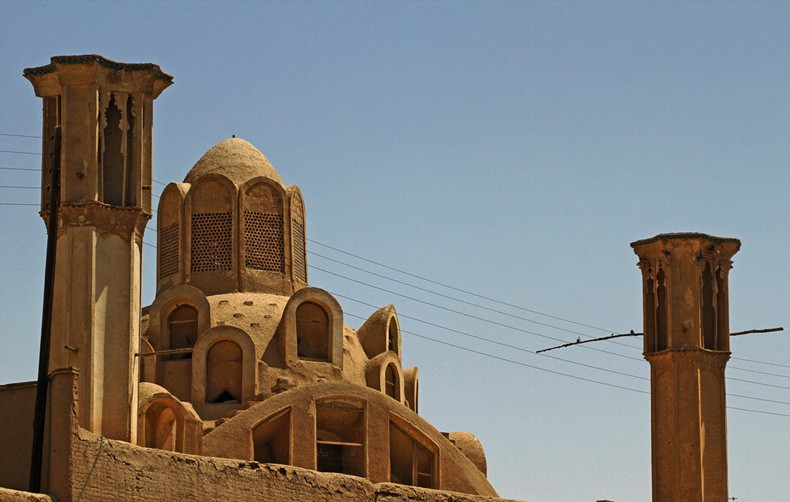
What Is a Badgir
A badgir is a vertical shaft, usually square or rectangular in cross-section, built on the roof of a house above a space called the howz-khaneh, a small pool room used as a summer retreat. The tower rises higher than the surrounding rooftops so that its openings face whatever breeze the region offers. Wind enters through these arched mouths, descends the shaft, and passes over a shallow pool of water at the base. The evaporation absorbs heat, and the cooled air spreads through adjacent rooms via underground channels not unlike modern ductwork. The principle is identical to that of an evaporative cooler, except the energy source is the wind itself.
Builders constructed badgirs from mudbrick and adobe, reinforcing them with timber beams to withstand gusts. The exterior was often decorated with patterned brickwork, turning a functional element into an ornament that signalled the wealth and taste of the household. The larger and more elaborate the badgir, the more prosperous the family beneath it.
Types of Badgirs Across Iran
Windcatchers are not a single uniform type. Architects adapted the form to local climate, available materials, and the direction of prevailing winds, producing at least six recognised varieties.
The simplest form is the single-sided badgir, a small tower with one open face directed toward the cool breeze while the other three sides are sealed. This type is common in Sistan and parts of Kerman province. It works in both directions: facing the wind, it draws cool air in; facing away, it acts as an exhaust, pulling stale air upward and out.
The two-sided badgir has openings on two opposite faces and appears mainly in Sirjan and occasionally in Kerman. The three-sided version, sometimes called the split-belly type, is rare and found in scattered locations.
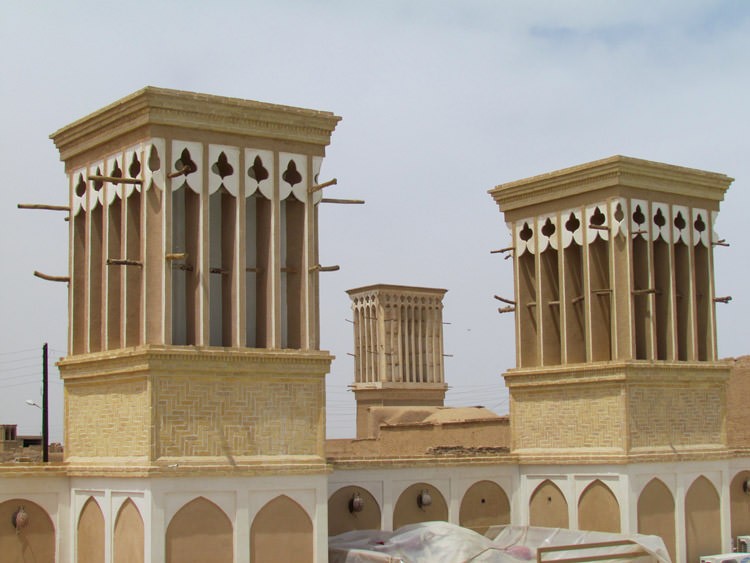
The four-sided badgir is the most complete and elaborate form. Its internal channel is divided by brick or plaster partitions into several lanes, and a sizeable pool often sits at the base. Dust-laden air meets the water, is humidified, cooled, and cleaned before entering the living space. This type dominates the historic cities of Yazd, Kerman, and Kashan.
In Yazd and surrounding towns, multi-faced and even circular badgirs are common, sometimes reaching eight sides. A unique variant found only in Sirjan is the chopakhi, or chimney-pipe badgir, which replaces the usual cubic exterior with curved elbow-shaped ducts while retaining the same internal airflow logic.
How the System Works in Practice
The genius of the badgir lies in the integration of every component. In a typical Yazdi house, summer rooms face north to avoid direct sunlight. At the far end of these rooms, beyond a series of large doors, is the howz-khaneh. The badgir sits directly above the small pool at the centre of this space. Wind descending the shaft strikes the water surface, evaporates a portion of it, and the resulting temperature drop sends a current of cool, moist air into the rooms. In wealthy houses, the howz-khaneh was fully enclosed, and the cool air travelled through underground ducts to reach multiple rooms.
Where a ground-level pool was impossible, builders routed a qanat stream through the basement and extended the badgir channel down to it. These basement spaces, called sard-ab, became the family gathering point on the hottest afternoons.
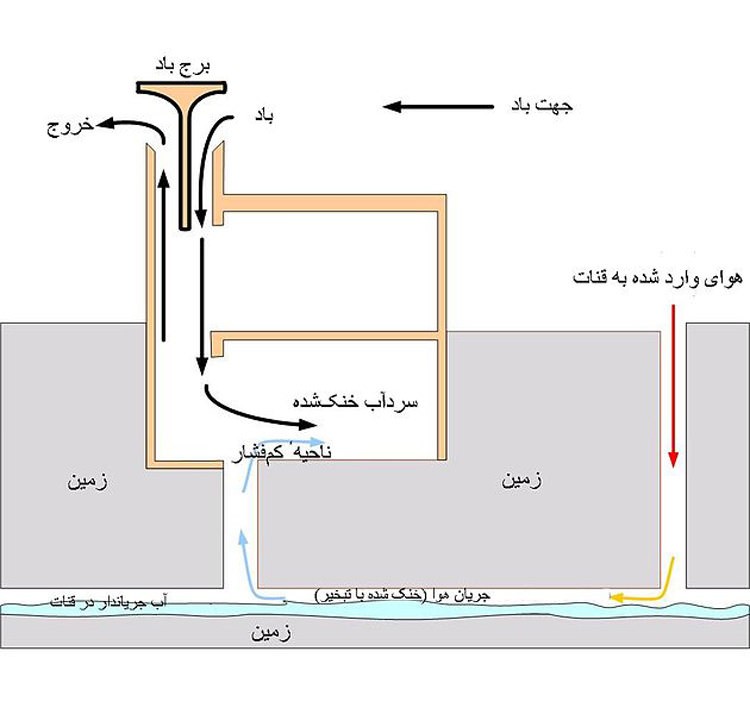
Beyond cooling living quarters, badgirs served other functions. They ventilated the underground cellars used for food storage. They kept the water in ab-anbars, the city's underground cisterns, fresh and cool. Above all, they created a continuous air circulation that made the interior of even the most solid mudbrick house breathable during the worst of summer.
The Badgir Mansion at Golestan Palace in Tehran
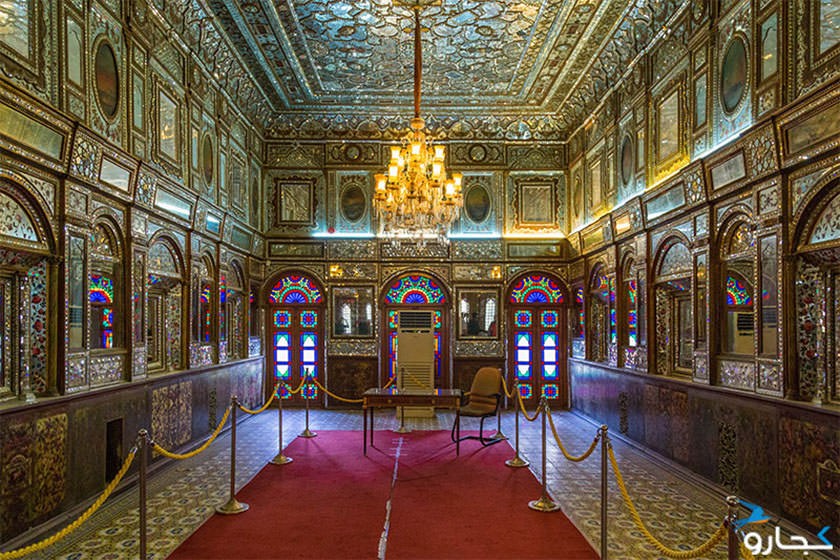
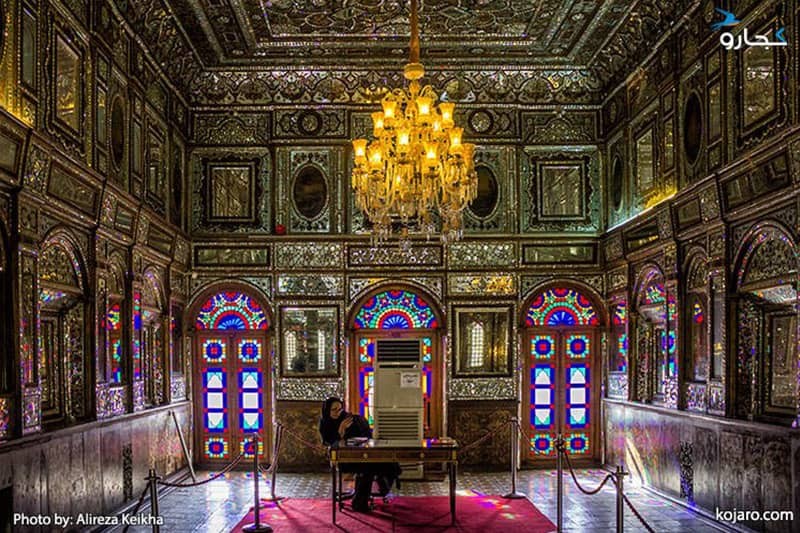
The tradition was not confined to the desert. When the Qajar dynasty expanded the Golestan Palace in Tehran during the reign of Fath-Ali Shah in the early nineteenth century, one of the new buildings was named the Emarat-e Badgir, the Windcatcher Mansion, for the four tall towers on its corners. The mansion was substantially remodelled under Naser al-Din Shah by the court architect Haj Ali Khan Hajeb al-Dowleh.
Inside, the mansion features a mirrored throne hall with nine orosi windows fitted with coloured glass, plaster columns twisted in the Zand style, marble dadoes, and inlaid parquet floors with the classic boteh jedegheh pattern. The four badgirs channel air down to a spacious howz-khaneh beneath the building, which today houses the Photography Museum. It was in this very hall that Mozaffar al-Din Shah was crowned, and it remains one of the most photographed corners of the Golestan complex.
Badgirs Beyond Iran
The concept spread well beyond Iran's borders. Ancient Egyptian and Babylonian buildings show traces of similar ventilation towers. In Iraq, the Abbasid-era palace of Ukhaidir features square windcatchers built into its walls, and the Arabic word for the device, badjir, is a direct borrowing from Persian. During the Fatimid period in Egypt, badgirs became part of the urban skyline of Cairo. The scholar Ibn Yunus wrote about their correct orientation, and the writer Abd al-Latif al-Baghdadi noted that a large, decorated windcatcher could cost as much as five hundred gold dinars. In modern Egypt, the device is known as the malqaf, literally the wind-catcher. The fifteenth-century treatise Matali al-Budur by the Egyptian litterateur al-Ghazuli devotes an entire section to windcatchers in poetry and prose.
Preserving a Living Tradition
Today, badgirs are more than historical curiosities. In cities like Yazd, Meybod, and Ardakan, they remain part of the living urban fabric. Walking through the Fahadan quarter of Yazd, you see badgirs of every size and shape rising above the flat rooftops, some restored, some crumbling, all testifying to the skill of builders who understood thermodynamics centuries before it was formally described.
Modern architects studying sustainable design have rediscovered the principles behind the badgir. Passive cooling, natural ventilation, and zero-energy climate control are at the heart of contemporary green architecture, and the Iranian windcatcher offers a proven, centuries-old template. UNESCO's listing of the historic city of Yazd recognises these structures as part of humanity's shared heritage.
For visitors planning a trip, [Mehyar](/hotels) offers hotel and transport options in Yazd, Kerman, and other cities where the finest badgirs stand. Combine a tour of the old town with a visit to the Dowlatabad Garden in Kerman, whose badgir is the tallest in the world at over thirty-three metres. Book your [bus ticket](/buses) through Mehyar for the most comfortable journey between the plateau's historic towns, and let the ancient engineering of the badgir remind you that the best ideas never go out of style.