
Tangeh Taheran Waterfall is one of the most remote and scenically dramatic natural attractions in Kerman Province, hidden in the highlands southeast of Bam. The waterfall forms where the Abad Chahal Tan River, fed from the peaks of the Chahal Jebal Baraz range, drops over a rock ledge beside towering cliff walls known locally as the Taheran walls. The gorge is narrow and the air is still, creating a sense of isolation that is rare in a region more famous for its ancient citadel than its waterfalls. For travellers visiting the UNESCO-listed Arg-e Bam, the waterfall offers a striking contrast: where the citadel speaks of human history stretching back millennia, Tangeh Taheran speaks of geological time and the slow work of water on stone.

Where is Tangeh Taheran Waterfall?
The waterfall is located 80 kilometres southeast of Bam city in Kerman Province, near the small agricultural village of Abad Chahal Tan. Bam itself lies in the southeastern part of Kerman Province, roughly 200 kilometres from Kerman city on the road towards Zabol and the Sistan-Baluchestan border. The region sits at the intersection of the central desert plateau and the mountain ranges that rise along the southeastern edge of Iran, creating a landscape of dramatic contrasts: barren desert plains give way suddenly to rugged highlands with permanent springs and seasonal waterfalls.
The Abad Chahal Tan River originates from the heights of the Chahal Jebal Baraz range, a mountain chain that forms the southeastern continuation of the larger Jebal Baraz system. The name "Chahal Jebal Baraz" translates roughly as "Forty Mountains of Baraz," reflecting the multiplicity of peaks and ridges that characterise the range. As the river descends from these heights, it carves through layers of sedimentary rock, creating narrow gorges, towering cliff walls, and occasional waterfalls where harder rock layers form natural ledges.
Tangeh Taheran is the most accessible of these water features, situated beside the village that gives the river its name. The "Taheran walls" referenced in the waterfall's name are the tall, striped cliff formations that flank the gorge, their layered geology visible in bands of colour that record millions of years of deposition.
The Waterfall and the Gorge
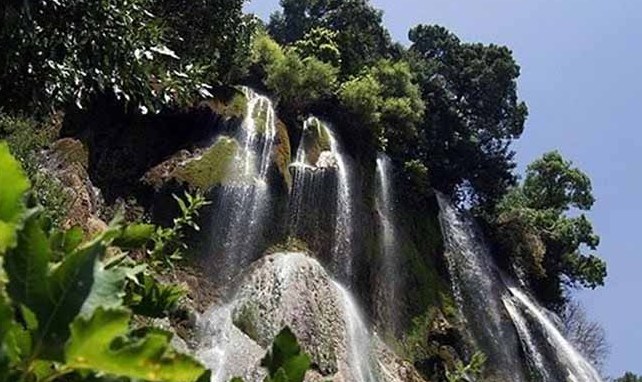
The waterfall itself is a single drop of moderate height, where the river pours over a natural rock ledge and plunges into a narrow pool at the base. What makes it remarkable is the setting: the gorge walls rise steeply on either side, creating a canyon-like atmosphere that amplifies the sound of falling water and traps the cool air rising from the pool. The rock faces are striped and layered, with bands of red, ochre, and grey that catch the light differently depending on the time of day.
The pool at the base of the waterfall is deep enough for a refreshing pause in warm weather, though the water is cold even in summer, fed directly by mountain snowmelt. The rocks around the pool are smooth and slippery, and the narrow gorge means that direct sunlight reaches the bottom only around midday. For the rest of the day, the light is indirect and diffused, giving the gorge a cool, almost cathedral-like quality.
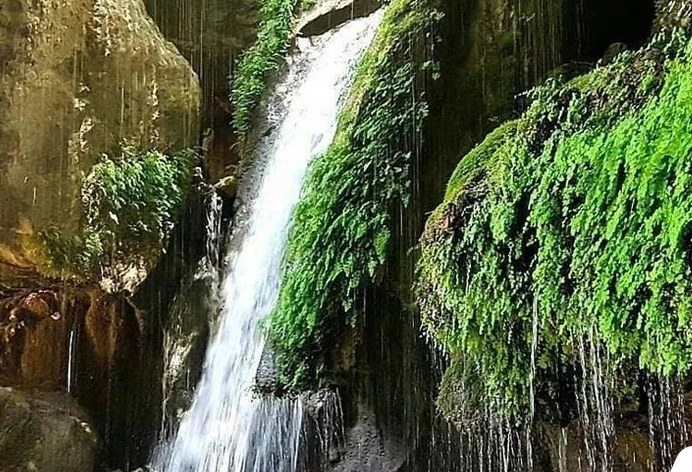
Downstream from the waterfall, the river continues its course through the gorge, passing over smaller cascades and rapids before eventually spreading out onto the desert plain. Upstream, the valley narrows further, with the cliff walls closing in and the river cutting ever deeper into the rock. For experienced hikers with proper equipment, following the gorge upstream offers a challenging and rewarding adventure, though the terrain is rough and there are no marked trails.
Abad Chahal Tan Village and Its People
The village of Abad Chahal Tan sits on a terrace above the river, a small agricultural community that has lived alongside the waterfall for generations. The village is modest, with traditional mud-brick and stone houses adapted to the hot, dry climate of the region. Fruit trees, irrigated by the river, grow in small gardens around the village, providing a splash of green in the otherwise arid landscape.
The people of Abad Chahal Tan are known for their hospitality, and visitors to the waterfall are often welcomed by villagers who offer tea, fresh fruit, or simply conversation. The local economy is based on agriculture, animal husbandry, and increasingly, tourism from Bam and other parts of Kerman Province. There are no formal tourist facilities at the village, but the authenticity of the experience is its own reward.
The village is also a starting point for longer treks into the Chahal Jebal Baraz range, which offers some of the most rugged and unspoiled mountain scenery in southeastern Iran. The peaks rise to over 3,000 metres, with seasonal snow, permanent springs, and alpine meadows that contrast sharply with the desert below. These treks are not for casual visitors; they require proper equipment, local knowledge, and sufficient supplies of water and food.
How to get there
From Bam, drive southeast along the mountain road towards the village of Abad Chahal Tan. The road is partly paved and partly rough, suitable for standard cars in dry conditions but requiring caution on the unpaved sections. Open Mehyar and choose Taxi from Bam for a direct ride to the village and waterfall; the driver can wait while you explore, or you can arrange a pickup time by phone if coverage allows. The total drive takes about two hours from Bam.
From Kerman city, take the highway southeast to Bam (about one hour), then continue southeast towards Abad Chahal Tan. The total journey from Kerman is roughly 280 kilometres and takes about three hours. Mehyar also operates bus services from Kerman to Bam, and from the Bam terminal you can take a local taxi to the waterfall.
The road to the village is the main challenge. In dry weather, any standard car can make it, though the unpaved sections can be rough and dusty. After rain, some sections may become muddy and slippery, and a vehicle with higher clearance is advisable. There is no formal parking area at the waterfall; visitors typically park beside the road near the village and walk the short distance to the gorge.
There are no facilities at the waterfall itself. Bring sufficient water, food, and sun protection, as the region is remote and the nearest shops are in the village or in Bam. Mobile phone coverage may be limited in the gorge, so it is wise to let someone know your plans before setting out.
Best time to visit
Late autumn to early spring (November to March) offers the most comfortable temperatures for visiting the desert highlands. During these months, daytime temperatures are mild and the hike to the waterfall is pleasant. The water flow is moderate, fed by seasonal rains and residual snowmelt.
Spring (March to April) brings the strongest water flow, as snowmelt from the Chahal Jebal Baraz peaks feeds the river. The surrounding hillsides may also burst into wildflower, adding colour to the desert landscape. This is the best time for photography, though the water is coldest and the gorge can be damp.
Summer (May to September) is extremely hot in this part of Kerman Province, with daytime temperatures regularly exceeding 40°C on the desert plain. The gorge itself is cooler, but the drive to reach it can be uncomfortable and potentially dangerous without adequate water and air conditioning. Summer visits are not recommended.
Winter brings cold temperatures, especially at night, and occasional snow at higher elevations. The waterfall still flows, and the gorge is atmospheric in the cold, crisp air, but the road can be icy and the days are short.
Practical details
The waterfall is free to visit and accessible during daylight hours. Allow one to two hours for a full visit including time at the pool and a short walk along the gorge. There are no formal facilities at the site; the nearest tea houses and shops are in Abad Chahal Tan village.
The waterfall combines easily with a visit to Bam and its UNESCO-listed Arg-e Bam citadel. For a complete Bam city guide, explore the historical attractions, desert landscapes, and other natural sites of this southeastern Kerman region.