
Cloud Ocean in Iran | Best Locations and Times to See the Sea of Clouds
There is a particular kind of silence that belongs to the world above the clouds. The noise of the valley fades. The ground beneath your feet is solid rock or damp grass. And below you, stretching to every horizon, is a white, shifting sea. Iran, despite its reputation for deserts and dry plateaus, is one of the best places on earth to experience this phenomenon. The country's northern mountain ranges, fed by Caspian moisture and cooled by altitude, produce cloud oceans with a regularity that rivals the famous viewpoints of Southeast Asia or South America.

What Creates a Cloud Ocean
A cloud ocean, or sea of clouds, occurs when a layer of clouds settles into a valley or basin at an elevation lower than the observer's position. The conditions required are specific: high altitude, abundant moisture, and surrounding terrain that traps the clouds rather than letting them disperse. In Iran, these conditions are met most reliably along the Alborz mountain chain and the highlands of Gilan, Mazandaran, and Golestan provinces, where the Caspian Sea pumps moisture into the northern slopes and the peaks rise high enough to stand above the cloud layer.
The phenomenon is most dramatic in spring and early summer, when rainfall is at its peak and the temperature contrast between valley and summit is sharpest. In many locations, the cloud ocean forms in the early morning and burns off by midday, making sunrise the ideal time for viewing.
Olsbelangah, Masal
The village of Olsbelangah sits at roughly 1,489 meters above sea level in the highlands above Masal, in Gilan Province. It is one of the most accessible cloud ocean viewpoints in Iran and one of the most popular with domestic travelers. Wooden cottages dot the hillside, and the view from the village terrace on a cloudy morning is unforgettable: a white sea fills the valley below, with only the highest treetops breaking the surface.
The best time to visit Olsbelangah for cloud ocean viewing is from mid-spring (mid-Ordibehesht, roughly early May) through the summer months. The cloudiest period, and therefore the most reliable for the phenomenon, falls in Ordibehesht and Khordad (May and June). On clear days, the Caspian Sea itself is visible from the heights.
Getting there involves driving from the town of Masal up a mountain road to the village. The road is passable by standard vehicles in fair weather. Accommodation ranges from basic wooden cottages to homestays with local families.
Oshkorat, Rudsar
The Oshkorat highlands stretch from the southern edge of Rudsar County in Gilan to the southern edge of Ramsar County in Mazandaran. This is a vast, little-explored region known locally as the "Land of Wonders," thanks to formations such as the Bride and Groom peaks, Samadabad Lake, and the Yazeen Tunnel. The elevation is high enough to produce cloud ocean conditions, particularly in spring and early summer.
The area is remote and infrastructure is limited. Visitors typically stay in village homes or camp in designated areas. A local guide is strongly recommended, as the terrain can be confusing and mobile phone coverage is patchy.
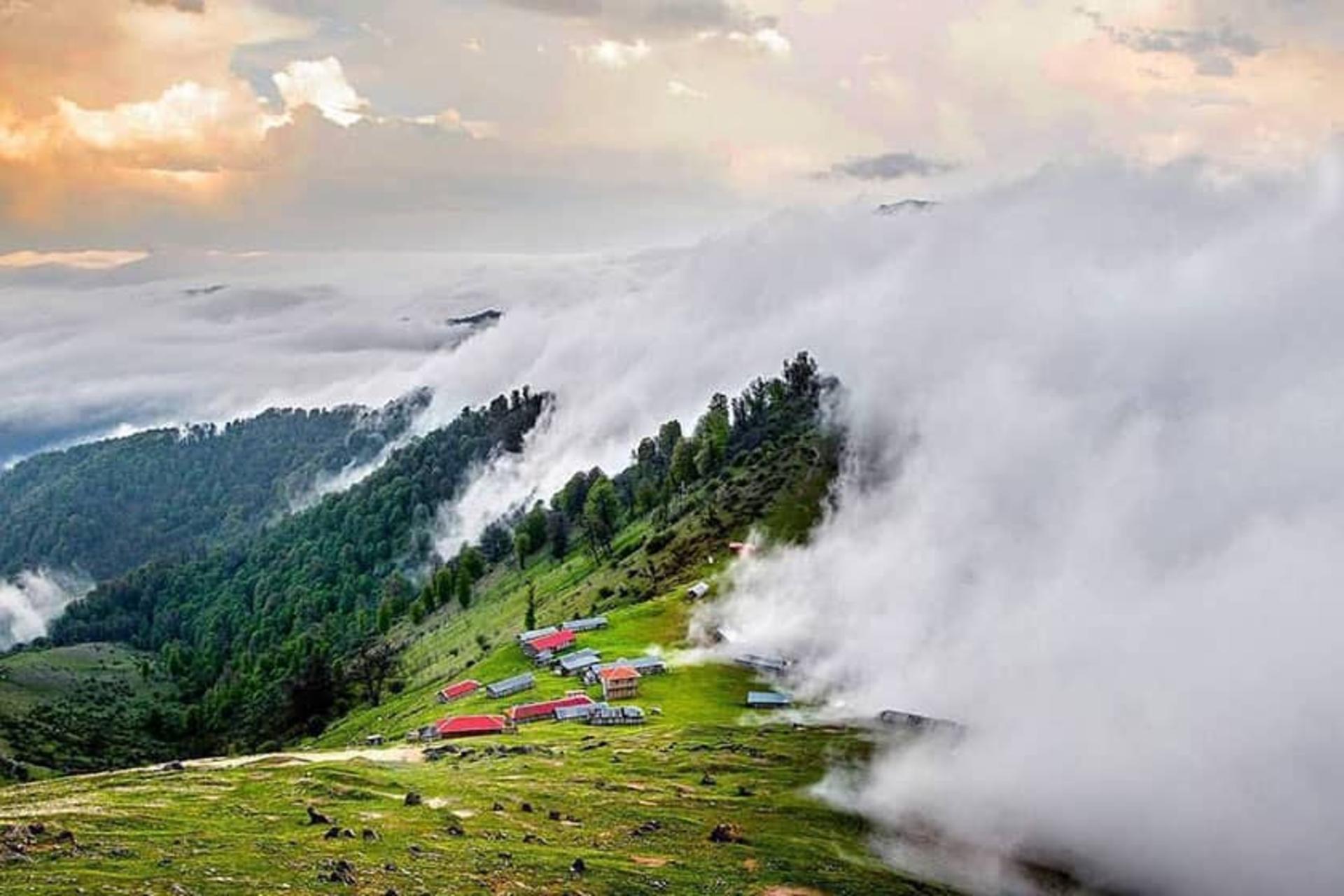
Filband, Babol
Filband sits at approximately 2,300 meters above sea level in Babol County, Mazandaran Province. It is one of the highest summer pastures in the region and one of the most dramatic cloud ocean viewpoints in Iran. The village is sometimes called a "four-season paradise" because locals claim you can experience rain, hail, wind, sunshine, and even a rainbow all in a single day.
Spring and summer are the best seasons for cloud ocean viewing at Filband. The village is about 200 kilometers from Tehran via the Haraz Road, making it a feasible long weekend trip from the capital. The turnoff is south of Amol, branching east toward the village.
The road to Filband is mountainous and winding, but paved for most of its length. In winter, snow can close the route for extended periods. Accommodation is available in village homes and simple guesthouses.
Subatan, Talesh
The highland pasture of Subatan lies 36 kilometers from the city of Talesh in Gilan and 21 kilometers from Lake Neor in Ardabil Province. Situated between 1,900 and 2,500 meters of elevation, Subatan is one of the most pristine cloud ocean locations in Iran. There is no electricity and no gas infrastructure. Nomadic families live in black tents and mud-brick houses, tending their flocks on the surrounding slopes.
The best time to visit is from mid-spring through late spring (mid-Ordibehesht to the end of Khordad). During this window, the clouds are at their thickest and the meadows at their greenest. Summer is also pleasant but the cloud ocean is less reliable.
Access requires a vehicle with reasonable ground clearance. The road from Talesh is partly unpaved but passable. Some visitors approach from the Lake Neor side via Ardabil.
Asalem to Khalkhal Road
The 70-kilometer road from Asalem in Gilan to Khalkhal in Ardabil Province is one of the most scenic drives in Iran. It passes through dense Hyrcanian forest, alpine meadow, and high mountain pass. Cloud ocean conditions are common along the higher sections, particularly in spring and autumn, when moisture from the Caspian pushes up into the mountains.
The route is split between forested lower sections and open highland sections. In the forest zone, the road twists through ancient trees. Above the tree line, the landscape opens into vast grasslands where horses and cattle graze freely. The weather changes rapidly and often dramatically along the route, sometimes cycling through all four seasons in a single hour.
Local food, honey, fresh dairy, and flat bread are available from roadside stalls and small villages. The drive is best done in daylight, and the return journey should be planned before dark, as the road is unlit and frequently foggy in the evening.

Javaherdeh, Ramsar
At 2,000 meters above sea level, the village of Javaherdeh is one of the highest points in Ramsar County, Mazandaran. The road to the village passes seasonal waterfalls, the Sefarud Forest Park, a mineral spring, and Swan Lake. The cloud ocean from Javaherdeh is spectacular, with the white layer filling the valleys below while the village sits in clear air and warm summer sun.
Javaherdeh has a long history and several heritage sites, including a Friday Mosque and ancient burial grounds. Half the year the village is covered in snow; in summer, the weather is cool and the views are expansive. It is 29 kilometers from Ramsar city center.
Javaherdasht, Rudsar
Javaherdasht is a highland village in Rudsar County, Gilan, also sitting at around 2,000 meters elevation. The road from Siahkalrud passes through forest, alongside the Sajidan River, and through a series of valleys and passes before reaching the open meadows above the village. Cattle and horses graze freely in the pastures, and wildflowers color the hillsides in spring.
The cloud ocean at Javaherdasht is most reliable from late spring through summer. Camping is popular, and village homestays offer basic but comfortable accommodation with fresh local food.
The Cloud Forest of Shahrud
Perhaps the most famous cloud ocean destination in Iran is the Cloud Forest (Jangal-e Abr) near Shahrud in Semnan Province. Located 45 kilometers north of the city, the forest sits at the boundary between the semi-arid landscapes of Semnan and the dense Hyrcanian forests of Golestan. The contrast is striking: one moment you are driving through dry scrubland, and the next you are immersed in an ancient forest of beech, oak, hornbeam, and yew, with clouds flowing through the canopy.
The forest is part of the Hyrcanian forest zone, a UNESCO Natural World Heritage Site. Species include wild cherry, box tree, and Atlantic oak. The cloud cover gives the forest its name: clouds are so frequently present that the forest appears to float on a sea of white.
The best time to visit is from mid-spring (Ordibehesht) through early autumn (early Mehr). For a multi-day trip, a local guide is essential, as the forest is large and the cloud cover can make navigation difficult. Accommodation ranges from forest camps to eco-lodges in nearby villages.
Heludasht, Amolash
Heludasht is a highland village about 30 kilometers from the center of Amolash in Gilan, at 1,200 meters elevation. The road passes through alder and beech forest, tea plantations, and hazelnut orchards before reaching the village, where the cloud ocean opens up below. On clear days, the plains of eastern Gilan and the cities of Langarud, Rudsar, and Lahijan are visible on the horizon.
The village has a small cafe and a handful of suites available for tourists. Nearby Khoshil Dasht is another highland pasture worth visiting if time allows. Spring and summer are the best seasons.
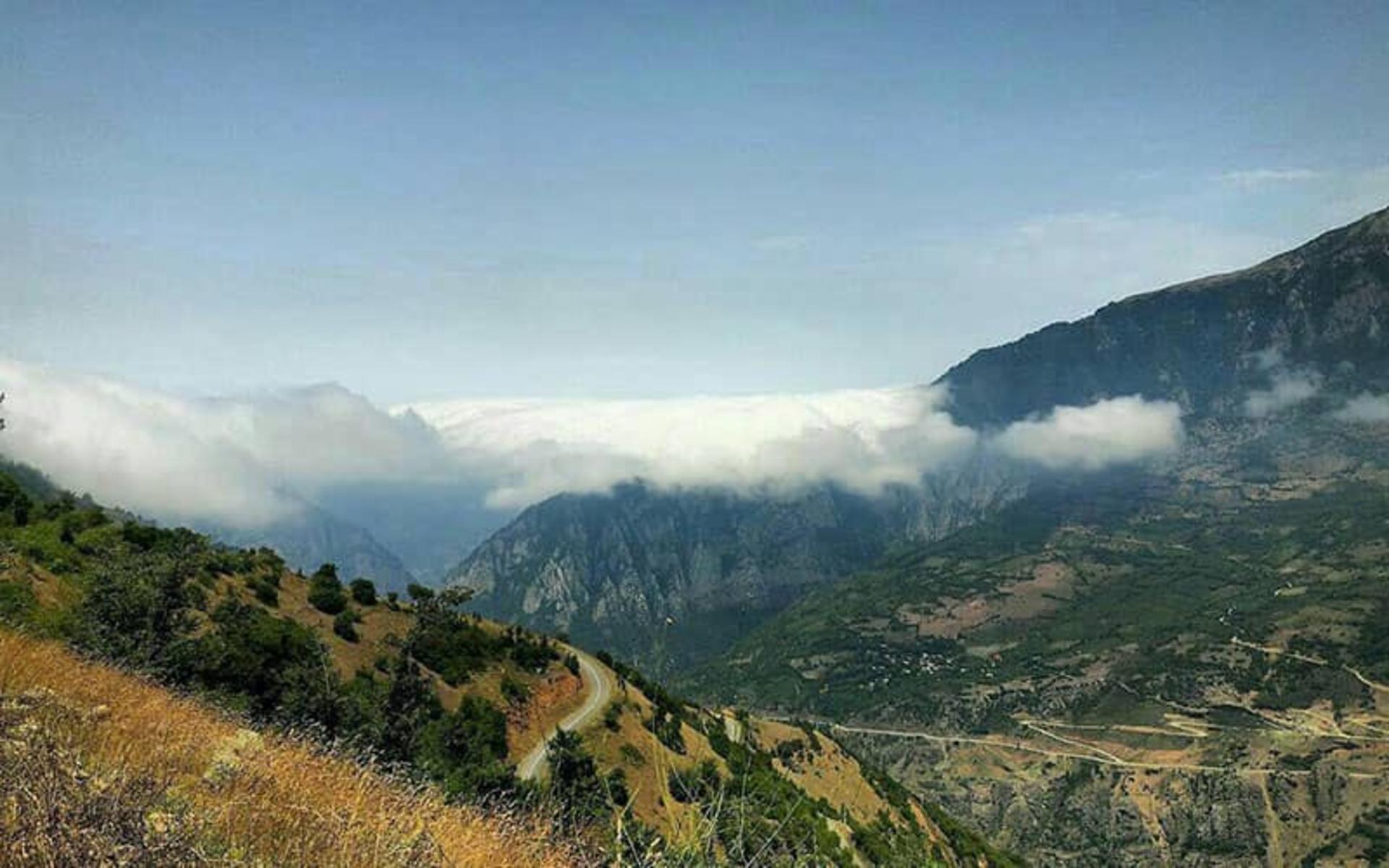
Damash Village, Rudbar
Damash is a highland village at 1,800 meters in the Emarlu district of Rudbar County, Gilan. Beyond the cloud ocean, Damash is famous for the Damash Lily, a rare species of fritillary found in only two locations worldwide. The lily blooms in late spring, and a local festival celebrates the flower each year.
The village has a mineral spring with drinkable water, and the surrounding heights offer panoramic views of the Alborz range. The weather is cool and often misty, adding to the atmospheric quality of the visit. Local food includes regional specialties such as Siyah Ghategh and Fesenjan stew.
Opart Village
The village of Opart sits on the natural boundary between Semnan and Mazandaran provinces, where the desert plateau meets the forested mountain slopes. It is one of the more remote cloud ocean destinations, and the landscape around it is distinctly different from the lush green of the Gilan highlands. Here, the cloud ocean forms against a backdrop of semi-arid ridges and dramatic geological formations.
Practical Tips for Cloud Ocean Viewing
Best season: Mid-spring to early summer (May to July) offers the most reliable cloud ocean conditions across most locations. Autumn can also produce spectacular displays, particularly in the Cloud Forest of Shahrud.
Best time of day: Early morning, ideally before sunrise. The cloud layer is thickest and most dramatic in the first hours of the day. By mid-morning, the sun often burns off the clouds, especially in summer.
What to bring: Warm clothing is essential, even in summer. Highland mornings can be surprisingly cold, with temperatures dropping close to zero at 2,000 meters and above. A windproof jacket, sturdy shoes, and a headlamp for pre-dawn walks are all recommended.
Getting there: Most cloud ocean destinations require a car, and some need a vehicle with good ground clearance. Roads can be unpaved, narrow, and steep. Check conditions locally before setting out, particularly in spring when snowmelt can damage mountain roads.
Accommodation: Options range from forest camps and nomadic tents to village homestays and basic eco-lodges. In peak season (late spring and summer), booking ahead through Mehyar is strongly recommended, as the most popular locations fill up quickly on weekends.
Plan your cloud ocean adventure with Mehyar. From hotels in the gateway cities to taxis for the mountain roads, the Mehyar app has the tools you need for an unforgettable journey above the clouds.