
Yazd is the city that the desert made. For millennia its people have lived between two dasht, the Great Salt Desert to the north and the Lut to the east, and the answer they built was mud brick, windcatchers and one of the longest qanats on earth. The Zoroastrian fire still burns inside a temple on a side street. The historic core is a UNESCO World Heritage Site, the Jameh Mosque carries the tallest minaret in the country, and the badgirs rise above every rooftop. Two full days is the honest minimum; three lets you add the qanat and the Zoroastrian sites without rushing.

How do I get to Yazd?
Yazd sits in the centre of the Iranian plateau, about 620 kilometres southeast of Tehran. Mehyar Buses cover the route in roughly six hours; Mehyar Flights makes the same journey in a little over an hour. The core sights sit within walking distance of one another inside the Fahadan quarter, and a Mehyar Taxi is the right call for the qanat, the Towers of Silence and the desert edges.
What is the Jameh Mosque of Yazd?
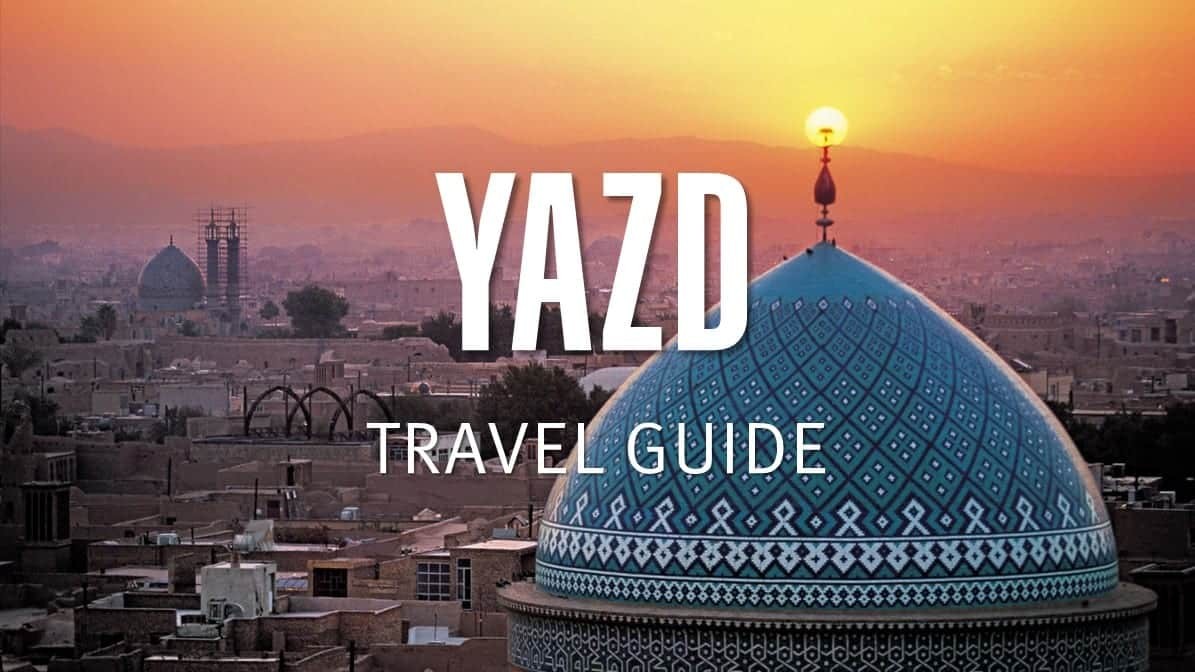
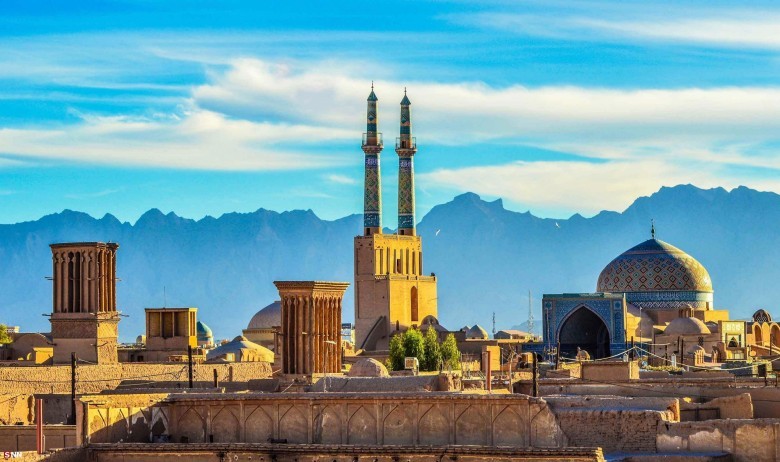
The Jameh Mosque is the first thing you see from the rooftop terraces of Fahadan. Its pair of minarets, at 48 metres the tallest in Iran, carries a band of seven-colour tilework in indigo, turquoise and white, and the dome behind them is a turquoise shell that has defined the skyline since the fourteenth century. The mosque stands on the site of a Sassanid fire temple, and the current building was rebuilt under the Ilkhanids in the early 8th century AH with further Safavid and Qajar additions.
Inside, the entrance corridor turns through a dog-leg into a four-iwan courtyard. The prayer hall holds a forest of stucco-covered columns, and the mihrab is a deep niche faced with carved stucco and glazed tiles. The best exterior photograph comes from Raha Square to the southwest in the late afternoon light.
Open from 8 to 11:30 and 15 to 18, entry is free or by small donation.
What is the Amir Chakhmaq Complex?
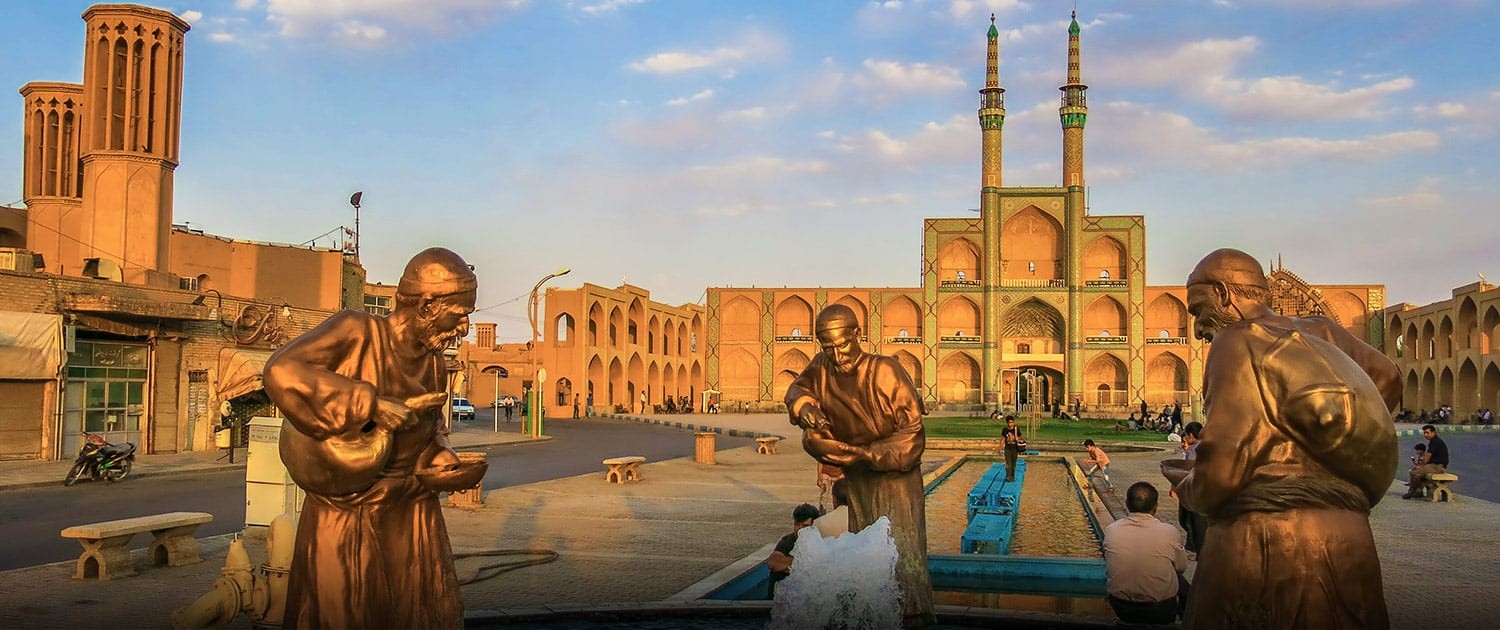
The second great landmark of Yazd is the Amir Chakhmaq Complex. Built in the 9th century AH by the Timurid governor Amir Jalaleddin Chakhmaq, it is a tekyeh, a gathering place for mourning ceremonies, with a mosque behind it and a historic bath to one side. The facade is the headline: nine arched alcoves in three symmetrical storeys, best at dusk when it is floodlit and the pool in the square below throws the reflection back at you. Restored under the Qajar governor, the interior courtyard is still used for Muharram processions.
Open around the clock, no ticket.
What is Dowlat Abad Garden?
Dowlat Abad is a UNESCO-listed Persian Garden and the home of the tallest traditional badgir in Iran, at 33.8 metres. The garden was laid out around 1163 AH by the governor of Yazd, and the pavilion at its centre is a two-storey octagon raised above a reflecting pool. The windcatcher catches the breeze at its top and channels it down through a shaft into the rooms below, and it remains the most successful piece of passive air conditioning you can see in the country.
The stained-glass windows of the pavilion are a second reason to visit: geometric patterns in yellow, blue and orange, and when the afternoon sun hits them the interior turns into a coloured lantern.
Open from early morning until late evening, ticket 30,000 to 50,000 tomans. Best in the late afternoon when the light is low and the stained glass is active.
What is the Old Town of Yazd?
The historic core of Yazd, known as the Fahadan quarter, is a UNESCO World Heritage Site and one of the oldest continuously inhabited urban areas in Iran. The city has been occupied for more than 3,000 years, and the district preserves mud-brick fabric of that occupation in alleyways planned to provide shade and channel the breeze. The buildings are almost all two storeys of packed earth and timber, with covered passages, windcatchers, and doors set into narrow lanes at angles that keep the sun off the walls.
Many of the merchant houses have been restored as guesthouses, cafés and artisan workshops, and the quarter is the best place in Yazd to simply wander. The centre is the Khan Square area, with its water reservoir, or ab anbar, and the traditional zurkhaneh. Allow at least two hours and go early in the morning or late afternoon, when the light is warm and the alleys are cool.

What is Lari House?
Lari House is the best-preserved example of a traditional merchant's residence in Yazd, dating from the 12th century AH and restored as a living monument to desert domestic architecture. The plan turns inward around a central courtyard with a pool, four iwans and planting. The windcatchers above the roofline pulled hot air up and drew cool air from the basement through the living spaces.
The rooms are furnished with period pieces, coloured-glass windows, plaster carving and wooden lattice, and the basement, or shavadoon, is the coolest space in the house. Open from 9 to 18, small ticket.
What is the qanat of Zarjach?
The qanat of Zarjach, also spelled Zarch, is the oldest and longest qanat in Iran, at more than 70 kilometres from its mother well in the mountains to its outlet in the city. An underground channel cut through rock and earth, it carries water by gravity alone and has supplied Yazd for centuries. The main entry point lies just outside the city centre, where you can descend about 15 metres into the cool underground passage with a guide.
Open from 8 to 18, ticket around 30,000 tomans, and best visited in the morning when the underground temperature is at its most refreshing.

What about the Zoroastrian sites?
Yazd holds the largest Zoroastrian community in Iran, and two sites are open to visitors. The Zoroastrian Fire Temple, or Atashkadeh, on Kashani Street houses a flame said to have been burning continuously since 470 CE and transferred to the current building when it was built in 1313 SH. The temple is a quiet room behind a garden, with the fire in a bronze urn at its centre, and the museum next door holds manuscripts and ceremonial objects. Open 8 to 12 and 14:30 to 17:30, ticket around 50,000 tomans.
The Towers of Silence, or Dakhmeh, on the eastern outskirts, are two circular platforms where Zoroastrian sky-burial was practised until the 1970s. A small interpretation centre explains the tradition, and the view from the hilltop across the desert to the city is the best in Yazd. Open 8 to 17, small ticket.
What is the Nakhl Gardani ceremony?
If you are in Yazd during Muharram, the Nakhl Gardani is the city's most dramatic ritual. A nakhl is an enormous wooden structure, heavy and ornate, carried through the streets on the shoulders of dozens of men as collective mourning for Imam Hossein. In Yazd the tradition is among the oldest in the country, and the nakhl of the Amir Chakhmaq quarter is the most famous. The carriers dress in black, the crowds beat their chests, and the nakhl is walked through the old town before being set down in the square. The date moves back by roughly eleven days each year against the Gregorian calendar. Arrive a day early to secure a good position.