
Semnan sits on the edge of the Dasht-e Kavir, where the Silk Road crossed the desert and caravans stopped to trade before the long push east. The capital of Semnan Province has kept its historical fabric more intact than most Iranian cities: a Seljuk minaret still rises above the Grand Mosque, Qajar caravanserais still line the bazaar, and Safavid bathhouses still hold their original tilework. This guide covers the key sights, the best time to visit, and how to reach Semnan with Mehyar services at every step.

Where is Semnan?
Semnan is the capital of Semnan Province in north-central Iran, set on the southern slopes of the Alborz range where the plains tip into the central desert. The city lies about 220 kilometres east of Tehran by road, a two-and-a-half-hour drive on the Tehran–Mashhad highway, and sits on the main rail and road corridor that connects the capital to the eastern provinces. The city mixes Safavid and Qajar monuments with a modern centre built around the old bazaar, a commercial core trading for nearly two centuries.
How to get to Semnan and getting around
Mehyar Buses runs frequent services from Tehran to the Semnan bus terminal, with departures throughout the day and a journey time of roughly two and a half hours on the desert highway. The road is flat, straight and well-paved, and the city also sits on the national rail line, so trains from Tehran are also available. Mehyar Flights connects Tehran to Semnan on a scheduled basis for those who prefer to skip the drive entirely.
Once in the city, Mehyar Taxi is the simplest way to reach your hotel and move between the central sights. Semnan is compact enough to walk its core, with the Grand Mosque, the bazaar and the Arg Gate all within a short circuit, but the best outlying sights, from Bastam to the desert villages, require a private car or taxi.
The Arg Gate and the Grand Mosque

The Arg Gate is the sole surviving gateway of the old citadel of Semnan, a remnant of the defensive walls that once ringed the city. Built during the Qajar period on the orders of Bahman Mirza Baha od-Dowleh, the son of Fath Ali Shah, the gate carries an inscription that dates the structure to 1302 AH during the reign of Naser al-Din Shah. The gate is a single-storey portal with brick vaulting and a arched passage, and it stands as the most visible reminder of the fortified city that Semnan once was.
The Grand Mosque of Semnan is one of the oldest religious buildings in the city, with origins that reach back to the early Islamic centuries. Local tradition holds that the mosque was raised on the ruins of a Zoroastrian fire temple during the caliphate of Ali ibn Abi Taleb, when the faithful of Semnan built one of the 1,001 mosques planned between Kufa and Bukhara. The Seljuk minaret, rising 31.2 metres from the northeast corner of the mosque, is the most striking feature: a Kufic inscription band and brick patterns mark it as a fine example of eleventh-century workmanship. The mosque was registered as national heritage number 163 in 1932.
The bazaar and the Imam Mosque

The bazaar of Semnan was built during the Qajar period and stretches roughly 1,600 metres through the heart of the city, divided into the Upper Bazaar in the north and the Lower Bazaar in the south. The Upper Bazaar contains five mosques, four ruined caravanserais, and the well-known Nasar Tekyeh. The architecture follows the traditional Iranian style, with brick and adobe vaults suited to the desert climate, and trade still moves through the covered lanes as in Silk Road days. The bazaar was registered as national heritage number 1740.
The Imam Mosque, also known as the Sultan Mosque or Shah Mosque, was built in 1864 during the reign of Fath Ali Shah Qajar by the master architect Salar Ali. The western iwan rises 19.5 metres and is the most ornate of the four, faced with seven-colour tilework and calligraphic bands. Four large moonlit entrances open at the corners of the courtyard, and the prayer hall carries stucco decoration and marble facing typical of late Qajar religious architecture.
Garmabe Hazrat and the Qajar houses
The Garmabe Hazrat bathhouse, also called the Pahneh Bath, stands between the Grand Mosque and the Imamzadeh Yahya and dates to the Safavid and Qajar periods. Built in 854 AH on the orders of Khwaja Ghiyath od-Din Bahram Semnani, the vizier of the Timurid ruler, the bath is divided into a dressing room, a warm chamber and a hot chamber, with a beautifully tiled entrance portal and Persian verses in nastaliq above the door. The bath was a waqf of the Grand Mosque and has been converted into an anthropology museum after restoration.
The House of Tadoin, also known as the Mohammadiyeh House, was a Qajar mansion belonging to a prominent Semnani merchant. Set on Taleghani Street inside the bazaar axis, the house has an outer courtyard for receiving guests and an inner courtyard linked to the service quarters. Today the House of Tadoin serves as the office of the Semnan Province Heritage, Handicrafts and Tourism Department.
The Imamzadeh Yahya and Bastam
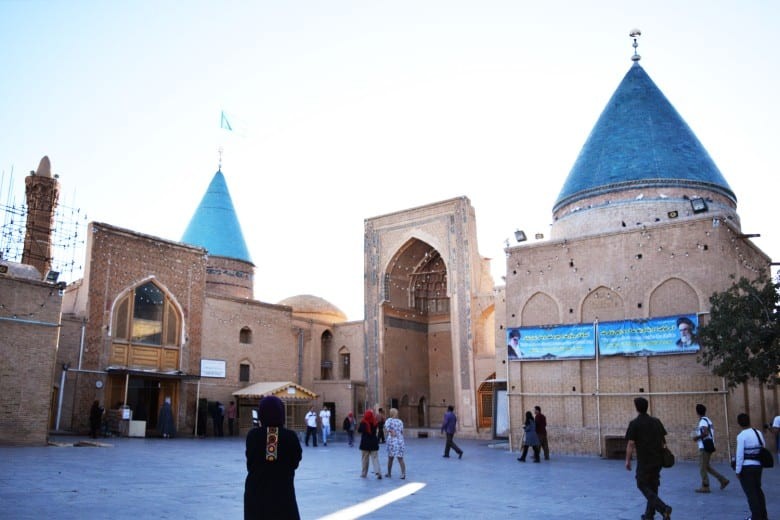
The Imamzadeh Yahya ibn Musa is set in the old fabric of Semnan at the southern end of the bazaar. The shrine is said to hold the tomb of a son of Imam Musa ibn Jafar who accompanied Imam Reza on his journey from Medina to Khorasan. Imam Reza left his brother behind to guide the people of the region, and the local community built the shrine after his martyrdom. The entrance is flanked by two arches with lapis lazuli tiles, and the dome is among the largest of any Imamzadeh in the province.
About 40 kilometres north of Semnan, the town of Bastam is home to the Mausoleum of Bayazid Bastami, one of the most celebrated Sufi mystics in Islamic history. The complex includes the shrine, a mosque and a minaret, and the surrounding desert landscape adds to the contemplative atmosphere.
Best time to visit Semnan
Semnan has a desert climate with hot, dry summers and cold winters. The most rewarding window runs from March through May, when temperatures are mild and wildflowers around Bastam and the Alborz foothills bloom. September through November brings comfortable daytime temperatures and clear skies, ideal for photography and for exploring the bazaar and the historical quarters. Summer, from June through August, can be very hot, with daytime temperatures often exceeding 35 degrees Celsius, but the evenings cool down and the desert light is spectacular. Winter is cold and some outlying sights may be less accessible.
Where to stay in Semnan
Semnan has a range of hotels near the central bazaar and along the main avenues, with options from budget guesthouses to comfortable mid-range properties. Most first-time visitors choose a central location so the Grand Mosque, the Arg Gate and the bazaar are within walking distance, and Mehyar Hotels lists vetted choices for every budget. If you plan to spend time at Bastam or the desert villages to the south, a property with parking and early road access will save you time.
Mehyar services in Semnan
Mehyar covers every stage of a Semnan visit. Mehyar Flights connects Tehran to Semnan, Mehyar Buses runs scheduled coaches from the capital and the eastern cities, Mehyar Taxi handles transfers between the bus terminal, your hotel and the outlying sights, and Mehyar Hotels keeps a current list of properties in the city centre. For onward travel to Shahroud, Damghan or Mashhad, Mehyar Buses and Mehyar Taxi both offer connections that keep your itinerary moving along the Silk Road corridor.