
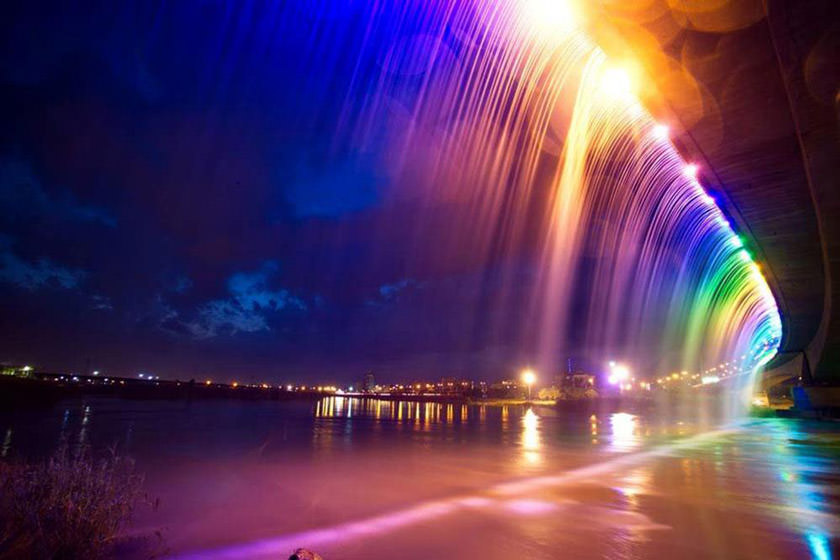
There is something unexpected about standing on a boulevard in one of Iran's hottest cities and watching a river pour over a bridge. The Ahvaz Waterfall, known to locals as Pol-e Haftom (the Seventh Bridge), is the longest artificial waterfall in the Middle East. It stretches across the Karun River in the heart of Ahvaz, and when the pumps are running and the coloured lights come on after dark, it transforms the riverside into one of the most photogenic public spaces in southern Iran. Residents gather here every evening to walk, sit, take photographs, and let the sound of falling water cool the air, if only in spirit.
The waterfall is not a natural feature. Six electro-pumps, each rated at 900 kilowatts, draw water from the Karun up to the bridge deck and release it in cascading curtains on both sides. The outer curve of the waterfall spans 200 metres, and the inner curve reaches 150 metres, creating a dramatic arc of moving water against the concrete and steel of the bridge. It is an engineering project that has become a civic landmark, and it works precisely because it turns something functional, a road bridge, into a spectacle.
Where is the Ahvaz Waterfall?
The waterfall is built into the seventh bridge crossing the Karun River in Ahvaz, the capital of Khuzestan province. Its address is on Shahid Chamran Boulevard, one of the main riverside thoroughfares in the city. The Karun is Iran's only navigable river, and it has been the lifeline of Ahvaz since the city's earliest days. The bridges crossing it are numbered, and the seventh, Pol-e Haftom, is the one that carries the waterfall.
The location is central and well connected. The boulevard runs along the eastern bank of the river, and the waterfall is visible from both sides. It is within a short taxi ride of the city centre, the bazaar district, and the older bridges upstream.
How the waterfall works
The concept is straightforward but the scale is what impresses. Six electro-pumps, each with a capacity of 900 kilowatts, draw water directly from the Karun and push it up to the bridge deck. From there, the water falls in sheets on both sides of the bridge, returning to the river below. The system is designed to run continuously, though the flow may vary depending on maintenance and electricity supply.
The outer arc of the waterfall, at 200 metres, is the longer and more visible from a distance. The inner arc, at 150 metres, creates a tighter curtain that is best appreciated from the walkways below. The combination of the two curves gives the waterfall its distinctive shape, a double arc of water framing the bridge.
The night display
The waterfall is impressive during the day, but it comes alive after dark. Coloured lights illuminate the falling water, and fountains shoot from the bridge into the river, creating a display of moving light and water that draws crowds every evening. The interplay of blue, green, purple, and gold against the dark surface of the Karun is one of the most photographed scenes in Ahvaz.
The night display is one reason the waterfall has become a social hub. Families, couples, and groups of friends gather on the riverside walkways in the hours after sunset. Street vendors sell tea, roasted corn, and sweets. The atmosphere is relaxed and festive, particularly on weekends and holidays. If you visit Ahvaz, an evening at the waterfall is as much about the people watching as it is about the water itself.

The riverside setting
The waterfall is part of a longer stretch of riverside development along Shahid Chamran Boulevard. The Karun banks in this area have been landscaped with walkways, benches, and green spaces, making it one of the main recreational corridors in the city. You can walk along the river for considerable distances, passing other bridges, parks, and cafes.
The riverside is particularly active in the cooler months, from October through April, when the weather in Ahvaz is pleasant and people spend their evenings outdoors. In summer, the riverside is still active in the late evening and at night, though the heat and humidity (known locally as sharji) can be intense.
How to get there
By Mehyar Taxi. The simplest way to reach the waterfall is to open Mehyar and book a Taxi to Shahid Chamran Boulevard. The driver will know Pol-e Haftom, as it is one of the most well-known landmarks in the city. Mehyar Taxi covers Ahvaz and the surrounding cities.
By Mehyar Buses. If you are coming from another city in Khuzestan, check the Mehyar app for intercity bus schedules. From the Ahvaz bus terminal, a short taxi ride will bring you to the waterfall.
By car. If you are driving, there is street parking along Shahid Chamran Boulevard, though spaces fill quickly on weekends and holidays. Consider arriving before sunset to secure a spot and stay for the night display.
On foot. If you are staying near the Karun River or in the central district, the waterfall may be within walking distance. The riverside walkways connect it to other bridges and parks along the Karun.
Best time to visit
The waterfall runs year-round, but the best time to visit is during the cooler months, from late October through early April. During this period, the evening temperatures are pleasant, and you can enjoy the riverside walk and the night display comfortably.
Summer evenings are hot and humid, but the waterfall display continues, and many locals brave the heat for the spectacle. If you visit in summer, go after 9pm, when the temperature has dropped slightly and the display is at its most vivid. Bring water and wear light, breathable clothing.
Night visits offer the best views of the illuminated fountains and the coloured lights. The display typically runs from sunset until around midnight, though this can vary. Daytime visits are worthwhile for appreciating the scale of the waterfall and the engineering, but the full experience is after dark.
Practical tips
- Visit duration. Plan for one to two hours. This gives you time to walk along the riverside, view the waterfall from different angles, and enjoy the atmosphere.
- No entrance fee. The waterfall is a public space, and there is no charge to visit.
- Go at night for the full experience. The illuminated fountains and coloured lights are the main draw. Arrive around sunset to see the transition from day to night.
- Combine with a Karun riverside walk. The waterfall is part of a longer stretch of riverside development. Walk upstream or downstream to see other bridges, parks, and the city's waterfront.
- Try the street food. Vendors near the waterfall sell tea, roasted corn, falafel, and local sweets. This is a good place to sample Khuzestani street food.
- Photography is excellent here. The waterfall, the reflections on the Karun, and the night lights all make for strong photographs. A tripod is useful for long exposures at night.
- Dress modestly. As with any public space in Iran, modest dress is appropriate. The riverside is a family area, and the atmosphere is relaxed but respectful.
Hours and access
The waterfall is accessible around the clock, as it is part of a public boulevard. The pumps and light display typically operate from sunset until around midnight, though hours may vary depending on the season and local management. The area is open to the public and is generally accessible, with paved walkways and benches along the riverside.
The waterfall is at street level and accessible for wheelchairs and strollers along the main walkways, though some of the lower viewing areas near the water may have steps.