
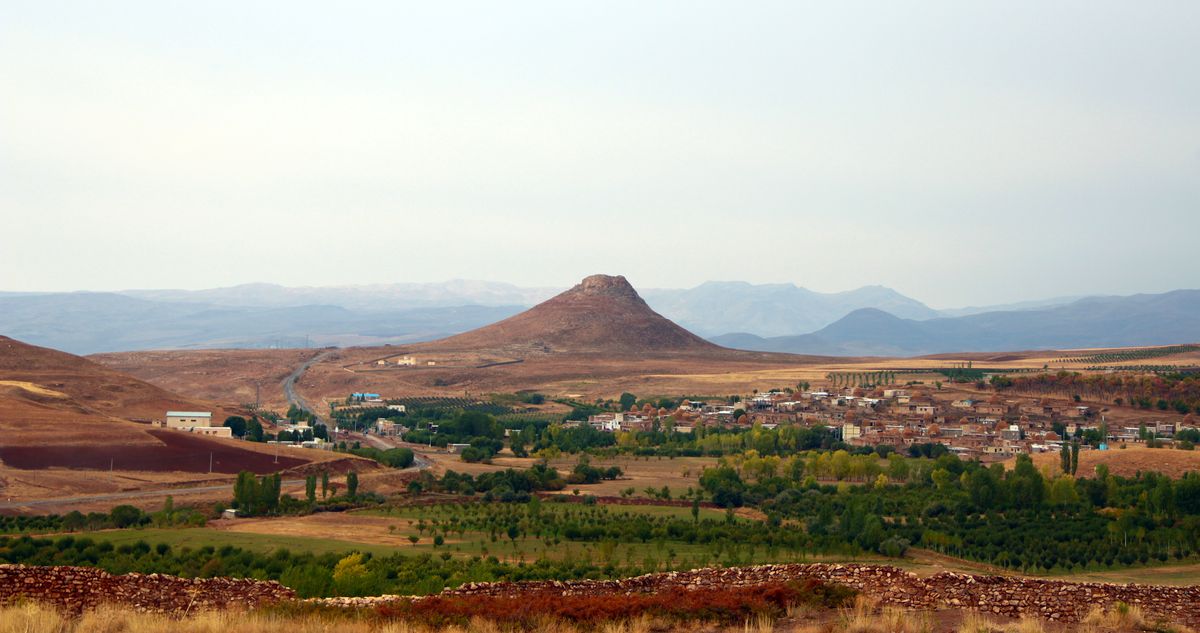
In the remote highlands of West Azerbaijan province, roughly 45 kilometres south of the town of Takab, a strange earthen cone rises from the steppe. Locals call it Zendan-e Berenje, the Rice Prison. According to one of the most persistent legends in Iranian folklore, the prophet-king Solomon once sealed rebellious jinns and demons inside this hollow hill. Whether you come for the myth or the archaeology, Berenje Prison is one of the most atmospheric ancient sites in northwestern Iran, and it sits just minutes from the UNESCO World Heritage complex of Takht-e Soleyman.

Where Is Berenje Prison?
Berenje Prison (Zendan-e Berenje) lies in the fertile plains surrounding the city of Takab, in West Azerbaijan province in the far northwest of Iran. The site is approximately 120 kilometres south of Zanjan and roughly 300 kilometres southwest of Tabriz, the regional capital. The nearest major airport is in Tabriz, and from there you can drive south along Route 27 toward Zanjan, branching off toward Takab after about 270 kilometres. Mehyar can arrange your taxi or car rental from Tabriz for the day trip, making the journey straightforward even without a private vehicle.
The structure itself sits on open grassland at an elevation of around 2,200 metres above sea level. The landscape around it is gently rolling, with scattered villages and grazing pastures that give the place a timeless, windswept character. In spring and early summer the steppe turns green, while autumn paints it in shades of gold and brown.
The Legend of Solomon's Prison
The name Zendan-e Berenje translates literally as Rice Prison, though why rice entered the name is unclear. Some storytellers say the structure once served as a granary, others that the shape resembles a pile of grain. The most famous legend, however, ties the site to King Solomon, or Soleyman as he is known in Persian tradition. According to the story, Solomon possessed the power to command not only humans but also jinns, the supernatural beings described in the Quran and older Semitic traditions. When certain jinns defied his authority, Solomon is said to have imprisoned them inside this hollow hill, sealing the entrance with heavy stones and mystical incantations.
This Solomon legend is not unique to Berenje. The nearby UNESCO-listed site of Takht-e Soleyman, or Throne of Solomon, carries similar myths. The lake at Takht-e Soleyman was once believed to be the place where Solomon's throne floated, and the crater of Zendan-e Soleyman (a separate but related feature) was thought to be the actual cell where the demons were kept. Over centuries, local tradition blurred the two sites together, so that the entire Takab area became a landscape of Solomonic memory.
What Archaeology Actually Tells Us
Setting myth aside, Berenje Prison is a genuine archaeological site of considerable age. The cone is not a natural formation in the ordinary sense. Geologists believe it formed from mineral deposits left behind by an ancient artesian spring. Over millennia, calcium and other minerals accumulated in a conical mound, creating the distinctive hollow shape that visitors see today.
What makes the site historically significant is evidence that ancient peoples deliberately modified and used the structure. Researchers have identified traces of a Mannaean temple dating to roughly 880 to 660 BCE. The Mannaeans were an Iron Age people who controlled parts of what is now Iranian Azerbaijan before the rise of the Medes and Persians. They built fortifications and religious structures across the region, and Zendan-e Berenje appears to have been one of their ceremonial centres.
Later, during the Sasanian period (224 to 651 CE), the site took on additional religious importance. Zoroastrian communities appear to have used the cone as a place of worship, possibly maintaining a sacred fire within the crater. The Sasanians were great builders of fire temples, and the elevated, isolated nature of Berenje Prison made it a fitting location for rituals dedicated to Ahura Mazda. Some scholars suggest the cone may have functioned as a kind of open-air fire altar, visible from great distances across the plain.
In 2001, Iran's Cultural Heritage Organisation registered Zendan-e Berenje as a national heritage site, recognising its layered historical and mythological significance.
What You Will See on Site
The most striking feature of Berenje Prison is the cone itself, which rises about 95 metres above the surrounding ground. The entrance at the top opens into a vast crater roughly 65 metres in diameter, plunging down to a depth of over 80 metres. Standing at the rim, you look straight down into a shadowed cavity that seems to swallow sound. The walls of the crater are layered with bands of mineral deposit, their colours ranging from pale cream to rust brown, created by thousands of years of sediment accumulation.

There are no handrails, no visitor centres, no gift shops. This is a raw, unpolished site. You walk up the slope, peer over the edge, and feel the weight of whatever stories the place holds. That rawness is part of the appeal. The wind is almost always blowing up here, and the silence is broken only by the calls of birds circling the crater.
On a clear day you can see the snow-capped peaks of the Zagros range to the south and the rolling hills that lead toward Kurdistan province. Photography is excellent, especially in the early morning or late afternoon when the light catches the mineral layers inside the crater and turns them warm gold.
Combining Berenje with Takht-e Soleyman
No visit to Zendan-e Berenje is complete without seeing the UNESCO World Heritage Site of Takht-e Soleyman, located roughly 35 kilometres to the northeast. Takht-e Soleyman is one of the most important Sasanian archaeological complexes in Iran, featuring the remains of a Zoroastrian fire temple built around a remarkable artesian lake. The lake is fed by underground springs and has an otherworldly deep blue-green colour that changes with the light.
At Takht-e Soleyman you will also find another crater known as Zendan-e Soleyman, which is architecturally different from Berenje Prison but carries the same Solomonic legends. The two sites together form a pair of ancient enigmas separated by a short drive, and spending a full day exploring both gives you a rare window into the spiritual geography of pre-Islamic Iran.
The Takht-e Soleyman complex includes walking paths around the lake, the ruins of the royal palace, and the raised platform where the sacred fire once burned. Admission fees are modest, and the site is well signposted. You can easily combine both locations in a single day trip from Takab.
Getting There
Reaching Takab and the surrounding ancient sites requires some planning, but the journey is part of the experience. Here is what you need to know.
By air and car. The closest major airport is Tabriz International Airport. From Tabriz, drive south along Highway 27 toward Zanjan. After approximately 270 kilometres, turn off toward Takab. The total drive takes about four hours. Mehyar can arrange a car rental or private driver from Tabriz for a comfortable day trip to both Berenje Prison and Takht-e Soleyman.
By bus. Regular buses run between Tabriz and Takab, departing from the Tabriz bus terminal. The journey takes roughly five to six hours. From Takab town centre, you will need a local taxi to reach the sites, as they lie outside the town on rural roads.
By train. The nearest railway station is in Zanjan, approximately 120 kilometres to the north. From Zanjan, take a taxi or bus south to Takab.
On site. There is no public transport between Takab and the ancient sites. A taxi from Takab to Zendan-e Berenje and back takes about 40 minutes each way. Negotiate a round-trip fare with your driver, or ask your hotel in Takab to arrange transport.
Best Time to Visit
The Takab highlands sit at over 2,000 metres, so winters are cold and snowy. Roads can be difficult between December and February. The best time to visit is from late April through October, when temperatures are mild and the steppe is at its greenest. Spring and early summer, from April to June, bring wildflowers and pleasant hiking weather. Autumn offers clear skies and golden light that is superb for photography. Avoid mid-July through August if you dislike intense heat, though the altitude keeps temperatures more bearable than in the lowland cities.
Practical Tips
There are no entrance fees at Zendan-e Berenje itself, as the site is open and unfenced. Takht-e Soleyman charges a small admission fee, often listed around a few hundred thousand rials for foreign visitors, though prices change frequently and you should confirm on arrival. Bring water, sun protection, and sturdy shoes for walking on uneven ground. There are no cafes or shops at the site, so stock up in Takab before heading out.
Nearby Attractions
Beyond Takht-e Soleyman, the West Azerbaijan region offers several other points of interest. The city of Takab itself has a small bazaar worth exploring for local crafts and Kurdish-influenced cuisine. To the north, the historic city of Zanjan offers the impressive Soltaniyeh Dome, a UNESCO-listed Ilkhanid mausoleum with the largest brick dome in the world. To the west, the cities of Mahabad and Urmia provide access to Lake Urmia, once the largest salt lake in the Middle East, and the unique Kandovan rock village near Tabriz is within day-trip range for those with extra time.
Mehyar covers travel across West Azerbaijan and can help you plan a multi-day itinerary combining the ancient Solomonic sites of Takab with the cultural treasures of Tabriz, Zanjan, and the wider northwest. Whether you are drawn by mythology, archaeology, or simply the beauty of the Iranian highlands, Berenje Prison and its neighbours offer a journey into a lesser-known corner of one of the world's oldest landscapes.