
Mashhad is the city most visitors expect to be one thing and find to be four. It is the burial place of Imam Reza, the eighth Imam of Shia Muslims, and the Haram that marks his grave draws millions of pilgrims every year, making this one of the largest religious complexes on earth. It is also the resting place of Ferdowsi, the poet who saved the Persian language by writing the Shahnameh, and of Nader Shah, the eighteenth-century conqueror who briefly made Iran the most powerful state in Asia. And it is a modern Khorasani city with a metro, enormous parks, a summer mountain belt an hour from the centre, and one of the biggest hotel stocks in the country.
The practical challenge is not finding things to do but ordering them. The Shrine and the old bazaar belong to the centre and to the first hours of a trip. Ferdowsi and Nader's mausoleum belong to a cultural half-day. The villages and cable cars of the north belong to a full day, or to every evening in July when the plain below is too hot to breathe. Give Mashhad three days and it stops feeling like a pilgrimage and starts feeling like a capital of the east.
Where is Mashhad?
Mashhad sits in northeastern Iran, in Khorasan Razavi province, close to both the Turkmen and Afghan borders, on a plain ringed by low hills. It is Iran's second-largest city and the capital of the Khorasan region, a place that has spent a thousand years being the eastern entrance to the Iranian plateau: caravans from Central Asia, Merv and Herat arrived here, and so do today's flights from across the Gulf and Central Asia.
The distance that matters most is the one to Tehran: roughly 900 kilometres to the west, nine to ten hours by road through Semnan and Shahrud, or one hour twenty-five by air. For travellers coming from Yazd or Isfahan, Mashhad is usually the third or fourth leg of an eastern loop rather than the first, and the overnight train makes those long hops productive.
How to get to Mashhad
By air. Mashhad's international airport handles more traffic than any Iranian airport outside Tehran, and the Tehran-Mashhad route is one of the busiest in the country, with flights through the whole day. Book through Mehyar Flights and add the transfer at the same time: the Haram is about twenty minutes from the terminal in light traffic and twice that at prayer time, and the ranks outside are busiest exactly when you arrive.
By road from Tehran. Three options, in order of comfort. Mehyar Taxi on this route means a private car with a driver, door to door, and is the sensible choice for a family or for anyone travelling with the luggage that pilgrimage tends to produce. Mehyar Buses run the Tehran-Mashhad corridor constantly, including night services that arrive at dawn, which is a well-known way to spend a journey and lose no day. Self-driving follows the Semnan-Damghan-Shahrud road, all highway and long, straight and monotonous until the hills appear.
By rail. Night trains connect Tehran with Mashhad. The compartments are basic and the ride takes most of the night, but it is cheap, and arrivals in the early hours suit a city that is awake before sunrise.
Inside the city. Mashhad has a metro, which no other Iranian city outside Tehran can say, and it is genuinely useful. Park Mellat, Haft Tir and Vakilabad stations put the three big parks within a short walk. Khiyam station is the stop for the Almas Shargh mall, the Bazhima science park, Spad amusement park, Aftab beach park and the bird garden, and a taxi line runs from the station toward all of them. Shariati station serves Kohsangi Park and its shopping complex. For anything in the north, and for the Shrine at rush hour, a car booked through Mehyar Taxi for the day beats four separate negotiations.
The Holy Shrine of Imam Reza
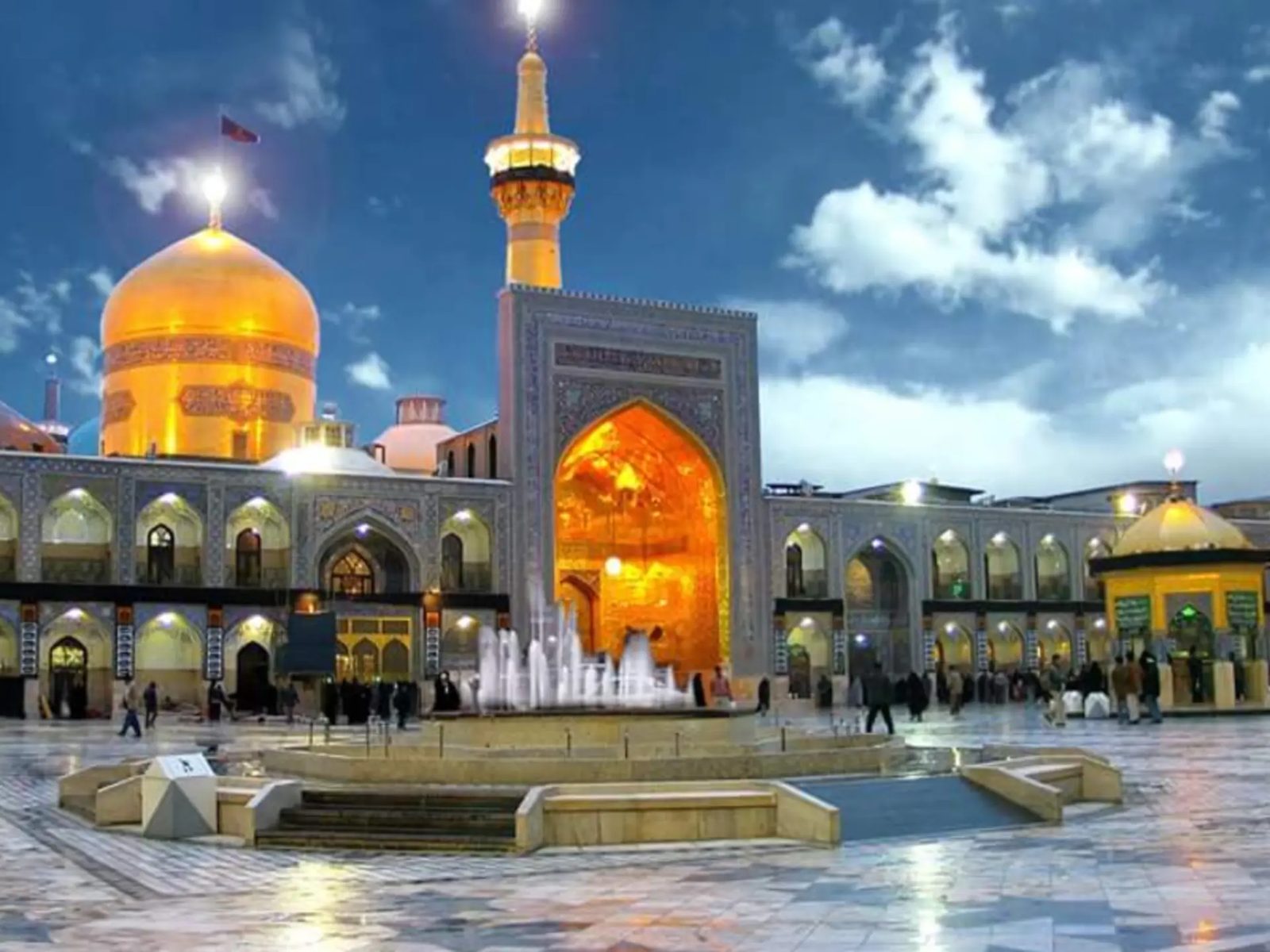
Everything in central Mashhad is oriented toward the Haram, the sacred precinct of Imam Reza, the eighth Imam, whose grave here has made the city a destination for more than a millennium. The complex you see today is the accumulation of many dynasties, and its scale is difficult to take in from the squares outside: from the courtyards, or sahn, and the long vaulted porticoes, the rovagh, the impression is of a small city within the city, with its own libraries, its own museum, its own printing house and its own hospitality.
Approach on foot from one of the four sides the city hands you: Shirazi street, Navaab Safavi street, Imam Reza boulevard or Tabarsi boulevard. Each gate opens onto a different courtyard, and each courtyard is tiled in a different palette, so visitors who come back five times see five different buildings. Inside the precinct are the shrine museum and library, among the most important in Iran for manuscripts and endowments, and the graves of two scholars buried here in honour: Sheikh Baha'i, the Safavid polymath, and Sheikh Tabarsi, the twelfth-century author of one of the classical commentaries on the Quran.
Visiting costs nothing. Women cover their hair inside the Haram, as in any Iranian shrine; there is no charge and no turnstile, and the atmosphere in the late morning is crowded but calm rather than tense. The best hour for a first visit is around dawn, when the light on the gold is cold and the crowds are pilgrims, not tourists. Come back after dark: the precincts are floodlit, and the squares sell tea, ice cream and dates until the small hours.
Goharshad Mosque
On the southern side of the Haram, entered directly from the precinct, stands Goharshad Mosque, the finest Timurid building in Mashhad and the largest mosque in the Astan Quds Razavi complex, the endowment that administers the Shrine. Its courtyard is older than those of the other courtyards around it, which is a neat way of saying that this was the original mosque of the precinct before the complex grew.
It was built in the fifteenth century, when Mashhad lay inside the Timurid world, and the workmanship is of that court's standard: tilework, calligraphy and a portal composed with the mathematical patience of the period. The mosque sits ringed by the Qods courtyard, the Imam Khomeini portico and the Sheikh Baha'i passage, so most visitors pass through it without fully noticing, which is a mistake. Give it twenty minutes on your first visit, before you have been numbed by scale.
Bazaar Reza, and what to buy
The old covered market runs along the Haram's edge, and pilgrims have bought their souvenirs here for centuries. It has two floors, and each is organised around seven or eight hashti, small octagonal courts that group the trades. The most famous workshops are the agate cutters, polishing stone, and along the same lanes are stalls for perfume, saffron, nabat (rock candy, often on a stick or with saffron), clay prayer stamps and prayer beads. Enter from Meydan 17 Shahrivar or from Felakhe Ab, and go with a rough idea of what each thing should cost, because the trade is genuine and the bargaining is expected.
Ferdowsi's tomb at Tus

Thirty kilometres from the city, at Tus, is the monument that many Iranians consider the more important of Mashhad's two graves. Ferdowsi completed the Shahnameh, the Book of Kings, around the year 1010: fifty thousand couplets of myth, legend and history, written when Persian was in danger of being displaced as a literary language. The argument that the epic did more to keep Persian alive than any academy could do is a common one, and hard to refute.
The tomb itself is a twentieth-century monument, designed by the Iranian architect Hushang Seyhun, and its low white colonnade and stone reliefs deliberately quote Persepolis and pre-Islamic Iran. A monumental statue of the poet stands in the forecourt, and the walls around carry carved scenes from the epic. Next to the building are a library and a museum holding valuable Shahnameh manuscripts, which is the reason to spend a second hour. In the grounds nearby lie two modern Iranian artists who asked, in effect, to be buried next to Ferdowsi: the poet Mehdi Akhavan Sales, a master of new Persian verse, and the singer Mohammad Reza Shajarian, whose name is close to a national institution.
The visit is easy: it is an hour there and back from central Mashhad, best combined with a late lunch in one of the northern villages. Go early in the morning to have the forecourt almost to yourself.
Nader Shah's mausoleum
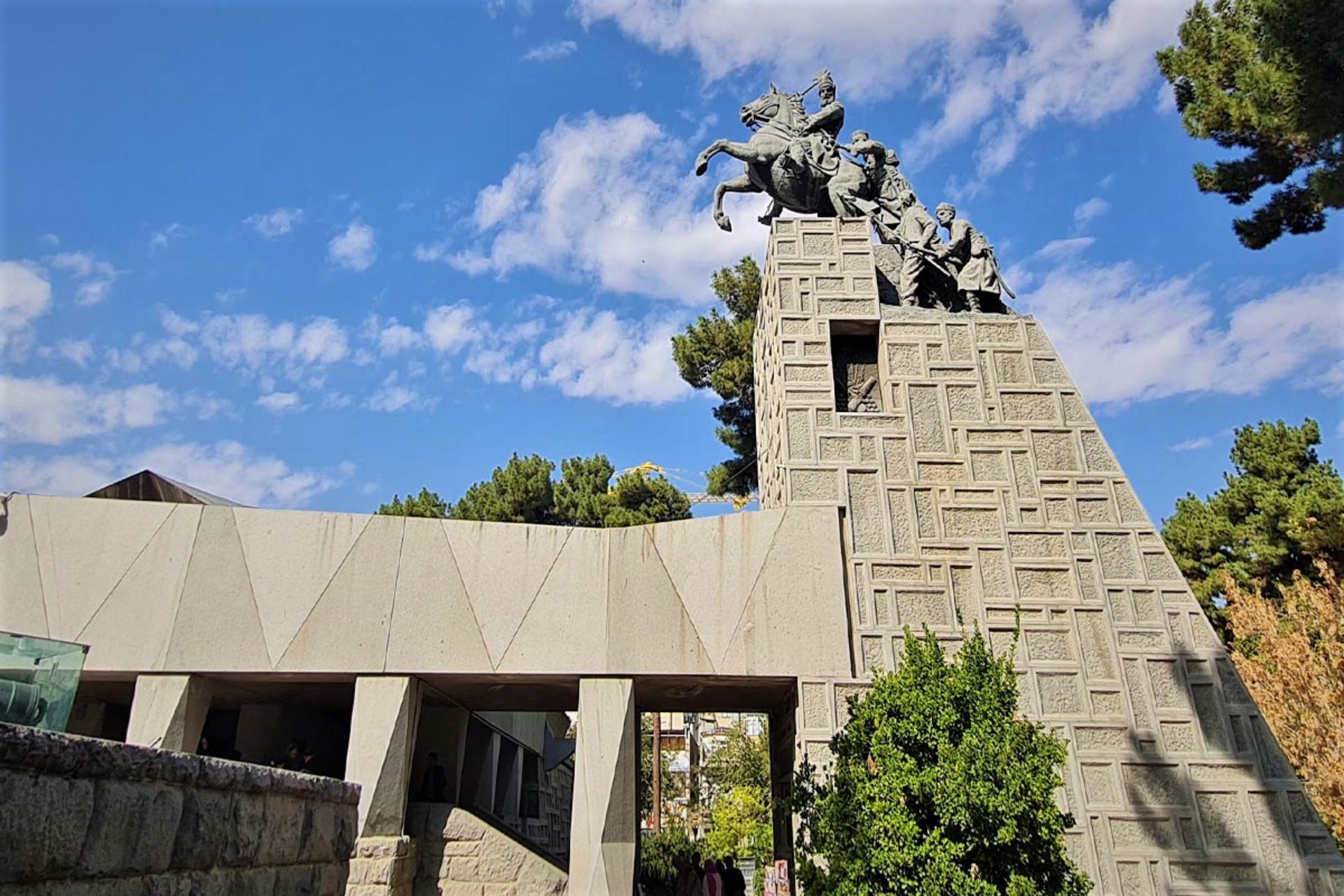
On Shirazi street, a short walk west of the Haram, is the tomb of Nader Shah Afshar, the Afsharid ruler who drove out the Afghan occupiers, marched as far as Delhi, and was assassinated in 1747. The present monument dates from the Qajar era and was raised by Qavam al-Soltaneh in the last years of Qajar rule to mark the site. It is a handsome piece of design, more imposing than its size suggests, and next to it is the Naderi Museum, two separate halls displaying weapons, military equipment and objects from the Afsharid through to the Qajar period.
Because it is largely covered, the complex is one of the better choices for a cold or wet half-day, and it pairs naturally with the bazaar and the Shrine on a single walk.
The cool north: Shandiz, Torkabad, Jaghargh
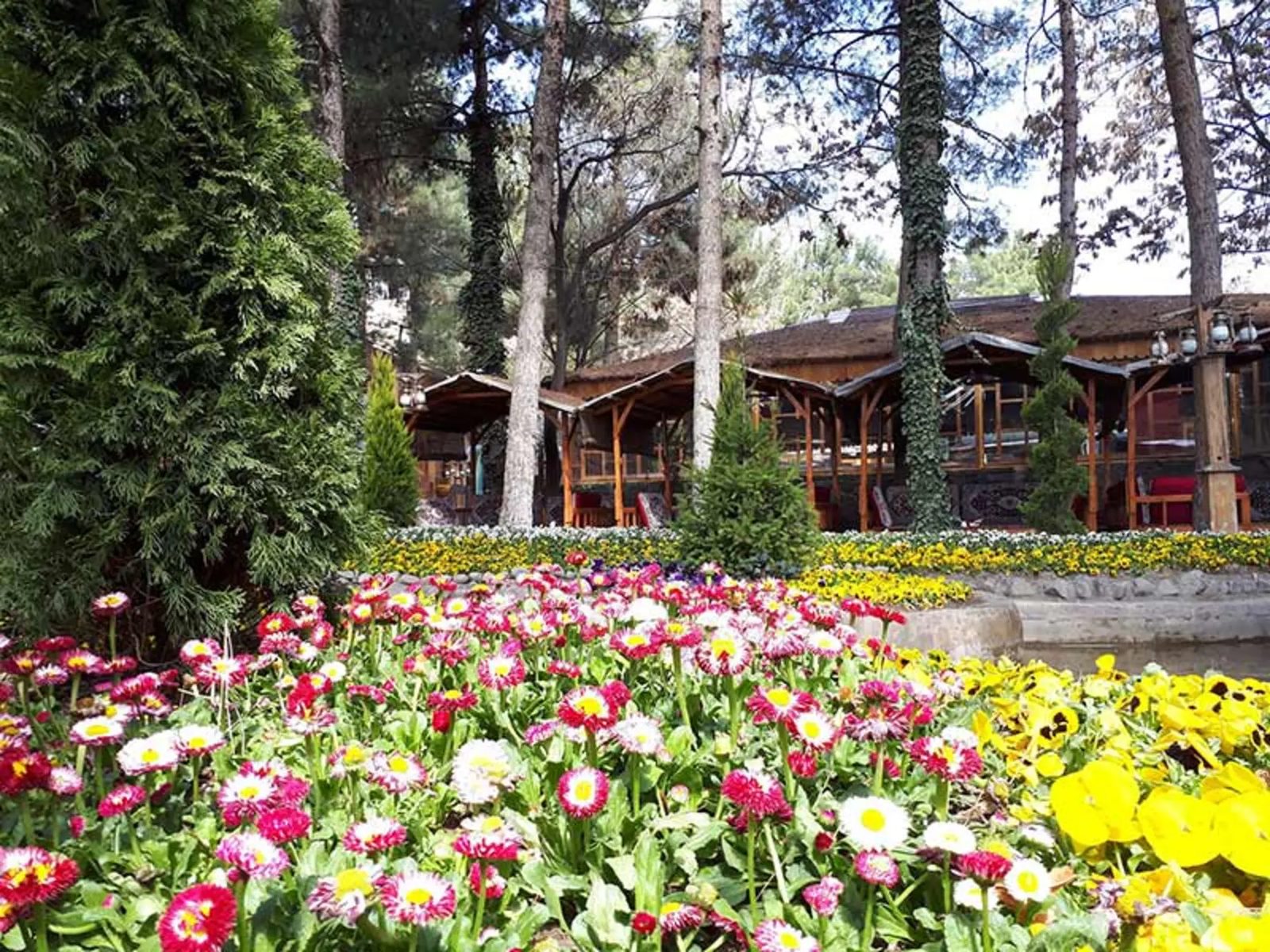
Mashhad's summer answer is altitude. A belt of mountain villages sits to the northwest, twenty to forty minutes from the centre, and in July and August they are effectively a different city.
Shandiz is the best known, a summer resort area with a genuinely cool microclimate, green villages and a long row of restaurants. It is mountainous, fed by full rivers, and the prettiest of its villages is Zoshk, which is where families go for the day. There are historical buildings here as well as orchards.
Torkabad is the other side of the same range, reached at the end of Vakilabad boulevard in the northwest. Its spine is the Panj Darreh river, with picnic grounds along it, and the area also holds Vakilabad, Behman and Kamar Maqboula parks. Torkabad is popular with families for its cable car and chairlift, and for its handicraft shops, which are a better souvenir option than anything in the bazaar.
Jaghargh village, on the Anbaran road near Torkabad, is the autumn postcard of Mashhad. It is cool, entirely covered in tall old trees that turn colour in October and November, and its landmarks are a cypress tree said to be nearly 700 years old, its historic cemetery and the Qanbar Koh cave nearby.
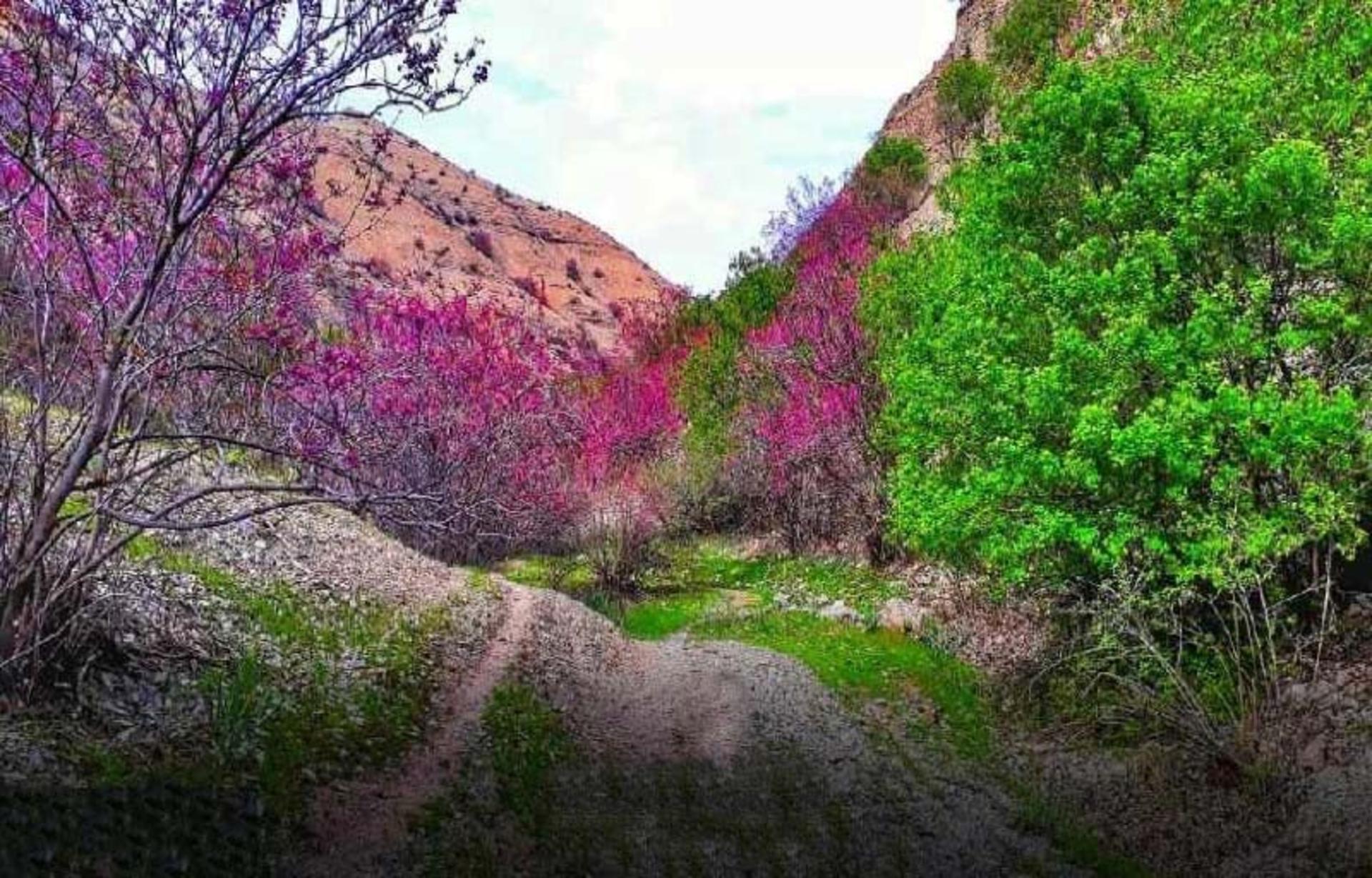
Alghavan Valley, also toward Torkabad, is the spring one: it is named for the argavan shrub, and in Ordibehesht, roughly May, the valley flushes pink with its blossom. It is one of the most valuable natural areas in northeastern Iran, and the drive in is simple, up toward Kalateh Ahan village.
Chalidreh
For a single active half-day, Chalidreh, in the same northern hills near Torkabad, is the most efficient stop in the province. It is a large recreational complex built around a lake, with a cable car and a chairlift across the water and the slopes, bungee jumping, a children's park, horse riding at its sports club, boating on the lake and restaurants at both ends of the line. In autumn the dense tree cover turns and the whole thing looks improbable against the dry plain behind it. It is busy on summer weekends; weekdays are calmer and the light is better.
Parks, and the view from Bam-e Mashhad
Mellat Park, on the edge of Vakilabad boulevard in western Mashhad, opened in 1964 and was outside the city when it was built; the urban sprawl caught up with it, which is now the reason it is easy to reach. It is a large park with an open-air pool, sports grounds and walking paths, and its amusement park is the oldest and best known in the city. Its ferris wheel stands around 80 metres, the tallest in Iran, and the night sections of the park are a standard family outing.
Kohsangi Park sits high on a peak of the same name in the west, which is why the food stalls along its lookouts do such good business. The view over Mashhad is the reason to come, and the fountain set among the rocks below is the photo everyone takes. It has an amusement section, boating and a children's area, and it is reached from Kalantari highway.
Vakilabad Forest Park, known previously as Bagh-e Vakilabad, is the old garden of the city and one of its favourite spring outings. Its river runs full in spring, the pine, plane and cypress walks are shaded all summer, and it contains fountains, a greenhouse and a botanical garden. It lies at the end of Vakilabad boulevard, where the road stops being a road and starts climbing.
Bam-e Mashhad, the roof of the city, is inside Khorshid Park at the end of Hashemieh boulevard, in the Vakilabad district on the slopes of the Kohsard range. The elevation gives one of the best panoramas in Iran over a very large city, and it is far better at night than by day. The park has a cycling track, a children's garden, beach football and volleyball courts, shaded pavilions and cafés that stay open late.
Malls, and what to do after dark
Mashhad is a shopping city, and the reason is the pilgrim traffic: whatever a million visitors a month need, somebody sells nearby. The best-known complex is Almas Shargh, six floors at the end of Khiyam Shomali boulevard, which is less a mall than an indoor evening: a traditional-style photo studio, the Land of Wonders amusement park, the Shahr-e Daryaei aquarium and a five-dimensional cinema, plus the expected clothing, household goods and Mashhad souvenirs.
For the nighttime rhythm that the city actually keeps, the answer is the Haram squares, whose light and crowds run to two or three in the morning, the roof of Bam-e Mashhad for the panorama, and Bazaar Reza in the early evening before the shops begin to draw their shutters.
When is the best time to visit Mashhad?
Spring is the best single answer, and the province's own peak season: mild days, green northern villages and, in April and May, the pink of the argavan blossom in Alghavan Valley. The cost is crowd size, because spring coincides with Iranian holidays and with the heaviest pilgrimage.
Summer is hot and dry on the plain, and Mashhadis answer it by going northwest. Plan the city for the morning and after sunset, when the precincts are floodlit and the parks fill, and take the villages, Chalidreh and the cable cars for the daytime. Autumn is the underrated season and the prettiest: Jaghargh's colour in October and November, warm days, thinner crowds. Winter brings snow and real cold, but the shrines, Nader Shah's museum, the mosques and the malls are all indoors, and hotel prices drop.
Where to stay in Mashhad
Location in Mashhad is a single question: how far from the Haram? The blocks around the precinct are packed with hotels of every grade, and many of them sell the view of the golden dome as their main feature. Staying there means you can walk back to your room between prayers, at any hour, with no transport at all. That convenience is also the argument for staying one district out, on Vakilabad or Hashemieh boulevards, if you are not visiting daily: the hotels are newer, the rooms bigger, and the metro and taxis still quick.
Prices swing hard with the pilgrimage calendar, so check the dates of the major religious observances before you fix yours, and book through Mehyar Hotels with free cancellation attached if your dates are approximate. Reserve the airport transfer and a car for the northern villages at the same time you confirm the room: Mashhad's transport problems are never about availability, only about ordering things in advance.