
Somewhere in the western folds of the Zagros, where limestone cliffs give way to oak forest and the air smells of wet stone, a river throws itself off a mountain in three great leaps. The locals call it Rizhav, which in Kurdish simply means "the place where water falls." On paper, it is Piran Waterfall, and at roughly 180 metres from top tier to pool, it holds the title of the tallest staircase waterfall in the Middle East. It is also one of the least crowded major natural attractions in Iran, which is part of what makes the trek worth doing.
This guide covers the two approach routes, what you actually see at each tier, the best season to come, and the historical sites within a short drive that turn a waterfall visit into a full day in the Dalahu highlands.
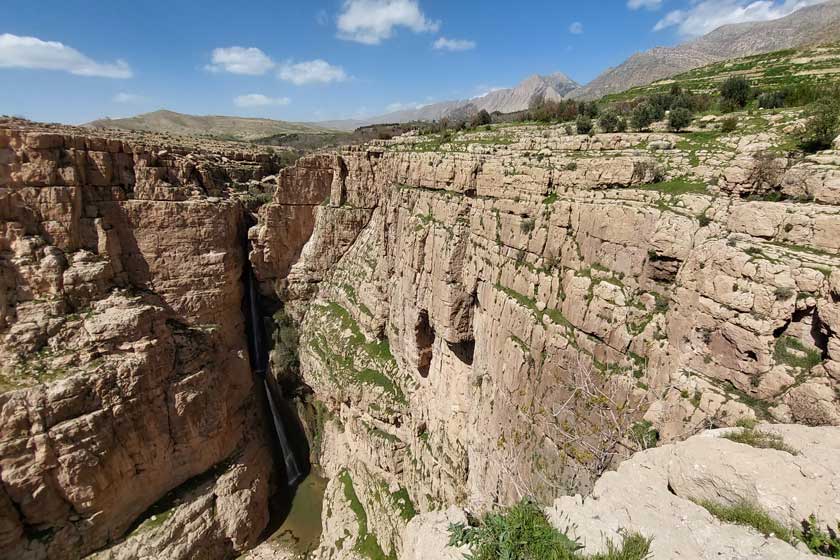
Where is Piran Waterfall?
Piran Waterfall sits in Dalahu County, Kermanshah province, about 10 kilometres northeast of the town of Sarpol-e Zahab. The waterfall itself lies between two small villages: Piran at the bottom of the valley and Zhalekeh near the top. The nearest major city is Kermanshah, roughly 100 kilometres to the northeast, and Tehran is about 600 kilometres east by road.
The waterfall originates from a spring area called Rizhav, flows past Zhalekeh village, and then drops through a wide valley known locally as Honeh before reaching the village of Piran below. The name "Piran" comes from the lower village; "Rizhav" (sometimes written Rizhaw or Rijav) is the Kurdish word for the cascade, built from rizh meaning "to pour" and aw meaning "water." You may also see it written as "Rijab" on some signs, which is an Arabized corruption of the original Kurdish and does not carry a separate meaning.
The waterfall has been registered on Iran's Natural Heritage List, and it is widely considered one of the most striking natural attractions in Kermanshah province.
The three tiers
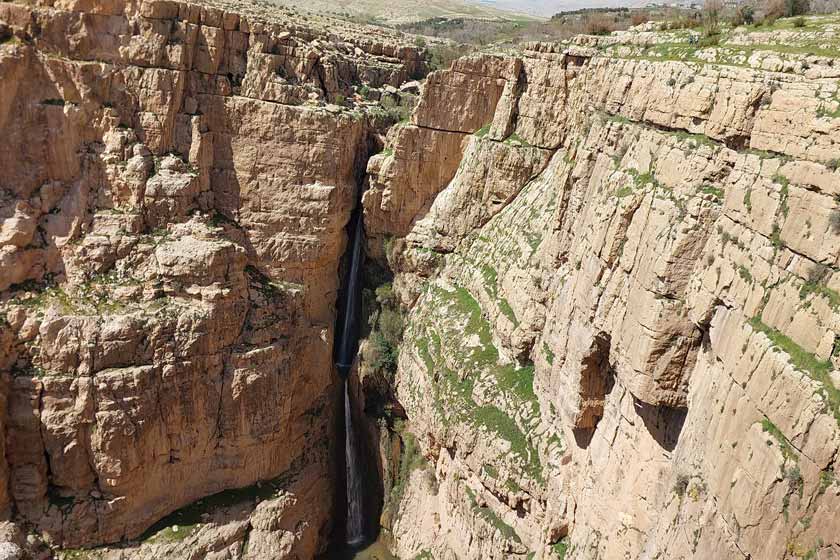
The waterfall breaks into three distinct tiers, and understanding this layout helps you decide which approach to take.
The two upper tiers are the dramatic ones. They are long, powerful drops that tumble over bare limestone faces, visible from a considerable distance. The lower tier is shorter and sits among dense trees, which means you cannot see it from above. If you approach from Zhalekeh village at the top, you will see only the two upper tiers. To appreciate the full three-stage cascade, you need to come up from the Piran village side and stand at the base.
The total height, counting all three tiers, is approximately 180 metres. The single longest visible drop is around 150 metres. These numbers place Piran among the tallest waterfalls in Iran, and it is frequently cited as the tallest staircase cascade in the Middle East, though the exact ranking depends on how one counts tiers and seasonal flow.
Two routes to the waterfall
There are two ways to reach Piran Waterfall, and they give you very different experiences. The villages of Piran and Zhalekeh sit at opposite ends of the waterfall, separated by roughly 45 kilometres of mountain road that winds around the ridges above.
From below: the Piran village approach
This is the route most visitors take. From Sarpol-e Zahab, drive northeast for about 10 kilometres to the village of Piran. Past the village, there is a car park roughly 2 kilometres from the base of the waterfall. From the car park, you walk the remaining distance on foot along a path that leads into the valley. The walk takes about 30 to 45 minutes at a comfortable pace, and it ends at a wide, green clearing where the lowest tier of the waterfall crashes into a pool surrounded by trees.
This approach lets you see all three tiers from below, which is the full picture. The valley floor is shady and cool even on warm days, and the sound of water is constant.
From above: the Rizhav and Zhalekeh approach
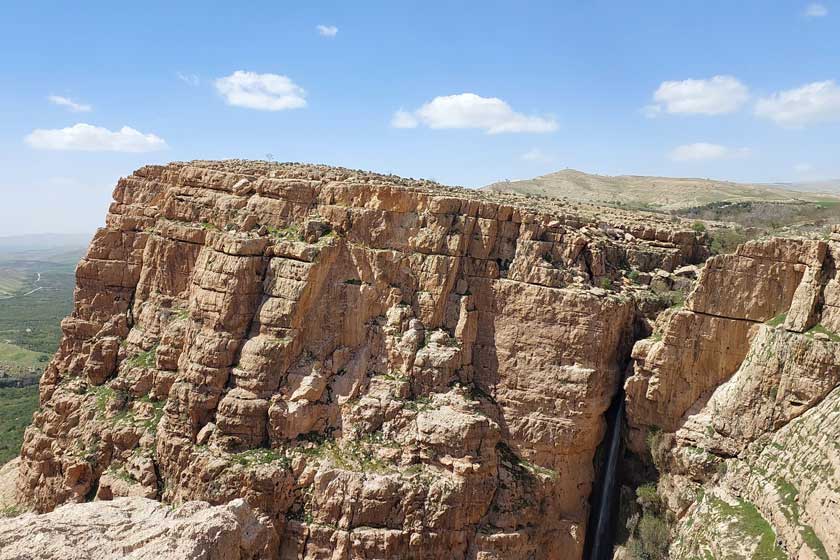
The second route goes through the Rizhav area, which is about 120 kilometres from Kermanshah on the road between Dalahu and Sarpol-e Zahab. From Rizhav, you reach Zhalekeh village, which sits above the waterfall. A path along the edge of the village leads to a viewpoint at the top of the cascade.
From up here, you see the two upper tiers in their full length, pouring over the cliff faces into the narrow gorge below. The view is spectacular in a different way: you are looking down into the valley, with the Zagros peaks stretching out behind. But you will not see the lowest tier, which is hidden under the tree canopy far below.
A note on earthquake damage
The major earthquake that struck Sarpol-e Zahab in November 2017 (magnitude 7.3) damaged the access road and the stairways that had been built for visitors. The waterfall itself was unaffected, but the infrastructure around it took a hit. Before you go, check locally whether the paths and parking areas have been fully restored. The natural beauty of the site remains intact.
What to do at the waterfall
The area around Piran Waterfall is not a developed tourist complex. It is a natural valley with basic visitor facilities, and most people come for a mix of walking, photography, and sitting by the water.
Hiking and exploration. The walk from the car park to the waterfall base takes you through oak forest and along the stream. The valley is wide enough to wander, and there are paths that lead further along the watercourse. Allow three to four hours for the full round trip if you are coming from the Piran side.
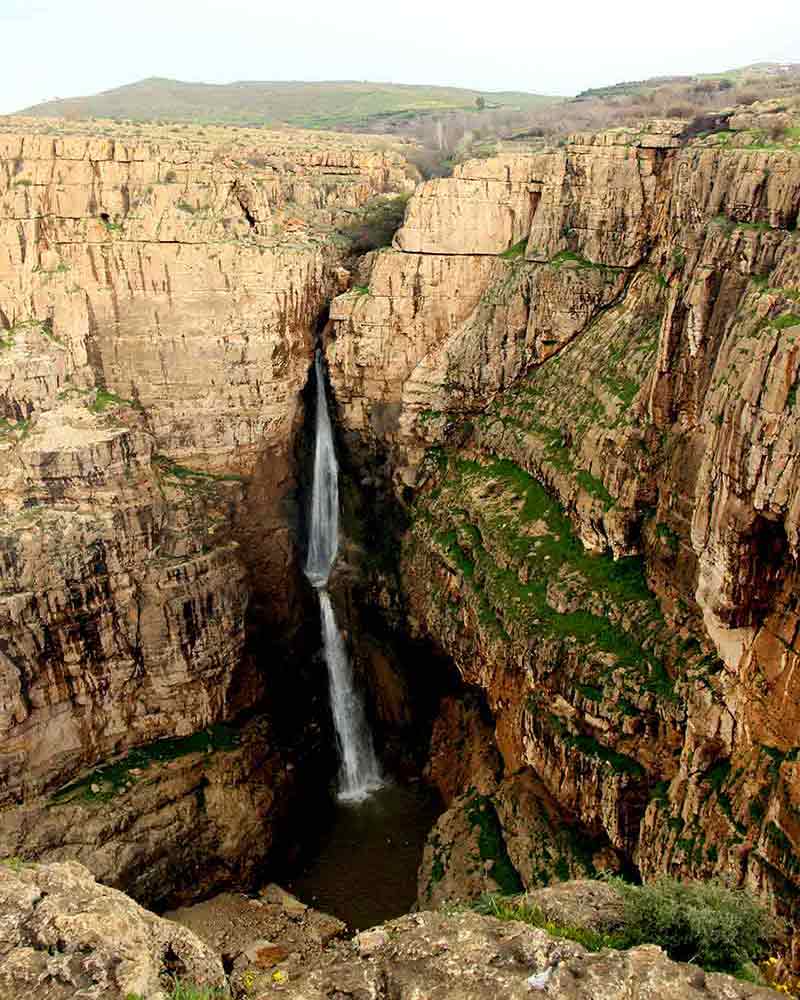
Photography. The waterfall offers dramatic compositions from multiple angles. From below, you get the full three-tier frame with the valley walls rising on either side. From above, you capture the long drops against the bare limestone. The light is best in the morning, when the sun is behind the eastern ridge and the valley is still in soft shadow.
Swimming. In the warmer months, visitors swim in the pools at the base of the waterfall. The water is cold, even in summer, and the pools are deepest near the main cascade.
Rock climbing. The cliffs around the waterfall attract climbers, though the walls directly below the cascade are overhanging and not suitable for ascending from the base. Experienced climbers sometimes arrange rappels from the top. If you are interested in climbing here, bring your own gear and go with someone who knows the rock.
Picnicking. Pavilions and sheltered areas are set about 300 metres from the waterfall, and camping is possible in the valley if you follow Leave No Trace principles. There are small restaurants roughly 12 kilometres from the site, in the villages along the road.

How to get there from Tehran and Kermanshah
Most visitors reach Piran Waterfall via Kermanshah or Sarpol-e Zahab. Here is what the journey looks like from each starting point.
From Tehran by car. The drive is roughly 600 kilometres and takes about seven to eight hours via the Kermanshah highway. From Kermanshah, continue southwest on the main road toward Sarpol-e Zahab, then turn northeast at Dalahu. The total distance from Tehran to the waterfall is approximately 600 kilometres.
By Mehyar Taxi. The most comfortable way to reach the waterfall without your own car is to open Mehyar, choose Taxi, and set your destination to Piran village or Zhalekeh. A taxi from Sarpol-e Zahab to the waterfall takes about 20 minutes. From Kermanshah, the drive is roughly 100 kilometres and about 90 minutes. You can arrange a round trip with a wait, since there is no taxi stand at the waterfall itself.
By Mehyar Buses. Mehyar Buses connects Tehran to Kermanshah regularly, and Kermanshah to Sarpol-e Zahab. From Sarpol-e Zahab, you will need a local taxi for the final 10 kilometres to the waterfall.
By organised tour. Some tour operators in Kermanshah include Piran Waterfall in day trips that also cover Yazdgerd Castle and the Anubanini inscription. These tours typically handle transport and a guide, and they are a good option if you want to see the full Dalahu area in one day.
On-site mobility. Once you arrive at the car park, the waterfall is reached on foot. There are no vehicles past the parking area. Wear shoes with good grip, as the path can be slippery near the waterfall base.
When to visit
The best time to visit Piran Waterfall is in spring, from April through May, when snowmelt feeds the cascade at full force and the valley is at its greenest. Early summer, through June, is also pleasant, with warm days and cool shade in the valley.
Autumn brings golden oak colours and fewer visitors, though the water flow drops significantly. Winter is not recommended: the roads can be icy, the paths slippery, and the waterfall, while still flowing, is harder to reach safely.
The region receives moderate rainfall, with an average annual precipitation of around 68 millimetres and a mean temperature of about 30 degrees Celsius in summer. The western Zagros climate is generally cooler than central Iran, which is one reason the area feels like a retreat during hot months.
Nearby attractions
The Dalahu highlands around Piran Waterfall are rich in both natural and historical sites. If you have a car or a hired driver, you can combine the waterfall with several other stops in a single day.
The Dalahoo Mountains
The waterfall sits within the Dalahoo mountain range, a forested section of the Zagros known for its oak woods, springs, and wildlife. The name Dalahoo comes from the Kurdish words for eagle (dal) and deer (ahoo), which both live in these mountains. The area has numerous villages, springs, and ancient sites scattered across its valleys.
Yazdgerd Castle
About 15 kilometres from Sarpol-e Zahab and roughly 20 minutes from the Rizhav approach to the waterfall, Yazdgerd Castle is one of the oldest and most fortified ancient castles in Iran. The fortress dates back to the Parthian era, and its name is linked to Yazdgerd III, the last Sasanian king, who reportedly took refuge here after the Arab conquest. The castle complex once covered roughly 40 square kilometres and included a kitchen, a guard tower, a windmill (called Ashiyeh Va in Pahlavi), a double-towered gate, a prison, a stable, an open square known as Gach Gonbad, a fire temple and glass workshop from the early Islamic period, and a long plaster wall. The site was registered on Iran's national heritage list in 2008. The road to the castle passes through beautiful oak forest.
The Anubanini Rock Inscription
Carved into a cliff face about 4,800 years ago, the Anubanini rock relief is one of the oldest rock inscriptions in Iran and the world. It belongs to the Lullubi people, who lived in this region before the arrival of the Aryan tribes. The relief shows King Anubanini standing before the goddess Ishtar, with a defeated prisoner under his feet. Below the figures, an inscription in Akkadian curses anyone who damages the tablet. The relief is located in Sarpol-e Zahab, on a rock about 16 metres above ground level, inside the grounds of a girls' school. Its elevated position is believed to have protected it from much of the damage that might otherwise have occurred over the millennia. About 30 percent of the relief was damaged by shrapnel during the Iran-Iraq war.
The Tomb of Abu Dujana
In the Rizhav area, near the upper approach to the waterfall, there is a cemetery with tombs dating to the early Islamic period. The main structure is a four-sided tomb with a conical dome, locally attributed to Abu Dujana, a companion of the Prophet Muhammad who is said to have defended the Prophet during the Battle of Uhud. The cemetery includes simpler graves marked with uncarved stones, as well as smaller four-arched structures reminiscent of Sasanian fire temples. The site has religious significance for local residents and is a quiet, contemplative place to visit.